

Karl Friston
Neural dynamics and brain function
Wellcome Centre for Human Neuroimaging
About
Research focus
Neural dynamics and brain function
Impact
2,019 pubs · 292,961 cites · h-index 256
Affiliations
Publications
Original Research
OCT 14BrobergFrontiers in Psychology
Reframing the lived experience of persistent dizziness: insights from active inference
We present an active inference account of persistent dizziness predicated on models of enactivism and ecological psychology; including first-hand accounts of the patient’s lived experience. Mechanistically, we consider persistent dizziness to reflect an initial failure of sensory attenuation of vestibular and other sensory prediction errors. This failure becomes self-maintaining if the patient infers—or learns—that unattenuated prediction errors cannot be resolved through action. The ensuing formulation provides an integrative account of the pathophysiology of dizziness and how it underwrites—and is maintained by—affective inference and an altered sense of agency that shapes the experience of the person with dizziness. We foreground the holistic person-centered approach on offer from a clinical perspective, and consider complementary levels of therapeutic intervention under this theoretical framework.
Review
SEP 9RizzolattiNeuroscience & Biobehavioral Reviews
The key dimensions of human action: Content and form
Human action, both in execution and observation, is characterized by two fundamental attributes: the action goal (the "what") and its vitality form (VF), namely the "how" an action is performed. Over the past three decades, substantial progress has been made in elucidating the neural bases of action goals. Converging evidence identifies a parieto-frontal network, possibly extending to additional brain regions, which encodes the goal-related content of both observed and executed actions (the mirror circuit). In contrast, considerably less attention has been devoted to the neural mechanisms underlying vitality forms. Nevertheless, growing evidence indicates that VFs are processed by a distinct insulo-cingulate network. Together, the parieto-frontal and insulo-cingulate circuits constitute a functional architecture that integrates goal representation with affective-motor expression. This integration enables social understanding and supports adaptive interpersonal behavior. The present review is organized into three sections. First, we examine the neural circuits underlying action goals and vitality forms. Second, we review evidence that interactions between these two neural systems underwrite action and its observation. Third, we discuss the role of vitality forms in the development of humanoid robots.
Original Research
AUG 28DonnarummaCell Reports
Inferential planning in the frontal cortex
Computational modeling study demonstrates that inferential planning generates simultaneous neural subspaces in primate frontal cortex, highlighting how probabilistic inference directs action...
Original Research
AUG 25FristonEntropy

The Free Energy Principle and Free Markets
Simulation study demonstrates improved portfolio management using active inference on historical financial data, suggesting a novel framework for modeling market dynamics and risk.
Original Research
JUL 27RuffiniNeural Computation
Cross-Frequency Coupling as a Neural Substrate for Prediction Error Evaluation: A Laminar Neural Mass Modeling Approach
Predictive coding frameworks suggest neural computations rely on hierarchical error minimization, yet the neural implementation of this inference remains unclear. We propose that cross-frequency coupling (CFC) furnishes fundamental mechanism for this process. Using our laminar neural mass model (LaNMM), we demonstrate that signal-envelope coupling (SEC) an envelope-envelope coupling (EEC) instantiate a hierarchical comparator mechanism. Specifically, SEC generates prediction-error signals by subtracting top-down predictions from bottom-up oscillatory envelopes, while EEC operates at slower timescales to implement gating—a critical mechanism for precision weighting. To establish the face validity and clinical implications of this proposal, we model perturbations of these CFC mechanisms to investigate their roles in pathophysiological and altered neuronal function. In Alzheimer’s disease, interneuron dysfunction disrupts the comparator, causing aberrant prediction error amplification in early stages and drastic attenuation in late phases. Conversely, serotonergic psychedelics increase excitatory gain, diminishing the modulatory effect of predictions and causing a failure of sensory attenuation. Collectively, these findings implicate multiscale cross-frequency coupling as a key computational mechanism supporting predictive coding and its disruption in disease.
Original Research
JUN 25FrankNature Neuroscience
Human hippocampal ripples tune cortical responses based on predicted uncertainty
Direct recordings demonstrate that hippocampal activity influences visual cortex responses under uncertainty, suggesting a predictive coding mechanism.
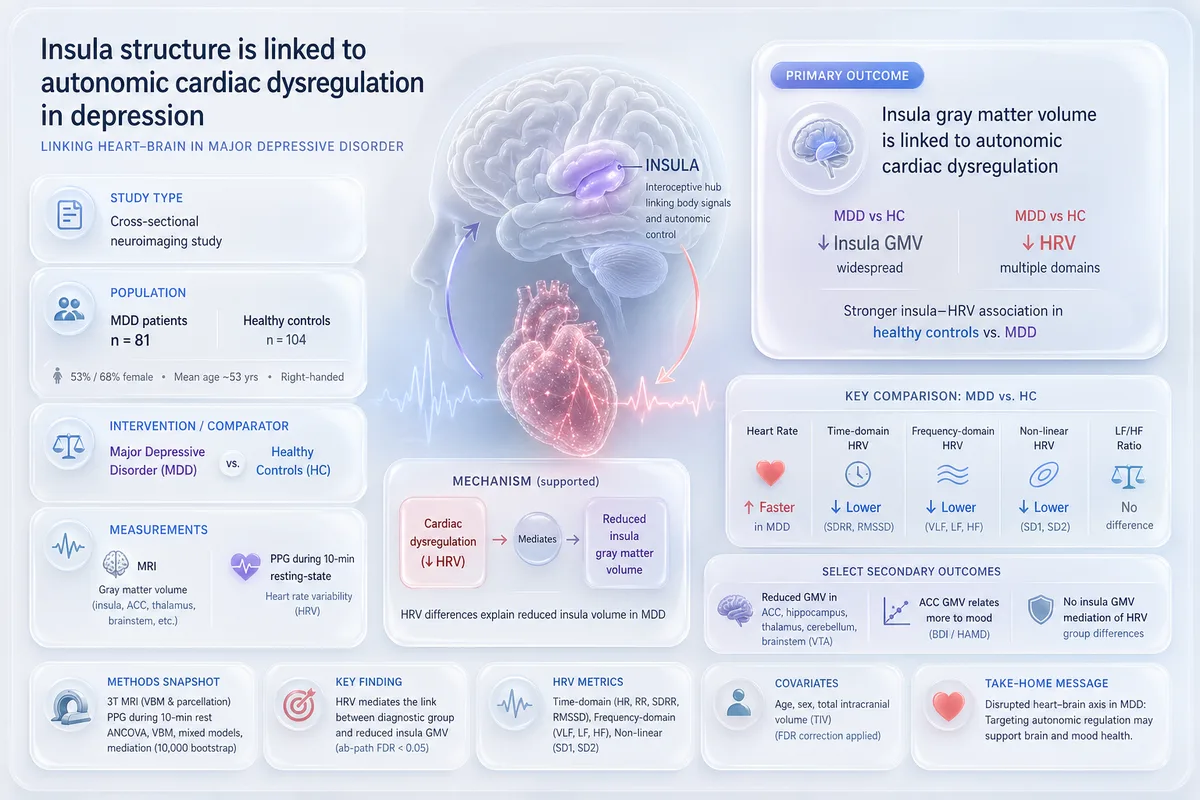
cross-sectional · n=1853 mentions
MAR 1FerminBiological Psychiatry
MDD linked to faster heart rates, reduced HRV, and lower insula gray matter volume.
Hypothesis-generating for insula contribution to autonomic cardiac dysregulation in MDD; prospective validation required before clinical application.
Original Research
APR 1Rodriguez-SanchezBiological Psychiatry
Biophysical Modeling of Excitation/Inhibition Balance and Conversion to Psychosis in the Clinical High Risk Syndrome
Background Reduced mismatch negativity (MMN) and P300 event-related potential (ERP) components are widely replicated in schizophrenia and are also observed in individuals at clinical high risk for psychosis (CHR-P) who subsequently convert to psychosis. It is unknown whether they reflect changes in excitatory and/or inhibitory synaptic function, both implicated in schizophrenia and considered potential drug targets. Methods We analyzed baseline MMN and P300 ERPs from the NAPLS2 study, asking whether altered synaptic excitation, inhibition, or both could explain amplitude reductions in CHR-P (n=583). CHR-P participants who converted to psychosis (CHR-Converters; n=77) or remitted by 24-month follow-up (CHR-Remitters; n=94) were compared on MMN evoked by pitch+duration double-deviant tones and P300 elicited by target tones from passive and active auditory oddball paradigms, respectively. Biophysical modeling was used to infer (excitatory) pyramidal cell and (inhibitory) interneuron function from both MMN and P300 ERPs. Results MMN and P300 amplitude reductions in future CHR-Converters relative to CHR-Remitters were best explained by reduced pyramidal cell excitability (posterior probability P>.95 of a group-by-condition interaction effect). In simulations, reduced pyramidal cell excitability suppressed deviant and target ERPs. Within CHR-Converters, more severe positive symptoms were associated with disinhibition of pyramidal cells (P>.99). Conclusions Results mirror previous findings in schizophrenia and suggest that reduced pyramidal cell excitability is present at baseline in future CHR-Converters, consistent with the hypothesis that hypofunction of pyramidal cells is a primary pathology in schizophrenia, rather than a consequence of chronic illness. Positive symptoms among CHR-Converters may reflect compensatory downregulation of inhibition.
Original Research
MAR 28SpisákNeurocomputing
Self-orthogonalizing attractor neural networks emerging from the free energy principle
Attractor dynamics are a hallmark of many complex systems, including the brain. Understanding how such self-organizing dynamics emerge from first principles is crucial for advancing our understanding of neuronal computations and the design of artificial intelligence systems. Here we formalize how attractor networks emerge from the free energy principle applied to a universal partitioning of random dynamical systems. Our approach obviates the need for explicitly imposed learning and inference rules and identifies emergent, but efficient and biologically plausible inference and learning dynamics for such self-organizing systems. These result in a collective, multi-level Bayesian active inference process. Attractors on the free energy landscape encode prior beliefs; inference integrates sensory data into posterior beliefs; and learning fine-tunes couplings to minimize long-term surprise. Analytically and via simulations, we establish that the proposed networks favor approximately orthogonalized attractor representations, a consequence of simultaneously optimizing predictive accuracy and model complexity. These attractors efficiently span the input subspace, enhancing generalization and the mutual information between hidden causes and observable effects. Furthermore, while random data presentation leads to symmetric and sparse couplings, sequential data fosters asymmetric couplings and non-equilibrium steady-state dynamics, offering a natural generalization of conventional Boltzmann Machines. Our findings offer a unifying theory of self-organizing attractor networks, providing novel insights for AI and neuroscience. • Attractor networks are derived from the Free Energy Principle (FEP) applied to a universal partitioning of random dynamical systems. • This approach yields emergent, biologically plausible inference and learning dynamics, forming a multi-level Bayesian active inference process. • The networks favor approximately orthogonalized attractor representations, optimizing predictive accuracy and model complexity. • Sequential data presentation leads to asymmetric couplings and non-equilibrium steady-state dynamics, generalizing conventional Boltzmann Machines. • Simulations demonstrate orthogonal basis formation, generalization, sequence learning, scalability and resistance to catastrophic forgetting.
Original Research
DEC 2025ShafieiNature Communications
Distributionally robust free energy principle for decision-making
Despite their groundbreaking performance, autonomous agents can misbehave when training and environmental conditions become inconsistent, with minor mismatches leading to undesirable behaviors or even catastrophic failures. Robustness towards these training-environment ambiguities is a core requirement for intelligent agents and its fulfillment is a long-standing challenge towards their real-world deployments. Here, we introduce a Distributionally Robust Free Energy model (DR-FREE) that instills this core property by design. Combining a robust extension of the free energy principle with a resolution engine, DR-FREE wires robustness into the agent decision-making mechanisms. Across benchmark experiments, DR-FREE enables the agents to complete the task even when, in contrast, state-of-the-art models fail. This milestone may inspire both deployments in multi-agent settings and, at a perhaps deeper level, the quest for an explanation of how natural agents – with little or no training – survive in capricious environments. Autonomous agents can misbehave when training and environment conditions become inconsistent. Here, the authors introduce a Distributionally Robust Free Energy model that embeds robustness directly into the agent decision-making mechanisms through free energy minimization.
Original Research
DEC 2025IbáñezNature Communications
Computational whole-body-exposome models for global precision brain health
The worldwide rise of neurological and psychiatric conditions poses major challenges. However, current global research remains fragmented, dominated by limited cohorts and poorly integrated datasets that disconnect whole-body health, exposome, and brain health. Theories rarely unify brain measures with extracerebral factors or capture heterogeneity in individual trajectories. We introduce multimodal diversity, a non-linear, non-simplistic causal and ecological construct integrating data representation, whole-body and exposomic factors, and computational modeling to address this situated, embedded, and embodied complexity. This heuristic metamodel integrates global, multilevel data into personalized predictions fostering population inclusion, multimodal integration, diagnostic precision, and equitable, context-sensitive advances in brain health. Ibanez et al. introduce multimodal diversity, a synergistic framework integrating multimodal brain metrics, whole-body health, and exposomic data through neurosyndemic computational modeling to advance context-sensitive precision brain health across global settings.
Original Research
NOV 2025CostaNeural Computation
Possible Principles for Aligned Structure Learning Agents
This paper offers a road map for the development of scalable aligned artificial intelligence (AI) from first principle descriptions of natural intelligence. In brief, a possible path toward scalable aligned AI rests on enabling artificial agents to learn a good model of the world that includes a good model of our preferences. For this, the main objective is creating agents that learn to represent the world and other agents' world models, a problem that falls under structure learning (also known as causal representation learning or model discovery). We expose the structure learning and alignment problems with this goal in mind, as well as principles to guide us forward, synthesizing various ideas across mathematics, statistics, and cognitive science. We discuss the essential role of core knowledge, information geometry, and model reduction in structure learning and suggest core structural modules to learn a wide range of naturalistic worlds. We then outline a way toward aligned agents through structure learning and theory of mind. As an illustrative example, we mathematically sketch Asimov's laws of robotics, which prescribe agents to act cautiously to minimize the ill-being of other agents. We supplement this example by proposing refined approaches to alignment. These observations may guide the development of artificial intelligence in helping to scale existing, or design new, aligned structure learning systems.
Original Research
OCT 2025StoofHuman Brain Mapping
Topographic Variation in Human Neurotransmitter Receptor Densities Explains Differences in Intracranial EEG Spectra
Brain function and its failures arise from dynamical patterns of neuronal activity shaped by synaptic neurotransmission. Both neurotransmitter receptor expression and neuronal population dynamics show a remarkable regional variability across the human cortex. We leverage this functional specialisation to characterise the relationship between receptor architectonics and electrophysiological signals. Using dynamic causal modelling (DCM), we fitted neural mass models to a normative set of intracranial EEG data. Subsequently, Bayesian model comparison helped to evaluate whether models improved when equipped with constraints on synaptic connectivity, based on regional neurotransmitter receptor densities. The results show that dynamic causal models generated region‐specific intracranial EEG spectra accurately. Incorporating prior information on normative receptor distributions further improved model evidence, indicating that regional variation in receptor density explains variations in synaptic connectivity and ensuing cortical population dynamics. The output is a cortical atlas of neurobiologically informed intracortical synaptic connectivity parameters. These can serve as empirical priors in future, patient‐specific models. In summary, we show that molecular cortical characteristics—that is, receptor densities—enrich and inform generative, biophysically plausible models of coupled neuronal populations. This work helps to explain regional variations in human electrophysiology, provides a methodological foundation to integrate multimodal data, and serves as a normative resource for future DCM studies of electrophysiology.
Original Research
OCT 2025FagerholmFrontiers in Computational Neuroscience
Using noise to distinguish between system and observer effects in multimodal neuroimaging
This analysis reveals how noise can differentiate system-level effects from observer-level effects, suggesting new insights into neural dynamics.
Original Research
OCT 2025SalvatoriNeural Networks
A survey on neuro-mimetic deep learning via predictive coding
Artificial intelligence (AI) is rapidly becoming one of the key technologies of this century. The majority of results in AI thus far have been achieved using deep neural networks trained with a learning algorithm called error backpropagation, always considered biologically implausible. To this end, recent works have studied learning algorithms for deep neural networks inspired by the neurosciences. One such theory, called predictive coding (PC), has shown promising properties that make it potentially valuable for the machine learning community: it can model information processing in different areas of the brain, can be used in control and robotics, has a solid mathematical foundation in variational inference, and performs its computations asynchronously. Inspired by such properties, works that propose novel PC-like algorithms are starting to be present in multiple sub-fields of machine learning and AI at large. Here, we survey such efforts by first providing a broad overview of the history of PC to provide common ground for the understanding of the recent developments, then by describing current efforts and results, and concluding with a large discussion of possible implications and ways forward.
Original Research
OCT 2025Williams
Apathy as a Loss of Prior Precision on Action Outcomes
Pre-registered study correlates reduced prior precision with apathy in healthy adults, highlighting GABAergic gain's role.
Original Research
SEP 2025Fagerholm
Noise as a diagnostic tool: Distinguishing System / Device Effects in Multimodal Neuroimaging
This study demonstrates that Bayesian model comparison can isolate observer-level differences in neuroimaging data, suggesting noise may enhance inference.
Original Research
SEP 2025FristonEntropy
Gradient-Free De Novo Learning
This note demonstrates de novo learning and generative modeling using active inference for sequential policy optimization.
Original Research
SEP 2025Rodriguez-Sanchez
Excitation/inhibition imbalance and conversion to psychosis in the clinical high risk syndrome: Biophysical modeling finds reduced pyramidal cell excitability across EEG paradigms
Biophysical modeling reveals reduced pyramidal cell excitability linked with decreased MMN and P300 in CHR-P individuals, suggesting potential biomarkers for psychosis risk.
Original Research
SEP 2025CesareProceedings of the National Academy of Sciences
Bridging feeling and motion: Insula–premotor dynamics in the processing of action vitality forms
fMRI study reveals insula and premotor interactions during action processing, highlighting affective state influences.