NG
Nicholas G. Martin
Genetic Associations and Epidemiology
QIMR Berghofer Medical Research Institute
About
Research focus
Genetic Associations and Epidemiology
Impact
2,821 pubs · 230,799 cites · h-index 220
Affiliations
Publications
GWAS
JAN 2015HibarNature
Common genetic variants influence human subcortical brain structures
The highly complex structure of the human brain is strongly shaped by genetic influences. Subcortical brain regions form circuits with cortical areas to coordinate movement, learning, memory and motivation, and altered circuits can lead to abnormal behaviour and disease. To investigate how common genetic variants affect the structure of these brain regions, here we conduct genome-wide association studies of the volumes of seven subcortical regions and the intracranial volume derived from magnetic resonance images of 30,717 individuals from 50 cohorts. We identify five novel genetic variants influencing the volumes of the putamen and caudate nucleus. We also find stronger evidence for three loci with previously established influences on hippocampal volume and intracranial volume. These variants show specific volumetric effects on brain structures rather than global effects across structures. The strongest effects were found for the putamen, where a novel intergenic locus with replicable influence on volume (rs945270; P = 1.08 × 10⁻³³; 0.52% variance explained) showed evidence of altering the expression of the KTN1 gene in both brain and blood tissue. Variants influencing putamen volume clustered near developmental genes that regulate apoptosis, axon guidance and vesicle transport. Identification of these genetic variants provides insight into the causes of variability in human brain development, and may help to determine mechanisms of neuropsychiatric dysfunction.
Genetic Association Study
JAN 2016LuptonNeurobiology of Aging
The effect of increased genetic risk for Alzheimer's disease on hippocampal and amygdala volume
Reduction in hippocampal and amygdala volume measured via structural magnetic resonance imaging is an early marker of Alzheimer's disease (AD). Whether genetic risk factors for AD exert an effect on these subcortical structures independent of clinical status has not been fully investigated. We examine whether increased genetic risk for AD influences hippocampal and amygdala volumes in case-control and population cohorts at different ages, in 1674 older (aged >53 years; 17% AD, 39% mild cognitive impairment [MCI]) and 467 young (16-30 years) adults. An AD polygenic risk score combining common risk variants excluding apolipoprotein E (APOE), and a single nucleotide polymorphism in TREM2, were both associated with reduced hippocampal volume in healthy older adults and those with MCI. APOE ε4 was associated with hippocampal and amygdala volume in those with AD and MCI but was not associated in healthy older adults. No associations were found in young adults. Genetic risk for AD affects the hippocampus before the clinical symptoms of AD, reflecting a neurodegenerative effect before clinical manifestations in older adults.
Meta-Analysis
OCT 26GordonTwin Research and Human Genetics
Augmented GWAS of Dizygotic Twinning in a New Sample of Mothers of DZ Twins From Australia and New Zealand Highlights CLYBL as a New Gene Influencing DZT
Dizygotic twinning (DZT) is an important marker of female fertility. The Twinning Genetics Consortium (TGC) recently reported the largest genomewide association meta-analysis (GWAMA) of DZT, identifying six genomewide significant loci and a seventh supported by functional evidence, in 8265 mothers of spontaneous DZ twins (MoDZTs) and 264,567 European-ancestry controls. To identify additional loci, we continued recruitment of MoDZTs in Australia and New Zealand (ANZ). Here, we report a GWAS of a new ANZ2026 sample (1598 MoDZTs and 5317 controls) and a GWAMA combining this sample with the previously reported ANZ2023 dataset. A new locus near CLYBL on chromosome 13 was tentatively identified. Because CLYBL is associated with vitamin B12 levels linked to fertility, it represents a plausible candidate. However, despite a 51% increase in ANZ cases, only one additional locus emerged, supporting the hypothesis that DZT is an oligogenic rather than highly polygenic trait. Meta-analysis with the TGC2024, the largest existing GWAS of DZT, strengthened signals at several loci, including HLA-G, while weakening others, such as ZFPM1 .
Original Research
OCT 26HuiderJournal of Affective Disorders
Genetic and environmental predictors of seasonality and seasonal affective disorder in individuals with depression
Background The etiology and nosological status of seasonal affective disorder (SAD) as a specifier of depressive episodes versus a transdiagnostic disorder are the subject of debate. In this study, we investigated the underlying etiology of SAD and dimensional seasonality by examining their association with latitude and genetic risk for a range of traits, and investigated gene-environment interactions. Methods This study included 12,460 adults (76% female, aged 18–90) with a history of depression from the Australian Genetics of Depression Study. Regression models included predictors for latitude (distance from equator) and polygenic scores for eight traits; major depressive disorder, bipolar disorder, anxiety disorders, chronotype, sleep duration, body mass index, vitamin D levels, and educational attainment. Outcomes were SAD status and general seasonality score. Results SAD was positively associated with latitude (OR[95%CI] = 1.05[1.03–1.06], p adjusted < 0.001), and there was nominal evidence of additive and multiplicative interactions between chronotype genetic risk and latitude (OR = 0.99[0.99–0.99], p adjusted = 0.381; OR = 0.98[0.97–0.99], p adjusted = 0.489). General seasonality score was associated with latitude (IRR = 1.01[1.01–1.01], p adjusted 0.001) and genetic risk for major depressive disorder (IRR =1.02[1.01–1.03], p adjusted < 0.001), bipolar disorder (IRR = 1.02[1.01–1.03], p adjusted = 0.001), anxiety disorders (IRR = 1.03[1.01–1.04], p adjusted < 0.001), vitamin D levels (OR = 0.89[0.80–0.95], p adjusted = 0.048), and educational attainment (IRR = 0.97[0.96–0.99], p adjusted < 0.001). Conclusions These findings enhance understanding of SAD etiology, highlighting contributions of psychiatric genetic risk and geographic measures on seasonal behavior, and support examining seasonality as a continuous dimension.
Original Research
SEP 23RusevaTwin Research and Human Genetics
Can Depression Polygenic Risk Score Predict Postinfective Fatigue Syndrome (PIFS) in the Dubbo Infection Outcomes Study (DIOS)?
Prospective cohort study finds depression polygenic risk does not predict postinfective fatigue syndrome, indicating constitutional mood disorder genetics do not drive post-illness fatigue.
Meta-Analysis
SEP 16JacksonUniversity College London
Unravelling the genetic basis of stuttering: GWAS meta-analysis highlights link with rare speech disorders
GWAS meta-analysis reveals shared genetic pathways between stuttering and childhood apraxia of speech in European cohorts, highlighting basal ganglia–cerebellar motor circuits in speech control.
Original Research
SEP 2SchwabaNature
Robust inference and correlates from genetic associations with personality
Genome-wide meta-analysis reveals robust genetic architecture for Big Five traits across diverse cohorts, indicating direct genetic influences minimally confounded by shared family environments.
Original Research
JUN 29KuileMolecular Psychiatry
Genome-wide genetic overlap between fear-based disorders and generalised anxiety disorder
Reveals genetic distinctions in anxiety disorders, suggesting a shared internalising liability.
cohort · n=2,972JACC Highlight
SEP 2012ZhangJournal of the American College of Cardiology
NPY promoter ∇−880Δ allele is linked to a ~5 mm Hg increase in resting systolic BP.
Common genetic variation at the NPY locus, specifically the proximal promoter ∇−880Δ allele, disrupts glucocorticoid signaling to increase NPY transcription and secretion, leading to elevated resting blood pressure and exaggerated stress responses.
Original Research
MAY 6KiewaArchives of Women s Mental Health
Poor mood after oral contraceptive use is associated with increased vulnerability to peripartum depression, premenstrual dysphoric disorder, and higher genetic risk for depression
Demonstrates that adverse mood effects from oral contraceptives increase risk for reproductive depressive episodes in women, indicating genetic vulnerability.
Meta-Analysis
MAR 10JayasingheNature Communications
A large-scale genome-wide association meta-analysis for nevus count provides direct insights into the genetics of melanoma
Meta-analysis identifies nevus-associated loci in European ancestry, suggesting genetic pathways influencing melanoma risk.
Late-Phase Clinical Trial
DEC 2025FinkelTwin Research and Human Genetics
The Interplay of Genes and Environment Across Multiple Studies (IGEMS) Consortium After Fifteen Years
The Interplay of Genes and Environment across Multiple Studies (IGEMS) is a consortium of 21 twin studies from 5 countries (Australia, Denmark, Finland, Sweden, and United States) established to explore the nature of gene-environment interplay in cognitive, physical, and emotional health across the adult lifespan. The combined data from over 145,000 participants (aged 18 to 108 years at intake) has supported multiple research projects over the three phases of development since its inception in 2010. Phases 1 and 2 focused on launching and growing the consortium and supported important developments in data harmonization, analyses of data pooled across multiple studies, incorporation of linkages to national registries and conscription data, and integration of molecular genetic and classical twin designs. IGEMS Phase 3 focuses on developing appropriate infrastructure to maximize utilization of this large twin consortium for aging research.
Original Research
DEC 2025DevrukhkarJohns Hopkins University
Senescence-Linked Fibrosis in the Aging Human Ovary Revealed by p16-Based Histological Profiling and Spatial Transcriptomics
protein expression, a canonical senescence marker, we identified and mapped senescent cells in postmenopausal ovaries. We integrated p16 immunohistochemistry, multiplexed immunofluorescence, spatial transcriptomics, and AI-guided digital pathology to map senescent microenvironments. p16-positive cells formed discrete stromal, vascular, and cyst-associated clusters that increased with age and were enriched for macrophages and myofibroblast-like cells. Wholetranscriptome profiling of 92 spatial regions uncovered a 32-gene p16-associated signature, BuckSenOvary, that distinguished p16-positive regions across cortex and medulla. BuckSenOvary is characterized by suppression of cell-cycle regulators and activation of inflammatory and extracellular-matrix remodelling genes. AI-based collagen matrix analysis confirmed that p16-positive regions exhibit more architecturally complex collagen, demonstrating that focal senescent microenvironments are fibro-inflammatory. These findings position senescent ovarian niches as therapeutic targets to preserve ovarian function.
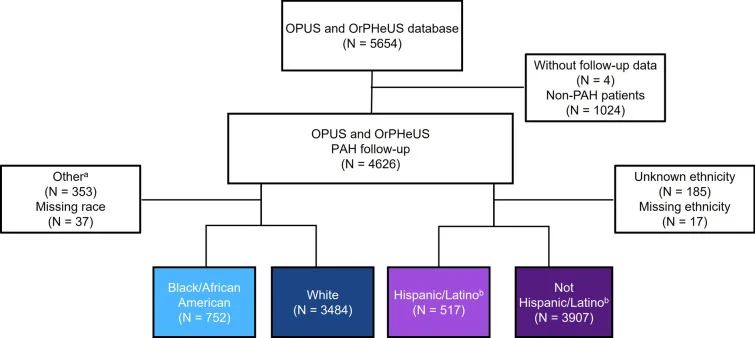
cohort · n=4,626
NOV 2025Melendres‐GrovesAdvances in Therapy
1-year survival was 89.6% for Black vs 90.3% for White patients, and 93.8% for Hispanic vs 89.9% for not Hispanic patients.
Similar survival across groups supports equitable macitentan outcomes in PAH; extends real-world data in underrepresented populations.
Meta-Analysis
NOV 2025DrouardUniversity of Washington
Genetic and environmental influences on educational disparities in adult weight change: an individual-based pooled analysis of 11 twin cohorts
Introduction Educational attainment (EA) is negatively associated with body mass index (BMI) but less is known about the association between EA and adult BMI change. We analyzed the role of genetic and environmental factors in the association between EA and BMI trajectory components over adulthood. Data and methods Pooled data from 59,490 twins aged 31–99 years (49% women) across 11 cohorts with EA and repeated measures of BMI were used. BMI trajectory components (baseline BMI and BMI change per decade) were estimated using linear mixed-effects (LME) and delta slope methods. EA was derived by regressing years of education on birth year and cohort. Associations between EA and BMI trajectories were evaluated with LME models in both cohort-specific and pooled data. Genetic and environmental contributions were evaluated using structural equation modeling. Results EA was more strongly negatively associated with baseline BMI and BMI change (mean of 1.31 and 1.32 kg/m 2 per decade in men and women, respectively) in women (β = – 0.14 kg/m², 95% CI: –0.15 to –0.12; β = –0.02 kg/m²/decade, 95% CI: –0.03 to –0.01, respectively) than in men (β = –0.07, 95% CI: –0.08 to –0.06; β = –0.01, 95% CI: –0.02 to – 0.001, respectively). The associations between baseline BMI and EA were explained by genetic factors in men (r A = –0.10) and by both genetic (r A = –0.17) and unique environmental factors (r E = –0.07) in women. For BMI change, the associations with EA were explained solely by genetic factors (r A = –0.04 in men; –0.06 in women). Conclusion Individuals with higher EA tend to have lower baseline BMI and slower BMI increases across adulthood. The majority of the associations are primarily genetically mediated.
Meta-Analysis
NOV 2025García‐MarínYale University
Genome-wide analysis in over 1.6 million participants uncovers 147 loci associated with obstructive sleep apnoea
We conducted the largest GWAS meta-analysis for obstructive sleep apnoea (OSA; N cases = 230,657; N controls = 1,377,442) using European ancestry genetic data from five countries. We identified 147 independent loci associated with OSA, and estimated SNP-based heritability at 16%. We report six independent loci in a separate African population meta-analysis (N cases = 46,834; N controls = 149,192). We observed spatially resolved gene enrichment involving GABAergic and glutamate pathways, synaptic transmission, and cytoskeletal remodelling. OSA-derived polygenic risk scores showed predictive ability for clinician ascertained OSA status, Fitbit-derived sleep features, and self-reported sleep traits in participants of diverse ancestral backgrounds. We identified putative causal relationships with ADHD, depression, multisite chronic pain, body mass index, and schizophrenia, among others. Our findings demonstrate a robust genetic component underlying OSA risk, independent of body mass index, implicating distinct neurobiological pathways related to synaptic function and corticothalamic feedback loops.
Original Research
NOV 2025CaoSkin Health and Disease
Unravelling the causal link between gut microbiota and acne risk using a genetic approach
Background Acne is a common inflammatory dermatological condition that can have detrimental psychological consequences due to its visible lesions and scarring. Recent studies suggest a potential role of gut microbiota in acne development; however, the evidence remains inconclusive and might be subject to various confounders. Objectives To investigate the causal relationship between gut microbiota and acne. Methods This study investigated the causal relationship between gut microbiota and acne using a two-sample Mendelian randomization (MR) approach with large-scale genome-wide association study summary statistics. To ascertain the direction of causality and the independent effect of gut microbiota, reverse MR and multivariable MR accounting for dietary phenotypes were performed. Results Higher abundances of the Actinobacteria phylum and class, Bifidobacteriales order, Bifidobacteriaceae family and Bifidobacterium genus were associated with a reduced risk of acne [odds ratios (ORs) ranging from 0.54 to 0.63]. In contrast, higher levels of the Gastranaerophilales order, Streptococcaceae family and Streptococcus genus were positively associated with an increased risk of acne (OR 1.12–1.36). Notably, associations for Bifidobacterium and its upstream taxa remained robust even after accounting for dietary factors. Conclusions These findings provide further evidence of a causal relationship between gut microbial composition and acne, highlighting the role of gut microbiota in developing more targeted and possibly less harmful alternatives to current acne management strategies.
Meta-Analysis
SEP 2025GrimesUniversity of Edinburgh
Genome-wide association study of adolescent-onset depression
Genome-wide association study identified genetic variants linked to adolescent-onset depression, suggesting pathways for intervention.
Original Research
SEP 2025GillespieBehavior Genetics
Genetic Overlap Between DSM-IV Major Depressive Disorder and Suicidal Behaviors: Evidence from Polygenic Risk Scores in Young Adult Twins
Analysis reveals shared genetic architecture between major depressive disorder and suicidal behaviors, suggesting implications for risk assessment strategies.
Original Research
SEP 2025BiconaBehavior Genetics
Dyslexia Polygenic Index and Socio-Economic Status Interaction Effects on Reading Skills in Australia and the United Kingdom
Observational analysis explored reading skills in children from Australia and the UK, suggesting gene-Socio-Economic Status interaction may differ internationally.