

Adolfo García‐Sastre
Influenza Virus Research Studies
Icahn School of Medicine at Mount Sinai
About
Research focus
Influenza Virus Research Studies
Impact
1,138 pubs · 101,746 cites · h-index 160
Affiliations
Publications
Blinded Clinical Trial
NOV 4MirandaScientific Reports
Phase II randomized non-inferiority trial comparing the humoral immunogenicity of NDV-HXP-S and BNT162b2 vaccines in Brazil
Background Coronavirus disease 2019 (COVID-19) prompted an unprecedented global vaccine development response and accelerated regulatory pathways for clinical vaccine development. Despite the end of the public health emergency, sustained preparedness, including scalable and affordable vaccine platforms remains essential. Methods This is a non-inferiority, multicenter, randomized, double-blind and active-controlled Phase II clinical trial, to evaluate the immunogenicity and safety of a fifth- dose booster of NDV-HXP-S 10 µg, an egg-derived, inactivated COVID-19 vectored-vaccine virus using the Newcastle disease virus (NDV) expressing stabilized pre-fusion S protein from Wuhan-hu-1 strain of severe acute respiratory syndrome coronavirus 2 (SARS-CoV-2), versus BNT162b2 30 µg. Healthy participants aged 18–59 years (n = 200) or ≥ 60 years (n = 200) were randomized at a 1:1 ratio to receive a single intramuscular dose on Day 1. Primary immunogenicity endpoints (per-protocol) were the Day 29 geometric mean titer (GMT) ratio of the 50% neutralizing titer (NDV-HXP-S/BNT162b2) against SARS-CoV-2 Wuhan-hu-1 and the difference in seroconversion proportions (≥ 4-fold rise if seropositive at baseline, or NT 50 ≥40 IU/mL if seronegative). Non-inferiority margins were a point estimate ≥ 0.80 with a 95% confidence interval (CI) lower bound > 0.67 for GMT ratio, and a 95% CI lower bound > − 10% for seroconversion. Primary safety endpoints were solicited vaccine-related adverse events (AEs) through Day 7 and unsolicited and serious vaccine-related AEs through Day 28. Follow-up occurred for 12 and 6 months for safety and immunogenicity evaluation, respectively. Results Between January 27th and August 30th 2023, 389 eligible subjects were included in the safety population. Of 389 participants, 263 (67.6%) were female, median age of 60.1 years (IQR, 40.8–65.4) and the majority of them were white, 218 (56.0%). Among the 311 (77.8%), the GMT ratio (NDV-HXP-S/BNT162b2) of neutralizing antibodies against SARS-CoV-2 (Wuhan) was 0.50 (95% CI: 0.40‒0.60), measured on Day 29. Meanwhile difference in seroconversion was − 36.7% (-45.3% to -28.0%). Vaccine-related solicited adverse events were 131 (67.2%) in NDV-HXP-S and 148 (77.1%) in BNT162b2 (P = 0.032) within 7 days post-vaccination, while vaccine-related unsolicited adverse events were 46 (23.5%) in NDV-HXP-S vs . 51 (26.4%) in BNT162b2 (P = 0.558) within 28 days. There were no vaccine-related serious adverse events (SAEs) () within 28 days post-vaccination. Conclusion Inactivated NDV-HXP-S at 10 µg did not meet the criteria for non-inferiority in comparison to BNT162b2 at 30 µg in SARS-CoV-2 Wuhan-hu-1 seroconversion and neutralization as a booster dose. Both vaccines had a favorable safety profile.
Cohort Study
NOV 2ReederAnnals of Internal Medicine
Timing of Long COVID Improvement in Prospectively Followed RECOVER-Adult Participants
BACKGROUND: Long COVID (LC) is widespread; however, limited information has been reported on the likelihood that symptoms remit over time. OBJECTIVE: To evaluate the likelihood of improvement among persons with likely LC. DESIGN: Prospective, multisite cohort study (RECOVER-Adult [Researching COVID to Enhance Recovery]). SETTING: 83 U.S.-based sites across 33 states; Washington, DC; and Puerto Rico. PARTICIPANTS: 1019 persons in RECOVER-Adult with likely LC (LC Research Index [LCRI] ≥11) 12 months after first SARS-CoV-2 infection. MEASUREMENTS: The primary outcome was time until 2 consecutive study visits with LCRI less than 11. Secondary outcomes were time until LCRI measure reduced 50% or more and quality of life was good or better, and LCRI decreased to 0. Unadjusted estimates of cumulative incidence and adjusted marginal cumulative incidence by age, sex, SARS-CoV-2 wave, and LC subtype were reported across all follow-up time points. RESULTS: An estimated 36.2% (95% CI, 33.0% to 39.5%) met the primary outcome by 24 months after infection, and 50.1% (CI, 46.1% to 54.0%) met the primary outcome by 36 months. An estimated 56.4% (CI, 52.2% to 60.4%) and 26.9% (CI, 23.3% to 30.5%), respectively, met the 2 secondary outcomes by 36 months. Among persons who still reported likely LC at 18 months and 24 months after first infection, relative timing of subsequent symptom improvement was similar. LIMITATION: Findings in this observational cohort are interpretable in a population with prevalent likely LC and do not address causal relationships between individual characteristics and symptom improvement. CONCLUSION: Among persons with likely LC 12 months after initial SARS-CoV-2 infection, one half experience meaningful reductions in symptoms by 36 months, whereas a quarter experience complete remission of symptoms. These findings underscore both the potential for natural recovery and the urgent need for placebo-controlled therapeutic intervention trials. PRIMARY FUNDING SOURCE: National Institutes of Health.
Original Research
OCT 27PastorCell Reports
Species-specific gene programs define divergent antiviral responses in Marburg virus reservoir bats and humans
Bats tolerate viruses that cause severe disease in humans. Egyptian rousette bats, the natural reservoirs of Marburg virus (MARV), sustain asymptomatic infection, whereas humans develop severe and fatal disease. To define the basis of this divergence, we establish a comparative framework using primary and immortalized Egyptian rousette and human cells exposed to double-stranded RNA and interferon (IFN). Bat cells upregulate antiviral effectors while limiting inflammatory amplifiers, a pattern further supported by analysis of independent in vivo MARV infection datasets. In contrast, human cells activate antiviral programs and immune hyperactivation in response to MARV. Integrating transcriptomic and proteomic analyses, we identify species-specific immune programs encompassing differential IFN-stimulated gene regulation, apoptotic control, and cytokine signaling. Our findings establish an integrative framework for understanding species-specific antiviral responses associated with MARV reservoir biology, identify pathways linked to immunopathogenesis in humans, and provide a foundation for future studies of host responses to filovirus infection.
Original Research
OCT 28RichardsonNature Communications
Coevolutionary constraints of Zika virus nonstructural protein 5 replication and interferon antagonism activities
The flavivirus nonstructural protein 5 performs multiple functions during infection, including RNA replication and type I interferon signaling antagonism. Although flavivirus NS5 proteins inhibit IFN signaling through distinct mechanisms, which suggests evolutionary flexibility, the evolutionary constraints for these activities to coexist within a single protein remain to be determined. Here, we map the Zika virus NS5 STAT2 antagonism determinants and compare them with replication constraints defined by deep mutational scanning. Antagonism and replication determinants extensively overlap, and no single amino acid substitution eliminates antagonism without impairing replication. Resolving these fitness landscapes in parallel identifies specific combinations of partially functional substitutions that retain replication capacity while markedly reducing antagonism. These viruses are profoundly attenuated in human STAT2 knock-in mice. Our results uncover a fundamental evolutionary constraint linking replication and immune evasion activities in NS5, highlight that STAT2 antagonism is essential for ZIKV pathogenesis and provide new avenues for attenuated ZIKV vaccines.
Original Research
OCT 23EncinasVirus Evolution
Zoonotic infections and genomic evolution of novel reassortant swine influenza A viruses in Spain
Influenza A virus (IAV) circulates widely in European pig populations and continues to diversify through frequent introductions from humans, followed by reassortment within swine. Spain represents a particularly dynamic ecological setting due to the coexistence of intensive white-pig production, extensive Iberian-pig systems, and abundant wild boar populations. This study provides an integrated analysis of IAV evolution and genomic diversity in swine in Spain between 2019 and 2022, expanding on previous surveillance from 2016 to 2019. Sampling across 24 provinces yielded 66 new whole-genome sequences from Iberian and white pigs. We identified 18 genotypes, including 11 novel reassortants not detected in our previous survey. Several genotypes, such as H1N2 G21 and G22, H3N2 G23, and the unusual H3N1 G12, were exclusive to the country. Some genotypes were detected across white pigs, Iberian pigs, and wild boar in Toledo and Badajoz, suggesting viral flow among swine populations. Phylogenetic analyses revealed ongoing introductions of H1N1pdm09 from humans into pigs, generating at least five reassortant genotypes (G10, G16–G19). These lineages incorporated pandemic internal cassettes and, in some cases, human-seasonal N2 segments, highlighting the continued role of humans as a source of viral incursions. Conversely, four zoonotic infections (H1N1v) detected in Spain between 2022 and 2026 were linked to genotypes circulating in white pigs, underscoring the bidirectional nature of IAV transmission at the human swine interface. Overall, this study demonstrates that Spain provides ecological conditions conducive to IAV diversification, reassortment, and zoonotic risk. The findings reinforce the need for sustained One Health surveillance.
Original Research
OCT 18WoodsPharmaceuticals
MDL-001: An Oral, Direct-Acting Broad-Spectrum Antiviral for Influenza-like Illness (ILI) and Chronic Hepatitis In Vivo
Background/Objectives: Endemic viral respiratory illnesses caused by influenza, RSV, and coronaviruses impose a global disease burden of hundreds of millions of infections and hundreds of thousands of deaths annually. Chronic hepatitis B and C infections persist in 254 million and 58 million people worldwide, respectively. No approved therapy addresses these viruses simultaneously. MDL-001 is an oral, direct-acting, broad-spectrum antiviral targeting the Thumb-1 allosteric site of viral polymerases. Methods: Here, we evaluated the antiviral activity of MDL-001 in vitro in influenza A/B, RSV, SARS-CoV-2, endemic human coronaviruses, and hepatitis B/C/D. We next evaluated MDL-001 antiviral activity in vivo in H1N1, SARS-CoV-2, HCV, and HBV. MDL-001’s in vivo efficacy was compared head-to-head versus standards of care including oseltamivir, remdesivir, sofosbuvir, and tenofovir alafenamide, or through the literature comparison with nirmatrelvir and molnupiravir. Lastly, we evaluated the pharmacokinetics, metabolism, tolerability, and safety profile of MDL-001. Results: Here, we report that MDL-001 inhibits influenza A/B, RSV, SARS-CoV-2, endemic human coronaviruses, and hepatitis B/C/D viruses with nanomolar EC90 potency in vitro. MDL-001 demonstrated equivalent in vivo efficacy to oseltamivir against mouse-lethal influenza A virus infection, reducing lung viral load by 2.6 log10 and preventing weight loss and mortality. MDL-001 demonstrated equivalent symptom reduction to subcutaneous remdesivir after SARS-CoV-2 infection. MDL-001 reduced SARS-CoV-2 lung viral titers by 2.9 log10, superior to the literature-reported 1.4 log10 and 1.0 log10 reductions for nirmatrelvir and molnupiravir, respectively. MDL-001 reduced HCV viremia by 3.3 log10, equivalent to sofosbuvir. Oral MDL-001 reduced plasma HBV surface antigen by 2.5 log10, superior to tenofovir alafenamide from Day 8 through Day 21. MDL-001 demonstrated an in vitro EC50 of 79.4 nM against infection with RSV strain A2, which is a 416-fold improvement over literature-reported ribavirin. Oral pharmacokinetics studies demonstrate that MDL-001 is rapidly absorbed and partitioned into lung (Kp = 39–52) and liver (Kp = 71–104) tissues. MDL-001 produced no treatment-related tolerability adverse events across 376 animals and showed no hERG, Ames genotoxicity, or micronucleus safety issues. Conclusions: These findings support MDL-001 as a broad-spectrum, direct-acting non-nucleoside antiviral clinical candidate.
Original Research
OCT 12WiestEMBO Molecular Medicine
Spatiotemporal heterologous vaccination relies on type I interferons at priming to enhance mucosal immunity
Parenteral vaccines against respiratory viruses poorly block infection and transmission due to suboptimal induction of mucosal immunity. In contrast, hybrid immunity and heterologous-route immunization regimens generate protective mucosal and systemic immunity. Herein, we examine how chronological order in heterologous prime/boost immunization regimens impacts immune responses using combinations of intramuscular mRNA and intranasal adjuvanted subunit vaccines against SARS-CoV-2. Enhanced long-lived mucosal and systemic immunity depended strongly on vaccine delivery sequence, with heterologous regimens administered in alternate order of routes yielding markedly distinct immune profiles with different Th-biases and divergent localizations. Immunity imparted through heterologous immunization was more durable and responsive to delayed boosting than parenteral-only regimens. Furthermore, intramuscular mRNA immunization uniquely shaped gene expression locally and systemically through IFN-I induction, allowing for enhanced responses to subsequent mucosal immunizations. These findings demonstrate that the context of initial antigen exposure—including the route of exposure and associated inflammatory signals—profoundly shapes responses to subsequent encounters. Thus, vaccine responses in antigen-experienced hosts differ fundamentally from those induced on a naive baseline, reflecting the influence of pre-existing innate and adaptive immune memory.
Original Research
SEP 23MarougkaProceedings of the National Academy of Sciences
Substitutions affecting the HA–NA–receptor balance preceded the emergence of the pandemic 2009 H1N1 virus
Swine are a crucial species in influenza A virus (IAV) ecology, capable of supporting replication and consequently evolution of human, avian, and swine strains. They are also the source of the 2009 pandemic H1N1 virus (H1N1pdm09). Understanding how swine IAV breach the species barrier is essential for detection of potentially pandemic viruses, but is often overlooked compared to avian IAV. We hypothesize that the HA–NA balance of (pre)pandemic swine viruses is a key feature that needs adjustment as swine and humans differ in their sialoglycome. We focused on a set of (pre)pandemic swine viruses collected in Mexico following the H1N1pdm09 emergence. Phylogenetic analysis showed that the emergence was preceded by substitutions in HA and NA predicted to affect their function. Thus, HA acquired substitution A227E, previously shown to reduce receptor binding in H1N1pdm09, while NA obtained substitution S369N in the 2nd sialic acid binding site (2SBS) predicted to reduce NA cleavage. The substitutions’ effect on the HA–NA balance, was confirmed with biolayer interferometry using recombinant proteins attached to nanoparticles. Engineering recombinant attenuated influenza viruses with swine HA and NA with/without the mentioned substitutions, showed that the 2SBS substitution negatively affected replication in primary human and swine cultures. Interestingly, replication was restored by the HA substitution. Overall, we show that the emergence of H1N1pdm09 in humans was preceded by substitutions in HA and NA that were acquired in swine and adjusted the HA–NA balance. We hypothesize that adjustment of the HA–NA balance was a critical step for crossing the host–species barrier.
preclinical
SEP 11SharmaPLoS Pathogens
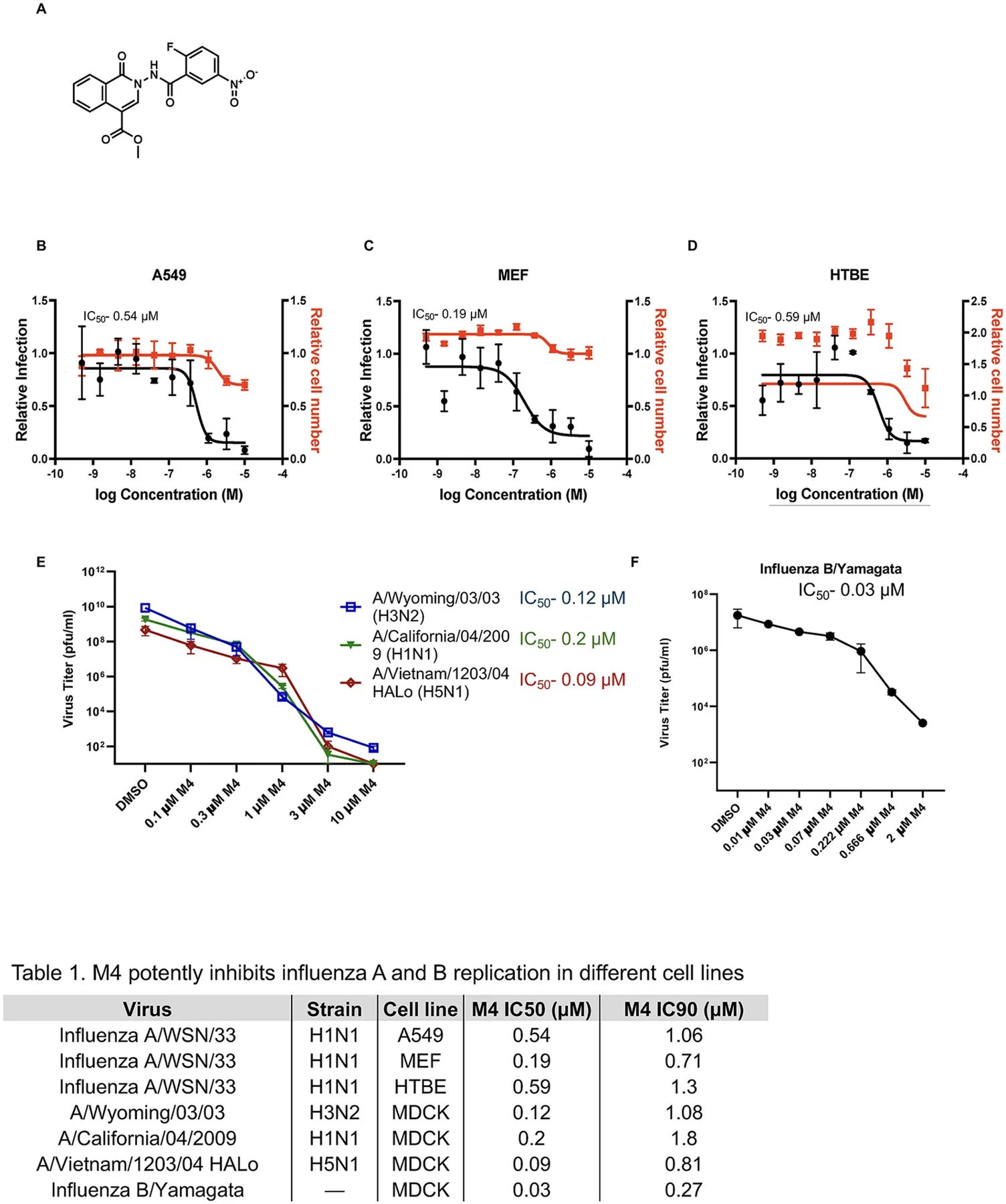
M4 inhibits influenza replication by targeting STARD7 and suppresses viral replication with baloxavir in mice.
M4 identifies a novel host-directed antiviral mechanism in vitro; hypothesis-generating for broad-spectrum influenza therapy pending in vivo validation.
In Vitro Study
SEP 10CastroMicrobiology Spectrum
A bireporter recombinant SARS-CoV-2 Omicron BA.5 for in vitro and in vivo studies
Preclinical study demonstrates optical tracking of bireporter recombinant Omicron BA.5 in humanized mice, highlighting a scalable platform for evaluating emerging variant antivirals.
Original Research
SEP 2McGrailCommunications Biology
ISG15 differentially modulates Clade Ib and II MPXV infection
In vitro study reveals ISG15 restricts monkeypox virus replication in human but not murine cells, indicating a species-specific antiviral barrier that shapes host range.
Original Research
SEP 1BykovJournal for ImmunoTherapy of Cancer
In situ APMV-4 vaccination primes systemic response to subtherapeutic dosing of aCTLA-4 in colorectal carcinoma
BACKGROUND: Colorectal carcinoma (CRC) is frequently typified by chronic inflammation and high levels of immunosuppression that render it resistant to immunotherapy. The multimodal immunostimulatory mechanisms of oncolytic virotherapy make it an attractive strategy for priming tumors for immune-checkpoint blockade (ICB). Here, we present an emerging oncolytic virotherapeutic, rAPMV-4, with previously described efficacy in preclinical models of CRC and melanoma. METHODS: We expand on the established efficacy of APMV-4 by characterizing responses to the virotherapy in preclinical single and bilateral MicroSatellite Stable CRC tumor models. To investigate local and systemic effects of the virus, we characterized responses in tumors, draining lymph nodes, and sera using RNA-seq, high-dimensional flow cytometry, and cytokine analysis. RESULTS: rAPMV-4 induced rapid, yet transient, interferon signaling, and early signatures of antigen presentation and T cell activation. Comparison with a human CRC cohort revealed a transcriptomic shift induced by the virus from a mesenchymal CMS4 to an "immune-high" CMS1 subtype predicted to respond well to ICB. Leveraging these signatures of response and resistance to the virotherapy, we designed a rational combinatorial approach with low-dose anti-CTLA-4, which reversed Treg activation and alleviated CD4 and CD8 dysfunction, leading to more potent systemic tumor elimination. CONCLUSIONS: This work supports the further clinical development of rAPMV-4, either alone or in combination, as an efficacious therapy for CRC.
Original Research
JUL 28ToufiqThe Journal of Immunology
Deep functional interpretation of influenza-induced ciliary gene dysregulation through stepwise Large Language Model profiling 2302296
Demonstrates ciliary gene dysregulation in influenza, suggesting impaired mucociliary clearance mechanisms.
Original Research
JUL 28YuThe Journal of Immunology
Reconstitution of human bronchial epithelial cells in humanized mice with autologous immune system 2335217
Investigates human epithelial-immune crosstalk in humanized mice, suggesting a novel model for respiratory research.
Original Research
JUL 28YohThe Journal of Immunology
Cardiac glycosides activate non-canonical STAT1 signaling to reprogram antigen-presenting cells 2310011
Shows cardiac glycosides trigger STAT1 signaling in antigen-presenting cells, indicating new immunotherapy pathways.
Original Research
JUL 28ToufiqThe Journal of Immunology
Deep functional interpretation of influenza-induced ciliary gene dysregulation through stepwise Large Language Model profiling 2301536
Reveals dysregulation of ciliary genes in influenza-infected cells, suggesting shared mechanisms across viral infections.
Original Research
JAN 5LizzadroJournal of Medicinal Chemistry
Discovery of Coronavirus Main Protease Inhibitors with Enhanced Brain Exposure and Potent Oral Efficacy in SARS-CoV-2 and MERS Infection Models
The main proteases (M Pro ) of coronaviruses are clinically validated targets for antiviral discovery. Herein, we detail the in vivo optimization of uracil-core M Pro inhibitors derived from AVI-4516, an in vivo active lead bearing an unactivated propargyl warhead. To expand the anticoronaviral spectrum, we introduced diverse C6 substitution to target the S1’ pocket in M Pro and observed enhanced cellular activity against various nirmatrelvir-resistant mutants. Pharmacokinetic profiling of 12 analogs revealed overall inferior exposure of the C6 aryl analogs. However, PK profiling across three species identified the improved atropisomeric lead ( M )-AVI-4773 (5-(5,6-difluoro-1 H -benzo[ d ][1,2,3]triazol-1-yl)-3-(( M )-isoquinolin-4-yl)-6-methyl-1-(prop-2-yn-1-yl)pyrimidine-2,4(1 H,3 H )-dione), which exhibits rapid-onset oral efficacy in both SARS-CoV-2 and Middle East respiratory syndrome (MERS) mouse models, highlighting a promising chemotype with the potential to deliver anticoronaviral development candidates.
Original Research
NOV 2025Péreznpj Vaccines
Immunogenicity and efficacy of homologous and heterologous NDV and MVA SARS-CoV-2 vaccines in mice and hamsters
Effective vaccination strategies adaptable to emerging viruses like SARS-CoV-2 and capable of inducing robust protective immunity are needed. We evaluated the immunogenicity and protective efficacy of homologous and heterologous prime/boost regimens against SARS-CoV-2 in K18-hACE2 mice and Syrian hamsters using Newcastle disease virus (NDV-HXP-S, intranasal) and modified vaccinia virus Ankara (MVA-S(3P), intramuscular) vectors encoding a prefusion-stabilized SARS-CoV-2 spike (S) protein. All regimens protected against weight loss and markedly reduced viral replication and lung pathology. Vaccination induced serum anti-S and anti-receptor binding domain IgGs and neutralizing antibodies against ancestral virus and variants. In mice, mucosal anti-S IgA and IgG were detected after NDV-HXP-S immunization. Homologous MVA-S(3P)/MVA-S(3P) and heterologous NDV-HXP-S/MVA-S(3P) elicited higher polyfunctional systemic T-cell responses, while homologous NDV-HXP-S/NDV-HXP-S induced stronger pulmonary CD8+ T cells. Hamsters vaccinated with NDV-HXP-S exhibited protection of the upper respiratory tract, with the NDV-HXP-S/MVA-S(3P) regimen showing a trend toward reduced direct contact transmission of SARS-CoV-2. These findings demonstrate the capacity of NDV and MVA vector platforms to induce robust systemic and mucosal antigen-specific humoral and T-cell responses against SARS-CoV-2, contributing to protection against both disease and transmission, and support further exploration of these vector platforms for vaccination against SARS-CoV-2 and potentially other pathogens.
Original Research
NOV 2025HenricheLife
The role of co-infection in the pathogenesis of acute SARS-CoV-2 infection and development of post-acute sequelae: A perspective
A major health challenge resulting from the COVID-19 pandemic is the manifestation of post-acute sequelae of SARS-CoV-2 (PASC). PASC (or long COVID) is a collective term used for clinical symptoms, various pathologies, and life-quality-changing functional impairment that persist for months to years after the initial SARS-CoV-2 infection. The mechanisms underlying PASC are not understood, although advances have been made in identifying factors that may contribute to long-term pathology. Recent data have emerged, showing an association between SARS-CoV-2 viral persistence and non-SARS-CoV-2 infections (pre-existing, viral reactivation, or new infections) in facilitating or mediating PASC. However, the heterogeneous nature and timing of co-infections have made it challenging to understand, interpret, and contextualize their contribution to PASC. Here, we summarize the impact of potential viral, bacterial, and fungal infections on SARS-CoV-2 pathogenesis, with a focus on their possible roles in the development of PASC. We also provide a framework to understand the mechanisms of PASC and inform basic, translational, and clinical research initiatives, including RECOVER, a large and ongoing research initiative to understand, treat, and prevent long COVID.
Original Research
NOV 2025Tur-PlanellsJournal for ImmunoTherapy of Cancer
Infectious bursal disease virus (IBDV) as a novel oncolytic virotherapy in glioblastoma
BACKGROUND: Glioblastoma (GBM) is the most aggressive form of cancer of the central nervous system. Despite advances in immunotherapies and standard-of-care treatments for GBMs, clinical outcomes remain limited-owing to the immunosuppressive tumor microenvironment and the intrinsic resistance of GBM to conventional approaches. As a result, there is growing interest in rational combination strategies, particularly those pairing oncolytic viruses with immune-based therapies or established treatment modalities. Oncolytic viruses, by displaying conditionally enabled tumor cell-restricted replication, while stimulating antitumor immune responses and leaving healthy tissue unharmed, have the potential to reshape the therapeutic landscape in GBM and aid in achieving more durable benefits for patients. This study investigates the use of infectious bursal disease virus (IBDV) as a potential virotherapy for GBM. METHODS AND RESULTS: In vitro, IBDV infects and replicates within murine GBM cells and patient-derived GBM stem cells, inducing direct oncolysis and activating proinflammatory gene expression programs. IBDV also enhances the cytolytic activity of temozolomide (TMZ) in treated GBM cells, complementing TMZ chemotherapeutic activity. In vivo, treatment with IBDV in CT-2A GBM-bearing syngeneic mice significantly reduced tumor growth and improved survival compared with control mice. Intratumoral administration of IBDV induces a deep remodeling of the tumor immune microenvironment, reducing immunosuppressive M2-like macrophages and increasing the ratio of CD8+T cells to regulatory T cells. This reversion of immunosuppression linked to monocyte-derived macrophages has been confirmed on experimental ex vivo infections of explants derived from human GBM donors. CONCLUSION: These findings support further consideration of IBDV as a novel virotherapeutic agent for GBM.