JACCChirinos et al.cohort
Machine-learning multimarker model linked to ~2.9-fold higher risk of death or HF hospitalization in HFpEF.
May refine HFpEF risk stratification beyond MAGGIC; leaves open prospective utility in trials.
176 pubs · 3,811 cites · h-index 32
JACCChirinos et al.cohort
May refine HFpEF risk stratification beyond MAGGIC; leaves open prospective utility in trials.
BMC CancerAo et al.Cohort Study
Postoperative recurrence risk remains heterogeneous among patients with locally advanced esophageal squamous cell carcinoma (ESCC) after neoadjuvant chemoimmunotherapy (NCIT) and surgery. We aimed to develop and externally validate a clinically accessible prognostic model for disease-free survival (DFS). This multicenter retrospective cohort study included patients undergoing esophagectomy after NCIT at four Chinese centers between October 2019 and December 2025. One center formed the training cohort and three independent centers formed the external validation cohort. Predictors were selected using least absolute shrinkage and selection operator-penalized Cox regression and bootstrap stability selection. Performance was evaluated by discrimination, calibration, decision curve analysis, and fixed-cutoff risk stratification and compared with ypTNM staging. Among 890 patients, 546 were included in the training cohort and 344 in external validation; DFS events occurred in 172 and 93 patients, respectively. The nomogram incorporated ypN stage, perineural invasion, major pathological response, ypT stage, sex, body mass index category, and lymphovascular invasion. The C-index was 0.741 (95% confidence interval [CI], 0.702–0.780) in training and 0.701 (0.644–0.757) in external validation. The optimism-corrected C-indices were 0.726 (0.688–0.762) for fixed-model validation and 0.706 (0.668–0.747) when predictor selection was repeated. In external validation, the C-index difference versus categorical ypTNM staging was 0.048 (0.014–0.082). External calibration showed reasonable agreement between predicted and observed DFS at 1 and 2 years, with overprediction of DFS at 3 years. Decision curve analysis showed greater net benefit than ypTNM staging within specific threshold ranges. High-risk classification using the fixed training-derived cutoff was associated with poorer DFS in training (hazard ratio [HR], 3.86; 95% CI, 2.75–5.44) and external validation (HR, 3.40; 95% CI, 2.16–5.35; both P < 0.001). This externally validated nomogram uses routinely available clinicopathological variables to provide individualized DFS estimates for patients with ESCC after NCIT and surgery and may complement ypTNM staging in postoperative risk stratification. Prospective validation is required before routine clinical use.
Journal of PeriAnesthesia NursingYu et al.RCT
VIVBIS had a similar effect as 2D video and printed materials in reducing preoperative anxiety in patients undergoing day case hysteroscopy. VIVBIS effectively met the preoperative information needs of patients undergoing day case hysteroscopy.
Circulation Heart FailureVidula et al.cohort
Higher circulating levels of dpucMGP are associated with an increased risk of death or heart failure-related hospitalization, and mediate the relationship between warfarin use and adverse outcomes in heart failure patients.
RadiologyWu et al.Cohort Study
Prospective study shows LAVImin predicts major adverse cardiovascular events in AMI patients, highlighting its incremental value over traditional risk factors.
BMC NeurologyZhang et al.Original Research
Case report reveals effective use of intravenous tenecteplase and intra-arterial tirofiban in pediatric acute ischemic stroke, suggesting promising management implications.
Intelligent MedicineZhang et al.Guideline
Guides AI integration into CCTA workflows now; extends imaging standards by defining three core research design elements.
BMC AnesthesiologyAn et al.RCT
BACKGROUND: Clinical evidence revealed patients suffered from moderate to severe pain after renal transplantation. Both quadratus lumborum block (QLB) and erector spinae plane block (ESPB) are effective strategies in perioperative analgesia. This trial aims to detect whether truncal blocks are utility in alleviating postoperative pain after renal transplantation. METHODS: Ninety-two patients underwent renal transplantation were recruited and randomized to QLB group, ESPB group and control group (C group). Patients in QLB or ESPB group received 0.5% ropivacaine 30 mL for single injection before surgery respectively and patients in C group did not receive any local anesthetic injection before general anesthesia induction. Postoperative pain intensity was evaluated at 0, 2, 4, 6, 8, 12, 24 and 48 h after surgery in the present study. Intraoperative medication and postoperative complications were also recorded and analyzed. RESULTS: The proportion of moderate to severe pain in the first 24 h when moving was lowest in the QLB group (41.9% in QLB group vs. 83.9% in ESPB group vs. 96.7% in C group, P < 0.001). Pain intensity score (NRS) in the QLB group was significantly improved at 0, 2, 4, 6, 8 and 12 h after surgery (P < 0.05). Area under curve (AUCs) of NRS scores were significantly lower in the QLB group than in the ESPB group and C group (P < 0.001). We also observed a reduction of remifentanil consumption in the QLB group than in either the ESPB or C groups (P = 0.008 and P < 0.001, respectively). CONCLUSIONS: Quadratus lumborum block before surgery more effectively suppressed pain after renal transplantation relative to erector spinae plane block. TRIAL REGISTRATION: This study was registered on October 2, 2020. ChiCTR2000038803.
International Journal of CancerWang et al.Review
Digestive system cancers represent nearly half of all global cancer cases and are associated with high mortality rates. Although immunotherapy has ushered in a new era for the treatment of digestive system cancers, the complexity and diversity of the immunosuppressive tumor microenvironment (TME) pose significant challenges to effective immunotherapy for digestive tumors. Dipeptidyl peptidase 4 (DPP4), also known as CD26, has garnered considerable attention for its role within the TME, where it plays a crucial role in the initiation and progression of digestive system cancers and serves as a predictive biomarker for certain cancers. Additionally, it is involved in regulating immune responses, angiogenesis, ferroptosis activation, tumor-associated inflammation, neurotransmission, and metastasis. Thus, DPP4 inhibitors play a pivotal role in modulating the intricate tumor ecosystem, contributing to the control of digestive system cancer development. Therefore, a deeper understanding of DPP4's mechanisms in the TME holds promise for establishing essential theoretical frameworks for developing novel treatment strategies for digestive system cancers. This review explores the regulatory role of DPP4 in the TME of digestive system cancers and its clinical implications, aiming to provide insights into potential advancements in oncological therapies.
Journal of Medicinal ChemistrySu et al.Original Research
Human relaxin-2 (relaxin, H2-RLX, RLN2), an endogenous hormone associated with mammalian pregnancy, and its cognate receptor relaxin family peptide receptor 1 (RXFP1) have been implicated as important modulators of cardiovascular function and agonism of RXFP1 may potentially be utilized for the treatment of heart failure. Exploration of chemical space around previously reported anthranilamide 2 led to the discovery of lead compound 39 with significantly improved agonist activities toward human and rodent RXFP1. Compound 39 induced a dose-dependent heart rate increase in isoflurane-anesthetized naïve rats, which is consistent with the hemodynamic profile of relaxin in rat. Compound 39 also elicited significant interpubic ligament (IPL) expansion in C57BL/6 mouse, measured with microCT imaging, which recapitulated the effect of relaxin.
BMC CancerKugeluke et al.RCT
BACKGROUND: The development of systemic therapy, including targeted drugs and immune checkpoint inhibitors, has significantly improved the prognosis of patients with advanced unresectable hepatocellular carcinoma (uHCC). Hepatic arterial infusion chemotherapy (HAIC) has been gradually applied to the treatment of advanced uHCC, showing good potential as conversion therapy. We aimed to investigate the efficacy and safety of HAIC combined with camrelizumab and apatinib as conversion therapy for uHCC. METHODS: for 46 h) on days 4-5 of each 21-day cycle for up to 8 cycles. Primary endpoints were conversion rate and margin-free (R0) resection rate. RESULTS: Between March 2021 and July 2023, 19 patients were enrolled. Median follow-up was 14.9 months (interquartile range, 10.9-21.1). Disease became resectable in 14 (73.7%) of 19 patients; nine (47.4%) patients received R0 resection, while five (26.3%) refused surgery and opted for observation. Three (33.3%) of nine patients with surgery achieved major pathological response, including two (22.2%) with pathological complete response. Objective response and disease control rates were 47.4% (9/19) and 89.5% (17/19) per Response Evaluation Criteria In Solid Tumors (RECIST) version 1.1 and both 89.5% (17/19) per modified RECIST. Survival data were immature. Fourteen (73.7%) of 19 patients had grade 3 or higher treatment-related adverse events, with the most common being increased alanine aminotransferase or aspartate aminotransferase (seven [36.8%]) and increased lymphocyte count (six [31.6%]). No treatment-related deaths occurred. CONCLUSIONS: The combination of HAIC, camrelizumab, and apatinib as conversion therapy shows promising clinical benefits and a manageable safety profile in patients with uHCC. Future randomized controlled trials are warranted. TRIAL REGISTRATION: ClinicalTrials.gov NCT05099848. Registered on October 13, 2021.
Advanced GeneticsLi et al.Original Research
Proteome-wide Mendelian randomization identified novel candidate causal proteins for various cardiovascular diseases, offering potential new targets for drug discovery.
The AnalystLiang et al.Original Research
Experimental evaluation demonstrates rapid multicomponent gas detection in deck decompression chambers, indicating enhanced life support monitoring during deep-sea operations.
Genes & DiseasesLi et al.Original Research
The long non-coding RNA taurine up-regulated gene 1 (TUG1) has been reported to be involved in various cancers, but its role in chondrosarcoma (CHS) remains a mystery. This research aimed to examine the function of TUG1 in CHS. We found that TUG1 expression was elevated in CHS. Functional assays demonstrated that TUG1 had a crucial role in the CHS cell progression. Mechanistically, TUG1 recruited ALYREF to maintain the stabilization of enhancer of zest homolog 2 (EZH2) mRNA and expression of H3K27me3, repressing the transcription of the tumor-suppressor gene CPEB1 . Additionally, exosomal TUG1 enhanced the polarization of M2 tumor-associated macrophages, which increased the proliferation and metastasis of CHS. Taken together, this study revealed the oncogenic role of TUG1 in CHS and its interactions with the downstream regulatory axis, offering novel insights into the tumorigenic mechanism of CHS.
Oncology LettersZhao et al.Case Report
Neuroendocrine neoplasms of the pancreas (pNENs) are rare. In February 2021, a 54-year-old woman was diagnosed with pNEN and multiple metastases within the liver. The patient, diagnosed with grade G2 neuroendocrine neoplasm (T4N0M1), underwent an ultrasonography-guided liver biopsy and radiofrequency ablation. After receiving Sandostatin LAR in April 2021, side effects led to its discontinuation after seven cycles. Following two sessions of radiofrequency ablation, the patient's condition was stable. However, disease progression was noted in September 2023, resulting in hemodialysis and closed peritoneal drainage. Surufatinib was administered, stabilizing the tumor by November 2023. The patient underwent transarterial chemoembolization due to a large tumor burden, with subsequent MRCP showing stability from diagnosis in February 2021 to June 2024. The present case report highlights the role of tailored treatment strategies considering patient comorbidities and tumor biology, and the significance of secondary puncture biopsy, which, despite not being pursued by the patient in the present study due to the associated risks, may provide survival benefits for patients with advanced or metastatic pNEN.
JACC Basic to Translational ScienceDib et al.Original Research
The molecular mechanisms contributing to large artery stiffness (LAS) are not fully understood. The aim of this study was to investigate the association between circulating plasma proteins and LAS using complementary proteomic and genomic analyses. A total of 106 proteins associated with carotid-femoral pulse-wave velocity, a noninvasive measure of LAS, were identified in 1,178 individuals from the Asklepios study cohort. Mendelian randomization analyses revealed causal effects of 13 genetically predicted plasma proteins on pulse pressure, including cartilage intermediate layer protein-2, high-temperature requirement A serine peptidase-1, and neuronal growth factor-1. These findings suggest potential novel therapeutic targets to reduce LAS and its related diseases.
Journal of NanobiotechnologyLi et al.Original Research
Lower back pain (LBP) is a common condition closely associated with intervertebral disc degeneration (IDD), causing a significant socioeconomic burden. Inflammatory activation in degenerated discs involves pro-inflammatory cytokines, dysregulated regulatory cytokines, and increased levels of nerve growth factor (NGF), leading to further intervertebral disc destruction and pain sensitization. Macrophage polarization is closely related to autophagy. Based on these pathological features, a structured biomimetic nanoparticle coated with TrkA-overexpressing macrophage membranes (TMNP@SR) with a rapamycin-loaded mesoporous silica core is developed. TMNP@SR acted like sponges to adsorbe inflammatory cytokines and NGF and delivers the autophagy regulator rapamycin (RAPA) into macrophages through homologous targeting effects of the outer engineered cell membrane. By regulating autophagy activation, TMNP@SR promoted the M1-to-M2 switch of macrophages to avoid continuous activation of inflammation within the degenerated disc, which prevented the apoptosis of nucleus pulposus cells. In addition, TMNP@SR relieved mechanical and thermal hyperalgesia, reduced calcitonin gene-related peptide (CGRP) and substance P (SP) expression in the dorsal root ganglion, and downregulated GFAP and c-FOS signaling in the spinal cord in the rat IDD model. In summary, TMNP@SR spontaneously inhibits the aggravation of disc inflammation to alleviate disc degeneration and reduce the ingress of sensory nerves, presenting a promising treatment strategy for LBP induced by disc degeneration.
HeartsBilak et al.Original Research
Background: This study assesses the temporal responses of cardiovascular function, fibro-inflammation, and glucometabolic profiles in asymptomatic adults with type 2 diabetes, following a low-energy meal replacement plan (MRP) or exercise training. Methods: Secondary analysis of DIASTOLIC: a randomised, open-label, blinded-endpoint trial of 12 weeks MRP (~810 kcal/day) or exercise training. Cardiac magnetic resonance, plasma fibroinflammatory, and metabolic markers were undertaken at baseline, 4, and 12 weeks. Results: Out of 24 participants in the MRP group and 22 in exercise training, 18 and 11 completed all three visits. MRP resulted in early (0–4 weeks) improvement in insulin resistance (HOMA-IR: 10.82 to 4.32), decrease in FABP-4 (4.87 ± 0.19 to 5.15 ± 0.32 mg/L), and improvement in left ventricular remodelling LV mass: volume (0.86 ± 0.14 to 0.78 ± 0.11), all with large effect sizes. MMP8 levels increased moderately at 4–12 weeks. Peak early diastolic strain rate (cPEDSR) initially decreased, then improved. Exercise training led to minor improvements in insulin resistance and MMP-8 levels, with no significant changes in cPEDSR or LV remodelling. Conclusions: MRP resulted in early improvements in insulin resistance, cardiac remodelling, and inflammation, but with an initial decrease in diastolic function, improving by 12 weeks. Exercise training showed minor early benefits in insulin resistance and inflammation, but no significant cardiac changes.
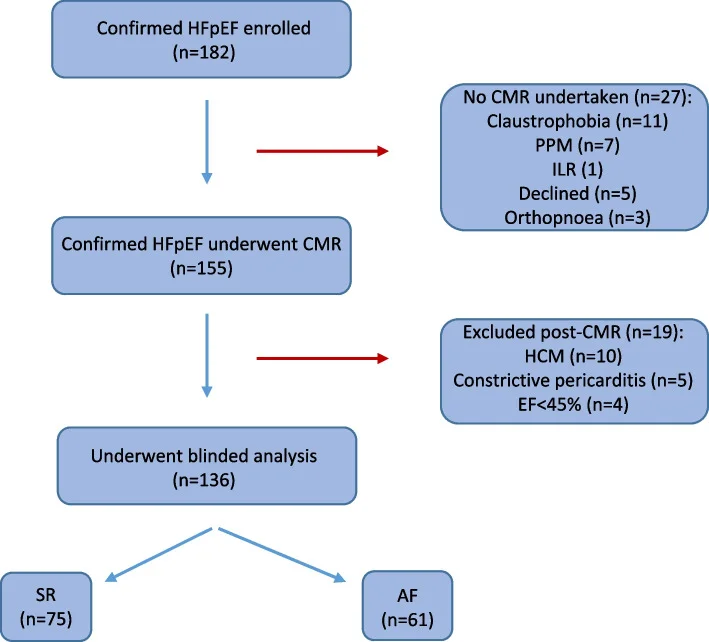
BMC Cardiovascular DisordersDattani et al.cohort
AF in HFpEF warrants no change in outcome expectations; hypothesis-generating for mechanics and biomarkers as intervention targets.
AJP Lung Cellular and Molecular PhysiologyEbert et al.Original Research
In this study, we confirmed protein expression differences in only a subset of predicted biomarkers from IPF and control subjects. Most differentially expressed proteins were predicted to be secreted from lung cells. However, a significant minority of the proteins are not known to be transcriptionally expressed by lung cells, suggesting an ongoing systemic response. The contributions of the systemic response in IPF may be important as new therapeutics are developed.
