RD
Ron Dagan
Pneumonia and Respiratory Infections
Ben-Gurion University of the Negev
About
Research focus
Pneumonia and Respiratory Infections
Impact
799 pubs · 31,583 cites · h-index 92
Affiliations
Publications
Original Research
SEP 11BiswasDiscover Applied Sciences
Determination of neutron radiation fields and exposure in geological repositories for high-level spent-fuel radioactive waste
Monte Carlo simulation study reveals elevated neutron dose rates at repository drift branches, indicating geometry strongly influences radiation shielding for nuclear waste workers.
Original Research
APR 2LevyThe Journal of Infectious Diseases
Is the Interplay Between Maternal Tdap and Pneumococcal Conjugate Vaccines Relevant to Infant Pneumococcal Carriage?
To The Editor—Maternal pertussis vaccination has been implemented for more than a decade in numerous countries and has demonstrated substantial benefits in preventing pertussis among young infants. In the absence of a monovalent pertussis vaccine, this strategy necessarily relies on combination vaccines that include diphtheria and tetanus toxoids in addition to the pertussis component. Early after implementation, maternal vaccination was shown to be associated with a transient reduction in the immunogenicity of infant vaccines sharing homologous antigens, a phenomenon commonly referred to as the “blunting effect” and related to levels of passively transferred maternal antibodies [1]. Multiple studies have confirmed reduced response to CRM197-conjugated pneumococcal conjugate vaccines (PCVs), deriving from the fact that CRM197 is a diphtheria toxoid mutant [2]. Importantly, no clinical impact of this reduced immunogenicity has been demonstrated, in terms of either pertussis and invasive pneumococcal diseases or nasopharyngeal carriage. A superficial reading of the article by Van den Bosch et al might suggest a clinically relevant negative consequence of maternal Tdap vaccination on pneumococcal carriage [3]. A careful examination of the data, however, does not support such an interpretation. Reanalysis of the data, pooling 2019 to 2021 as a transition period, yielded informative results (Table 1). Most differences between the Tdap and non-Tdap groups was confined to the period of high (94.6%) PCV10 coverage (serotype 6C, 15.2% vs 8.7% [P = .01], respectively; PCV13 serotypes, 32.1% vs 21.7% [P = .003]). In contrast, when PCV13 was widely used (2021–2022), differences were minimal and nonsignificant. Therefore, increasing the use of PCV13 corresponded to smaller differences between the Tdap and non-Tdap groups for PCV13 serotypes and serotype 6C. Most important, independent of maternal Tdap status, the introduction and use of PCV13 were associated with an approximately 3-fold reduction in the carriage of PCV13 serotypes (Tdap group, 32.1% vs 26.6% vs 10.9% [trend test, P < .0001]; non-Tdap group, 21.7% vs 24.0% vs 10.5% [trend test, P < .001]) [4]. These findings directly challenge the validity of the pooled analysis presented and raise serious concerns regarding the appropriateness of combining periods characterized by different PCVs. Furthermore, the reduced response in offspring of Tdap recipients is expected only with CRM197-conjugated PCVs. However, as we show, the main difference in carriage was during the almost exclusively PCV10 period. In PCV10, most vaccine serotypes are not conjugated to any diphtheria-associated antigen (except serotype 19F, for which no problem was shown in the current report); thus, no plausibility for interference with maternal Tdap can be argued.
Original Research
JAN 1RochmanEPJ Nuclear Sciences & Technologies
The 0E2 benchmarks for PWR UO 2 decay heat: an analysis from the NEA WPNCS
This paper presents the work performed in the subgroup 16 of the Working Party for Nuclear Criticality Safety (WPNCS) of the OECD Nuclear Energy Agency. The main goal was to define two decay heat benchmarks for Spent Nuclear Fuel (one pincell and one assembly), perform calculations and compare and analyze the results in light of existing calorimetric measurements. The selected case is the PWR UO 2 assembly 0E2, irradiated at the Ringhals-3 reactor and measured at the Clab facility in Sweden. In total, 21 institutes worldwide participated to the exercise, leading to 55 calculated results (named C ). It was found that the measured decay heat values ( E ) can be satisfactorily reproduced with two-dimensional assembly calculations, leading to an average C / E value of 0.99, with an uncertainty (or one standard deviation) of ±0.01.
Original Research
NOV 2025BeekOpen Forum Infectious Diseases
Differential Impact of Pneumococcal Conjugate Vaccines on Hospitalized Versus Outpatient Community-Acquired Alveolar Pneumonia in Children Younger Than 5 Years Suggests Differences in Pathogenesis
Background: Current evidence suggests that in young children with community-acquired alveolar pneumonia (CAAP), bacterial-viral coinfections (mostly respiratory syncytial virus [RSV]-pneumococcus coinfections) are more prevalent among hospitalized children than among outpatients and that RSV-pneumococcal coinfections are more frequently associated with non-PCV13 serotypes. Based on this background, we speculated that following pneumococcal conjugate vaccine [PCV] implementation, the decline of hospitalized CAAP episodes would be lower than that of outpatient episodes. Methods: This analysis was a part of an ongoing (since 2004) population-based, active surveillance in children < 5 years, including all CAAP visits to the pediatric emergency room in southern Israel. Community-acquired alveolar pneumonia was radiologically confirmed by consensus reading. Episodes were divided into hospitalized and those discharged without hospitalization (outpatients). We used a negative binomial regression model to evaluate PCV7/PCV13 impact by age and ethnic group using monthly and yearly incidence rates. Analyzed periods were pre-PCV (2004-2009), PCV7/PCV13 transition (2009-2011), early-PCV13 (2011-2015), and late-PCV13 (2015-2019). Results: Of 11 130 episodes, 3677 and 7633 were outpatients and hospitalized, respectively. Post-PCV incidence dynamics significantly diverged between the 2 study groups. (1) During the PCV7/PCV13 transition, outpatient rates significantly declined, but not those of hospitalizations. 2) During late-PCV13 period, a significantly greater decline was reached among outpatients (67%; 95% confidence interval [CI] 62%-71%) versus hospitalized (47%; 95% CI 41%-54%). This difference remained for all age and ethnic groups. Conclusions: The marked divergence in PCV impact between hospitalized and outpatient episodes is intriguing, but consistent with previous studies suggesting that hospitalized CAAP was associated with a lower proportion of PCV13 serotypes, in conjunction with viral-bacterial (mostly RSV-pneumococcus) coinfections.
Review
MAR 2025Carbonell‐EstranyExpert Review of Anti-infective Therapy
Twenty-five years of palivizumab: a global historic review of its impact on the burden of respiratory syncytial virus disease in children
Narrative review demonstrates the efficacy of palivizumab against respiratory syncytial virus in high-risk infants, highlighting the need for equitable access to next-generation preventives.
Cohort Study
MAR 2025DaganClinical Infectious Diseases
Decline in Community-Acquired Alveolar Pneumonia Positive for Respiratory Syncytial Virus in Hospitalized Children Following Implementation of Pneumococcal Conjugate Vaccine (PCV) in Israel
BACKGROUND: We assessed the impact of pneumococcal conjugate vaccine (PCV) implementation on respiratory syncytial virus-positive, community-acquired alveolar pneumonia (RSV-CAAP) in young children in southern Israel. METHODS: This study was nested within a prospective population-based active surveillance system during 2004-2019. All children <60 months old residing in the region and served by the region's only hospital were included. A negative binomial regression model was used to evaluate the impact of PCV on the incidence of all-cause CAAP and RSV-CAAP and was the basis for estimating averted episodes. RESULTS: A total of 7640 all-cause CAAP episodes were observed; 50% were tested for RSV, of which 42% were positive. Shortly after PCV13 implementation, all-cause CAAP and RSV-CAAP rates markedly declined, stabilizing within 3-4 years. The mean annual hospitalization rates for all-cause CAAP and RSV-CAAP declined by 47% (95% CI: 40%-53%) and 29% (95% CI: -2% to 51%), respectively, during the late-PCV period, compared with the expected rates. This translated to a reduction in the mean annual incidence of 3.73 cases of all-cause CAAP/1000 children (95% CI: 2.98-4.58) and 0.50 cases of RSV-CAAP per 1000 children (95% CI: -.05 to 1.13). The highest incidences of averted cases occurred in children aged 12-23 months. CONCLUSIONS: The observed dynamics of hospitalizations due to all-cause CAAP and RSV-CAAP following PCV implementation are consistent with the notion of a synergistic role of RSV and pneumococcus in CAAP in young children.
Original Research
FEB 2025WongThe Journal of Infectious Diseases
Estimating the Serotype-Specific Association Between the Concentration of Vaccine-Induced Serum Antibodies and Protection Against Pneumococcal Colonization
These findings suggest that while new PCVs might provide sufficient protection against disease, protection against transmission might be somewhat reduced for some serotypes. The overall impact should be evaluated in the local context, and further monitoring is critical to evaluate the impact of these changes in the coming years.
RCT
DEC 2024DaganClinical Infectious Diseases
Immune Response to the 13-Valent Pneumococcal Conjugate Vaccine Is Reduced in Infants Immunized During the Respiratory Viral Season
BACKGROUND: We hypothesized that response to infant pneumococcal conjugate vaccines (PCVs) administered during peak respiratory viral seasons (RVSs) could be blunted, particularly to higher carrier-load PCVs. METHODS: We conducted a post hoc analysis of a large, double-blind, randomized study comparing 13-valent vs 7-valent PCVs (PCV13, PCV7) administered to infants (at 2, 4, 6, and 12 months). We defined RVS, based on local epidemiology as December through April and non-RVS as June through October. Infants receiving the first dose at 7-9 weeks during the defined seasons were eligible. Serotype-specific immunoglobulin-G geometric mean concentrations (SSIgG-GMCs; µg/mL) were compared between the 2 seasons at age 7 and 13 months. RESULTS: 179 and 225 infants received PCV13 in RVS and non-RVS. The corresponding numbers for PCV7 were 188 and 217. At 7 months, PCV13 recipients during RVS had significantly lower SSIgG-GMCs compared with non-RVS for 10/13 serotypes (GMC ratios: 0.76-0.86). This difference remained significant in 2/13 serotypes after a booster dose. Unlike PCV13 recipients, PCV7 recipients showed no seasonal difference. Results were similar for both vaccine results among children who had received the first dose only or both the first and second dose during the defined seasons. Similarly, no difference was observed if the booster was given in RVS or non-RVS. CONCLUSIONS: Administration of the first PCV13 dose to young infants during RVS resulted in a significant blunting of the immune response, partially corrected by booster administration. PCV7 recipients were unaffected, suggesting an increased susceptibility to respiratory viral immune blunting with higher carrier-load PCVs.
Original Research
DEC 2024BennettThe Lancet Infectious Diseases
Global impact of ten-valent and 13-valent pneumococcal conjugate vaccines on invasive pneumococcal disease in all ages (the PSERENADE project): a global surveillance analysis
BACKGROUND: Pneumococcal conjugate vaccines (PCVs) that are ten-valent (PCV10) and 13-valent (PCV13) became available in 2010. We evaluated their global impact on invasive pneumococcal disease (IPD) incidence in all ages. METHODS: Serotype-specific IPD cases and population denominators were obtained directly from surveillance sites using PCV10 or PCV13 in their national immunisation programmes and with a primary series uptake of at least 50%. Annual incidence rate ratios (IRRs) were estimated comparing the incidence before any PCV with each year post-PCV10 or post-PCV13 introduction using Bayesian multi-level, mixed-effects Poisson regressions, by site and age group. All site-weighted average IRRs were estimated using linear mixed-effects regression, stratified by product and previous seven-valent PCV (PCV7) effect (none, moderate, or substantial). FINDINGS: Analyses included 32 PCV13 sites (488 758 cases) and 15 PCV10 sites (46 386 cases) in 30 countries, primarily high income (39 sites), using booster dose schedules (41 sites). By 6 years after PCV10 or PCV13 introduction, IPD due to PCV10-type serotypes and PCV10-related serotype 6A declined substantially for both products (age <5 years: 83-99% decline; ≥65 years: 54-96% decline). PCV7-related serotype 19A increases before PCV10 or PCV13 introduction were reversed at PCV13 sites (age <5 years: 61-79% decline relative to before any PCV; age ≥65 years: 7-26% decline) but increased at PCV10 sites (age <5 years: 1·6-2·3-fold; age ≥65 years: 3·6-4·9-fold). Serotype 3 IRRs had no consistent trends for either product or age group. Non-PCV13-type IPD increased similarly for both products (age <5 years: 2·3-3·3-fold; age ≥65 years: 1·7-2·3-fold). Despite different serotype 19A trends, all-serotype IPD declined similarly between products among children younger than 5 years (58-74%); among adults aged 65 years or older, declines were greater at PCV13 (25-29%) than PCV10 (4-14%) sites, but other differences between sites precluded attribution to product. INTERPRETATION: Long-term use of PCV10 or PCV13 reduced IPD substantially in young children and more moderately in older ages. Non-vaccine-type serotypes increased approximately two-fold to three-fold by 6 years after introduction of PCV10 or PCV13. Continuing serotype 19A increases at PCV10 sites and declines at PCV13 sites suggest that PCV13 use would further reduce IPD at PCV10 sites.
Original Research
DEC 2024QuesadaThe Lancet Infectious Diseases
Serotype distribution of remaining invasive pneumococcal disease after extensive use of ten-valent and 13-valent pneumococcal conjugate vaccines (the PSERENADE project): a global surveillance analysis
BACKGROUND: Widespread use of pneumococcal conjugate vaccines (PCVs) has reduced vaccine-type invasive pneumococcal disease (IPD). We describe the serotype distribution of IPD after extensive use of ten-valent PCV (PCV10; Synflorix, GSK) and 13-valent PCV (PCV13; Prevenar 13, Pfizer) globally. METHODS: IPD data were obtained from surveillance sites participating in the WHO-commissioned Pneumococcal Serotype Replacement and Distribution Estimation (PSERENADE) project that exclusively used PCV10 or PCV13 (hereafter PCV10 and PCV13 sites, respectively) in their national immunisation programmes and had primary series uptake of at least 70%. Serotype distribution was estimated for IPD cases occurring 5 years or more after PCV10 or PCV13 introduction (ie, the mature period when the serotype distribution had stabilised) using multinomial Dirichlet regression, stratified by PCV product and age group (<5 years, 5-17 years, 18-49 years, and ≥50 years). FINDINGS: The analysis included cases occurring primarily between 2015 and 2018 from 42 PCV13 sites (63 362 cases) and 12 PCV10 sites (6806 cases) in 41 countries. Sites were mostly high income (36 [67%] of 54) and used three-dose or four-dose booster schedules (44 [81%]). At PCV10 sites, PCV10 serotypes caused 10·0% (95% CI 6·3-12·9) of IPD cases in children younger than 5 years and 15·5% (13·4-19·3) of cases in adults aged 50 years or older, while PCV13 serotypes caused 52·1% (49·2-65·4) and 45·6% (40·0-50·0), respectively. At PCV13 sites, PCV13 serotypes caused 26·4% (21·3-30·0) of IPD cases in children younger than 5 years and 29·5% (27·5-33·0) of cases in adults aged 50 years or older. The leading serotype at PCV10 sites was 19A in children younger than 5 years (30·6% [95% CI 18·2-43·1]) and adults aged 50 years or older (14·8% [11·9-17·8]). Serotype 3 was a top-ranked serotype, causing about 9% of cases in children younger than 5 years and 14% in adults aged 50 years or older at both PCV10 and PCV13 sites. Across all age and PCV10 or PCV13 strata, the proportion of IPD targeted by higher-valency PCVs beyond PCV13 was 4·1-9·7% for PCV15, 13·5-36·0% for PCV20, 29·9-53·8% for PCV21, 15·6-42·0% for PCV24, and 31·5-50·1% for PCV25. All top-ten ranked non-PCV13 serotypes are included in at least one higher-valency PCV. INTERPRETATION: The proportion of IPD due to serotypes included in PCVs in use was low in mature PCV10 and PCV13 settings. Serotype distribution differed between PCV10 and PCV13 sites and age groups. Higher-valency PCVs target most remaining IPD and are expected to extend impact.
RCT
DEC 2024ArbetterClinical Infectious Diseases
Lower Respiratory Tract Infections Following Respiratory Syncytial Virus Monoclonal Antibody Nirsevimab Immunization Versus Placebo: Analysis From a Phase 3 Randomized Clinical Trial (MELODY)
Nirsevimab protected against RSV single and coinfections, with no evidence of replacement of RSV with other respiratory viruses. Clinical Trials Registration. NCT03979313.
Randomized Controlled Trial
OCT 2024WongYale University
Estimating the serotype-specific association between the concentration of vaccine-induced serum antibodies and protection against pneumococcal colonization
Background Pneumococcal conjugate vaccines (PCVs) offer indirect protection by reducing pneumococcal colonization in the vaccinated children and thus transmission. As higher-valency PCVs may trigger a weaker immune response, it is important to understand how differences in immunogenicity between PCVs translate to effectiveness against colonization. Methods We estimated the serotype-specific relationship between the concentration of vaccine-induced serum immunoglobulin G (IgG) and protection against colonization using a hierarchical Bayesian model with the longitudinal data from a randomized controlled trial in Israel. Then, we combined these estimates with the summary-level immunogenicity data (geometric mean concentration and 95% confidence intervals) from head-to-head clinical trials comparing PCV13 vs. PCV7, PCV 15 vs. PCV13, and PCV20 vs. PCV13 to infer the relative effectiveness of higher-valency PCVs against colonization. Results The hierarchical Bayesian model predicted that the risk of colonization increased as serum IgG decreased, and the association differed by serotype. Our approach estimated higher-valency PCVs to have lower vaccine effectiveness against colonization with some serotypes: 14 and 23F across comparisons; 4 when comparing PCV13 with PCV7 and comparing PCV20 with PCV13; 5, 6A, 6B 7F, 19A, and 19F when comparing PCV15 and PCV20 with PCV13, and additionally 1, 9V and 18C when comparing PCV20 with PCV13. Conclusions These findings suggest that while new PCVs might provide sufficient protection against severe disease, protection against transmission might be somewhat reduced for some serotypes. The overall impact should be evaluated in the local context and further monitoring is critical to evaluate the impact of these changes in the coming years.
Original Research
JUL 2024BelmanNature
Geographical migration and fitness dynamics of Streptococcus pneumoniae
Genomic modeling reveals slow spread and post-vaccine fitness gains of non-vaccine Streptococcus pneumoniae in South Africa, indicating transient antimicrobial resistance declines.
Original Research
JUN 2024ChengMicrobial Genomics
Estimating geographical spread of Streptococcus pneumoniae within Israel using genomic data
Understanding how pathogens spread across geographical space is fundamental for control measures such as vaccination. Streptococcus pneumoniae (the pneumococcus) is a respiratory bacterium responsible for a large proportion of infectious disease morbidity and mortality globally. Even in the post-vaccination era, the rates of invasive pneumococcal disease (IPD) remain stable in most countries, including Israel. To understand the geographical spread of the pneumococcus in Israel, we analysed 1174 pneumococcal genomes from patients with IPD across multiple regions. We included the evolutionary distance between pairs of isolates inferred using whole-genome data within a relative risk (RR) ratio framework to capture the geographical structure of S. pneumoniae . While we could not find geographical structure at the overall lineage level, the extra granularity provided by whole-genome sequence data showed that it takes approximately 5 years for invasive pneumococcal isolates to become fully mixed across the country. This article contains data hosted by Microreact.
Human Clinical Trial
JAN 2024DaganJournal of the Pediatric Infectious Diseases Society
Infants Receiving a Single Dose of Nirsevimab to Prevent RSV Do Not Have Evidence of Enhanced Disease in Their Second RSV Season
To characterize nirsevimab in the prevention of RSV, children from the Phase 3 MELODY trial were followed through their second RSV season. No increase in medically attended RSV lower respiratory tract infections or evidence of antibody-dependent enhancement of infection or disease severity was found for nirsevimab vs placebo recipients. Clinical Trial Registration: Clinicaltrials.gov, NCT03979313, https://clinicaltrials.gov/ct2/show/NCT03979313.
Review
JAN 2024RochmanEPJ Nuclear Sciences & Technologies
An introduction to Spent Nuclear Fuel decay heat for Light Water Reactors: a review from the NEA WPNCS
This paper summarized the efforts performed to understand decay heat estimation from existing spent nuclear fuel (SNF), under the auspices of the Working Party on Nuclear Criticality Safety (WPNCS) of the OECD Nuclear Energy Agency. Needs for precise estimations are related to safety, cost, and optimization of SNF handling, storage, and repository. The physical origins of decay heat (a more correct denomination would be decay power ) are then introduced, to identify its main contributors (fission products and actinides) and time-dependent evolution. Due to limited absolute prediction capabilities, experimental information is crucial; measurement facilities and methods are then presented, highlighting both their relevance and our need for maintaining the unique current full-scale facility and developing new ones. The third part of this report is dedicated to the computational aspect of the decay heat estimation: calculation methods, codes, and validation. Different approaches and implementations currently exist for these three aspects, directly impacting our capabilities to predict decay heat and to inform decision-makers. Finally, recommendations from the expert community are proposed, potentially guiding future experimental and computational developments. One of the most important outcomes of this work is the consensus among participants on the need to reduce biases and uncertainties for the estimated SNF decay heat. If it is agreed that uncertainties (being one standard deviation) are on average small (less than a few percent), they still substantially impact various applications when one needs to consider up to three standard deviations, thus covering more than 95% of cases. The second main finding is the need of new decay heat measurements and validation for cases corresponding to more modern fuel characteristics: higher initial enrichment, higher average burnup, as well as shorter and longer cooling time. Similar needs exist for fuel types without public experimental data, such as MOX, VVER, or CANDU fuels. A third outcome is related to SNF assemblies for which no direct validation can be performed, representing the vast majority of cases (due to the large number of SNF assemblies currently stored, or too short or too long cooling periods of interest). A few solutions are possible, depending on the application. For the final repository, systematic measurements of quantities related to decay heat can be performed, such as neutron or gamma emission. This would provide indications of the SNF decay heat at the time of encapsulation. For other applications (short- or long-term cooling), the community would benefit from applying consistent and accepted recommendations on calculation methods, for both decay heat and uncertainties. This would improve the understanding of the results and make comparisons easier.
Original Research
AUG 2023DaninoInternational Journal of Infectious Diseases
The impact of pneumococcal conjugate vaccine on ceftriaxone consumption in the community among young children
OBJECTIVES: Following pneumococcal conjugate vaccine (PCV) introduction, community pediatric dispensed prescription rates (DPR) of oral antibiotics declined, in parallel to respiratory tract infection (RTI). We assessed the dynamics of outpatient parenteral ceftriaxone DPR. METHODS: Computerized data for children <5 years were examined during 13 years (including 4 pre-PCV years). DPR from clinics with ≥50 insured children, active both before and after PCV implementation were included. Interrupted time series with segmented regression stratified by age and ethnicity, and adjusted for seasonality was applied to show monthly DPR trends. RESULTS: A total of 29,226 prescriptions were dispensed. No significant trends in ceftriaxone DPR were seen pre-PCV. Shortly after PCV implementation, DPR abruptly and significantly declined, stabilizing in late-PCV period (5 years postimplementation). The dynamics were compared between the two ethnic groups in the region, Jewish and Bedouin children (the latter with higher crowding and respiratory disease rates). Among Jewish children, ceftriaxone was mainly dispensed during winter vs no seasonality among Bedouin children. CONCLUSIONS: In southern Israel, outpatient ceftriaxone DPR declined post-PCV in young children, similar to the trends of RTIs and oral antibiotic prescriptions, suggesting a causative role of PCVs. The differences between the two ethnic groups suggest possible involvement of additional factors.
RCT
JUL 2023AhaniNature Communications
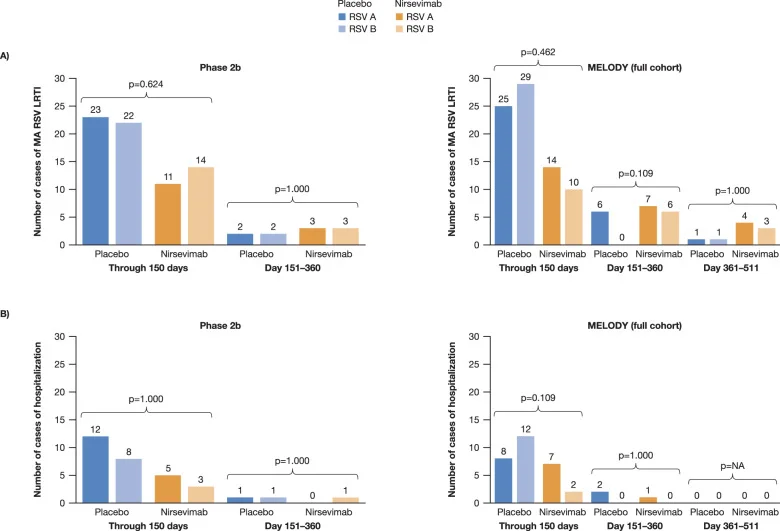
>99% of RSV isolates from the Phase 2b and MELODY trials retained susceptibility to nirsevimab, with resistance-associated binding site substitutions being rare.
Supports nirsevimab use in infants without resistance concerns; confirms high barrier to RSV escape in RCTs.
Cohort Study
JUN 2023Ben‐ShimolEurosurveillance
Dynamics of invasive pneumococcal disease in infants < 2 years old following PCV7/13 implementation using two infant and a booster dose schedule: evidence for indirect protection of young infants, Israel, 2004 to 2019
BackgroundPneumococcal conjugated vaccine (PCV)7 and PCV13 programmes started in Israel from July 2009 and November 2010 respectively, with a 2+1 schedule (one dose at 2 months old, one at 4 months old, and a booster dose at 12 months old). Thereafter, invasive pneumococcal disease (IPD) rates substantially declined in children. Uptake of all three doses in < 2-year-olds since 2012 is > 90%. For still incompletely vaccinated infants (≤ 12 months old), how well the PCV 2+1 programme shields from IPD is not fully resolved.AimTo assess the adequacy of protection conferred by the 2+1 schedule PCV vaccination programme, particularly among incompletely-vaccinated infants.MethodsThis was a population-based, prospective, nationwide active IPD surveillance study in Israel, 2004-2019, in children < 24 months old. We estimated annual incidence rates (IR) of overall IPD, IPD caused by PCV13 serotypes (VT13), and non-PCV13 serotypes (NVT13). Annual IPD IRs were stratified by age: < 4 months (receiving ≤ 1 dose), 4-6 months (immediately post dose 2), 7-12 months (a few months post dose 2), and 13-23 months (post dose 3). Late-PCV (2004-2008) to pre-PCV13 (2016-2019) mean annual IR ratios (IRRs) were calculated.Results2,569 IPD episodes were recorded. VT13 decreased > 90% in all age groups, while NVT13 seemed to increase. All-IPD rates declined in all age groups by 56-70%. The 2+1 schedule impact on 7-12-month-old infants (pre-booster) was similar to that on 13-23-month-old children (post booster), with PCV13 IPD reductions of 97% and 98%, respectively.ConclusionsIndirect (herd) protection of infants, including < 4 month-olds with ≤ 1 PCV dose, was achieved by the 2+1 PCV schedule programme which thus seems adequate.
RCT
JUN 2023WilckClinical Infectious Diseases
A Phase 3, Randomized, Double-Blind, Comparator-Controlled Study to Evaluate Safety, Tolerability, and Immunogenicity of V114, a 15-Valent Pneumococcal Conjugate Vaccine, in Allogeneic Hematopoietic Cell Transplant Recipients (PNEU-STEM)
BACKGROUND: Individuals who receive allogeneic hematopoietic cell transplant (allo-HCT) are immunocompromised and at high risk of pneumococcal infections, especially in the months following transplant. This study evaluated the safety and immunogenicity of V114 (VAXNEUVANCE; Merck, Sharp & Dohme LLC, a subsidiary of Merck & Co., Inc., Rahway, NJ, USA), a 15-valent pneumococcal conjugate vaccine (PCV), when given to allo-HCT recipients. METHODS: Participants received 3 doses of V114 or PCV13 (Prevnar 13; Wyeth LLC) in 1-month intervals starting 3-6 months after allo-HCT. Twelve months after HCT, participants received either PNEUMOVAX 23 or a fourth dose of PCV (if they experienced chronic graft vs host disease). Safety was evaluated as the proportion of participants with adverse events (AEs). Immunogenicity was evaluated by measuring serotype-specific immunoglobulin G (IgG) geometric mean concentrations (GMCs) and opsonophagocytic activity (OPA) geometric mean titers (GMTs) for all V114 serotypes in each vaccination group. RESULTS: A total of 274 participants were enrolled and vaccinated in the study. The proportions of participants with AEs and serious AEs were generally comparable between intervention groups, and the majority of AEs in both groups were of short duration and mild-to-moderate intensity. For both IgG GMCs and OPA GMTs, V114 was generally comparable to PCV13 for the 13 shared serotypes, and higher for serotypes 22F and 33F at day 90. CONCLUSIONS: V114 was well tolerated in allo-HCT recipients, with a generally comparable safety profile to PCV13. V114 induced comparable immune responses to PCV13 for the 13 shared serotypes, and was higher for V114 serotypes 22F and 33F. Study results support the use of V114 in allo-HCT recipients. Clinical Trials Registration. clinicaltrials.gov (NCT03565900) and European Union at EudraCT 2018-000066-11.