
Journal of clinical lipidologyRazavi et al.Original Research

Seth S. Martin
General / Preventive / Lipids
Johns Hopkins University
About
Seth S. Martin works in General / Preventive / Lipids affiliated with Johns Hopkins University.
Seth S. Martin, MD, MHS, is a Professor of Medicine in the Division of Cardiology at the Johns Hopkins University School of Medicine. He directs the Advanced Lipid Disorders Program and Digital Health Lab at the Ciccarone Center for the Prevention of Cardiovascular Disease and is an attending cardiologist at The Johns Hopkins Hospital. His work includes development of an improved LDL cholesterol estimation algorithm that has been adopted in professional guidelines.
Research focus
Preventive cardiologyLipidology and LDL cholesterol estimation (Martin-Hopkins equation)Digital and mobile health (mHealth)Cardiovascular risk assessmentHealth equity in cardiovascular care
Impact
663 pubs · 58,807 cites · h-index 75
Training
MHS
Johns Hopkins Bloomberg School of Public Health
2015
MD
University of Pennsylvania Perelman School of Medicine
2008
BS
Washington and Lee University
2004
Affiliations
Work Experience
Professor of Medicine, Division of Cardiology
Johns Hopkins University School of Medicine · 2015 - Present
Director, Advanced Lipid Disorders Program and Digital Health Lab, Ciccarone Center for the Prevention of Cardiovascular Disease
Johns Hopkins Medicine · 2015 - Present
Cardiology Fellow
Johns Hopkins University School of Medicine · 2011 - 2015
Internal Medicine Resident
Duke University Hospital · 2008 - 2011
Publications
ObesityZahid et al.Retrospective Study
Wearable‐Derived Physical Activity Patterns in Preclinical and Clinical Obesity
Objective The Lancet Diabetes & Endocrinology Commission issued a new obesity definition to move beyond BMI and prioritize excess body fat and dysfunctional adiposity, stratified by preclinical and clinical groups. We evaluated the physical activity patterns across obesity groups with wearable‐derived accelerometry and risk for cardiovascular disease. Methods We performed a retrospective cohort analysis of step count, moderate‐to‐vigorous exercise, and sedentary time in 24,679 adults with Fitbit and electronic health records from the All of Us Research Program, stratified by no, preclinical, and clinical obesity groups. Results There was a decline in physical activity across obesity groups: median daily steps were 7846, 6702, and 5128, weekly moderate‐to‐vigorous physical activity exercise 140, 91, and 35 min; and daily sedentary time 12.2, 12.8, and 13.4 h for no, preclinical, and clinical obesity, respectively. Physical activity decreased with BMI and obesity‐related multimorbidity. Conclusions Wearable‐derived physical activity patterns show distinct patterns for preclinical and clinical obesity.
Circ: Heart Failure
@circhf
📌Sim Pub w/ #ScientificSessions26: Can digital health accelerate GDMT optimization? Randomized ENGAGE-HF trial shows improved #GDMT optimization at 90 days: 83.7% vs 74.0% (P=0.010) Greater uptake of MRAs & SGLT2 inhibitors A promising approach to post-discharge HF care
A Multicenter Randomized Controlled Trial of a Digital Health Intervention for Medication Optimization in Heart Failure: The ENGAGE-HF Trial Outcomes
Circulation Heart FailureDorsch et al.
CirculationPeng et al.Original Research
Prevalence of Apolipoprotein B and LDL Cholesterol Discordance: Insights From the VLDbL and NHANES

Emelia J. Benjamin
General / Preventive / Lipids · Semmelweis University
We're becoming more and more aware of the importance of high blood pressure. Levels we used to think were normal we now associate with worse outcomes, and treating them makes a big difference.
Heart Disease and Stroke Statistics—2019 Update: A Report From the American Heart Association
CirculationBenjamin et al.
JACCMartin et al.cross-sectional

AnswersChallenges guidelines
Does Friedewald-estimated LDL-C accurately reflect directly measured LDL-C in adults, particularly at levels <70 mg/dl?
Friedewald underestimates LDL-C versus direct measurement, misclassifying ~23% of patients with estimated levels </dl.
The Friedewald equation frequently underestimates LDL-C at levels <70 mg/dl, especially when triglycerides are ≥ 150 mg/dl, suggesting direct measurement may be necessary in high-risk patients.
JACCMartin et al.review
Leptin resistance emerges as a potential diagnostic and therapeutic target in obesity-related CVD.
Leptin resistance is a complex pathophysiological phenomenon linking obesity, inflammation, and insulin resistance to cardiovascular disease, representing a potential therapeutic target.

Paul M. Ridker
General / Preventive / Lipids · Brigham and Women's Hospital
The ACC 2025 Scientific Statement is important both for clinicians and for evolving guidelines. Crucially, doctors will not treat what they do not measure and the scientific statement clearly and concisely calls for near universal hsCRP screening in both primary and secondary prevention.
High-Sensitivity C-Reactive Protein and Cardiovascular Disease
Journal of the American College of CardiologyYousuf et al.
Arteriosclerosis Thrombosis and Vascular BiologySpaulding et al.review
AnswersConfirms guidelines
Does healthy sleep reduce the risk of heart disease and stroke in adults?
Healthy multidimensional sleep associates with reduced heart disease and stroke risk across current assessments.
This review highlights the importance of multidimensional sleep components as a key health behavior for cardiovascular disease prevention, aligning with the AHA's Life's Essential 8.
SHILAP Revista de lepidopterologíaFiltz et al.review

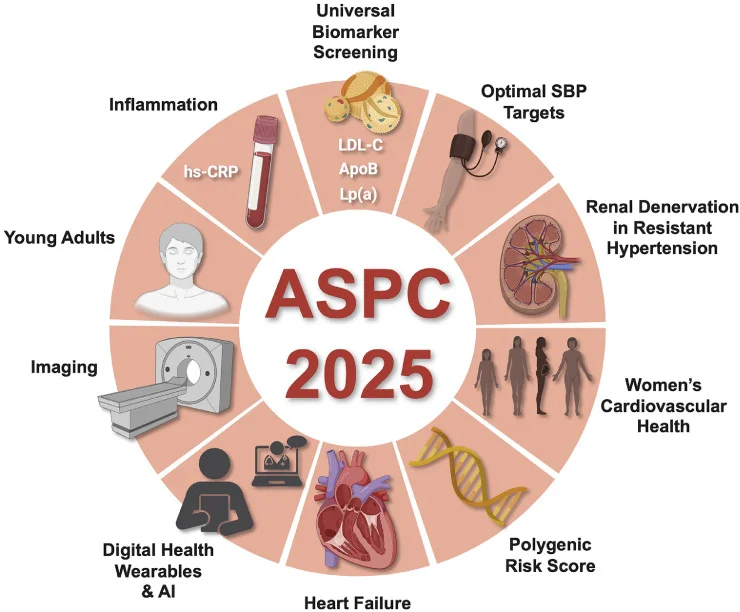
ASPC 2025 highlights evolving CVD prevention via precision risk stratification, digital tools, and novel therapies.
Evolving prevention strategies warrant clinician awareness; leaves open prospective validation before routine integration.
American Journal of Preventive CardiologyJones et al.Original Research
LATTICE consortium launches to accelerate evidence-based cardiometabolic therapies into diverse clinical practice settings.
The LATTICE consortium was established to accelerate the implementation of evidence-based cardiometabolic therapies into clinical practice.
Journal of the American Heart AssociationOanesa et al.Original Research
Human‐Centered Design to Tailor Telehealth Cardiac Rehabilitation to Diverse Populations: The MCNAIR Study
The study demonstrates the effectiveness of human-centered design in creating a telehealth cardiac rehabilitation program, suggesting improved access for diverse populations.
Journal of General Internal MedicineAlexander et al.cross-sectional
AnswersConfirms guidelines
Does full implementation of US and European lipid-lowering guidelines improve projected LDL-C and cardiovascular outcomes in US adults compared to current practice?
Full guideline-directed lipid-lowering implementation could reduce major cardiovascular events by ~24%.
Full implementation of US and European lipid-lowering guidelines in the US population could yield an additional median LDL-C reduction of up to 48.5 mg/dL and a 21-27% relative reduction in major cardiovascular events.
Journal of the American Heart AssociationKing et al.cohort
Answers
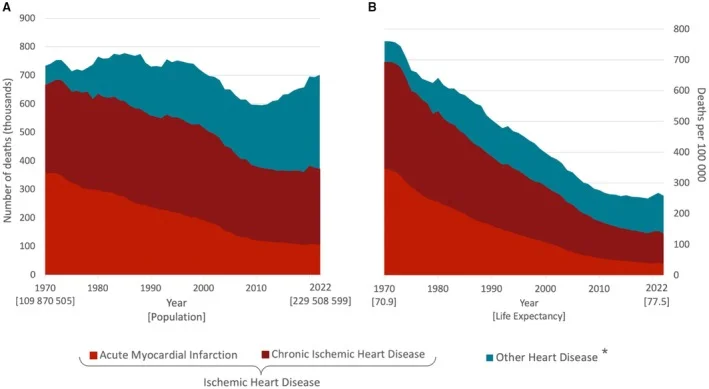
What are the long-term trends in heart disease mortality in the United States from 1970 to 2022?
Overall heart disease mortality falls ~66% from 1970 to 2022 despite increases in other subtypes.
Rising nonischemic heart disease mortality despite overall decline warrants targeted investigation; extends 5-decade observational trends.
JACC AdvancesRazavi et al.cross-sectional
Black adults show ~32% lower odds of Lp(a) testing compared to White adults.
The prevalence of guideline-recommended Lipoprotein(a) testing in the US is extremely low (0.8%), with significant racial and socioeconomic disparities highlighting the need for equitable testing expansion.
Annals of Internal MedicineBeavers et al.Guideline

Answers
Does statin therapy prevent ASCVD in people with HIV?
Statin Therapy as Primary Prevention for Persons With HIV: A Synopsis of Recommendations From the U.S. Department of Health and Human Services Antiretroviral Treatment Guidelines Panel
Prompts statin initiation for PWH at ASCVD risk ≥5%; extends primary prevention guidelines to this higher-risk population.
Scientific ReportsXie et al.cross-sectional
Answers
What are the reasons for non-acceptance of statin therapy in patients at high cardiovascular risk?
Lifestyle preference drives ~52% of statin refusals among high-risk patients.
Patient reluctance to initiate statin therapy is primarily driven by preference for lifestyle modifications, aversion to medications, polypharmacy burden, and fear of adverse reactions, which are often linked to past medical experiences.
JAMA CardiolConnolly et al.editorial
Answers
What reimbursement reforms are required to facilitate digital health adoption in cardiovascular care?
Reimbursement reform is essential to support the adoption of digital health innovations in cardiovascular care delivery.
Reimbursement reform is essential to support the adoption of digital health innovations in cardiovascular care.
Journal of the American Heart AssociationShah et al.cohort
AnswersConfirms guidelines
Does delayed statin acceptance increase the risk of myocardial infarction and ischemic stroke in adults with diabetes and no preexisting ASCVD?
Delaying statin therapy in diabetes is linked to higher CV risk, mediated by elevated LDL-C.
Delaying statin therapy in patients with diabetes significantly increases the risk of myocardial infarction and ischemic stroke, mediated by higher LDL cholesterol exposure.
Diabetes CareKazé et al.cohort
Answers
Does increased visit-to-visit variability in lipid levels increase the risk of incident heart failure in adults with type 2 diabetes?
High total cholesterol variability is linked to ~68% higher incident HF risk in diabetes.
Increased visit-to-visit variability in lipid levels is independently associated with a higher risk of incident heart failure in patients with type 2 diabetes.