March 1, 2026European Heart Journal Supplements
Clinical predictors of pulmonary hypertension at 1 year follow-up after pulmonary embolism treated by catheter-directed therapies
Key result
Baseline sPAP >60 mmHg and prior DVT strongly predict residual pulmonary hypertension after PE catheter therapy.
- aOR 12.20
- aOR 12.66
Key Points
- The goal is to identify 1-year predictors of pulmonary hypertension in patients treated with transcatheter interventions.
- Analyzed data from 135 patients with pulmonary embolism treated via percutaneous methods.
- Measured systolic pulmonary artery pressure at follow-up to define residual pulmonary hypertension.
- Used logistic regression to determine independent predictors of pulmonary hypertension.
- Residual pulmonary hypertension occurred in 11.1% of the patients at 1-year follow-up.
- Higher baseline pulmonary artery pressure and prior deep-vein thrombosis were significant predictors.
- Bilateral principal involvement in thrombus location was linked to lower odds of residual hypertension.
Structured PICO
P
Population
135 patients with pulmonary embolism treated with percutaneous therapy (from the USAT IH-PE Registry) who had echocardiographic follow-up available at 1 year
I
Intervention
Percutaneous therapy (catheter-directed transcatheter intervention)
O
Outcome
Residual pulmonary hypertension, defined as systolic pulmonary artery pressure (sPAP) >40 mmHg at ≈1 yearsurrogate
Severe baseline pulmonary hypertension and prior deep-vein thrombosis are strong independent predictors of residual pulmonary hypertension at 1 year in patients treated with percutaneous therapy for pulmonary embolism.
Implication
May warrant closer surveillance after catheter-directed PE therapy; hypothesis-generating pending larger prospective validation.
Abstract
Introduction Residual pulmonary hypertension (PH) after pulmonary embolism (PE) impairs functional recovery and survival. Among patients treated with percutaneous therapy, determinants of late PH are insufficiently characterized. We aimed to identify 1-year predictors of PH in a cohort treated with transcatheter intervention. Methods and Results Out of the 275 PE patients undergoing percutaneous treatment enrolled in the USAT IH-PE Registry, echocardiographic follow-up was available in 135. The primary endpoint was residual PH, defined as systolic pulmonary artery pressure (sPAP) >40 mmHg at ≈1 year, which occurred in 15/135 (11.1%). On univariable analyses, baseline sPAP >60 mmHg (30.8% vs 8.2%; p=0.014), prior deep-vein thrombosis (25.0% vs 8.2%; p=0.018), prior PE (30.0% vs 9.6%; p=0.048), and need for non-invasive ventilation (26.7% vs 9.5%; p=0.049) were associated with the endpoint; thrombus location across bilateral principal, bilateral lobar, and unilateral principal was related (p=0.017). Multivariable logistic regression identified baseline sPAP >60 mmHg (adjusted odds ratio [aOR] 12.20, 95% CI 1.73–85.98; p=0.012) and prior deep-vein thrombosis (aOR 12.66, 95% CI 1.53–104.61; p=0.018) as independent predictors. Bilateral principal involvement was associated with lower odds (aOR 0.092; p=0.029). Conclusions In PE patients after percutaneous therapy, severe baseline PH and prior venous thromboembolism identify high risk of 1-year residual PH.
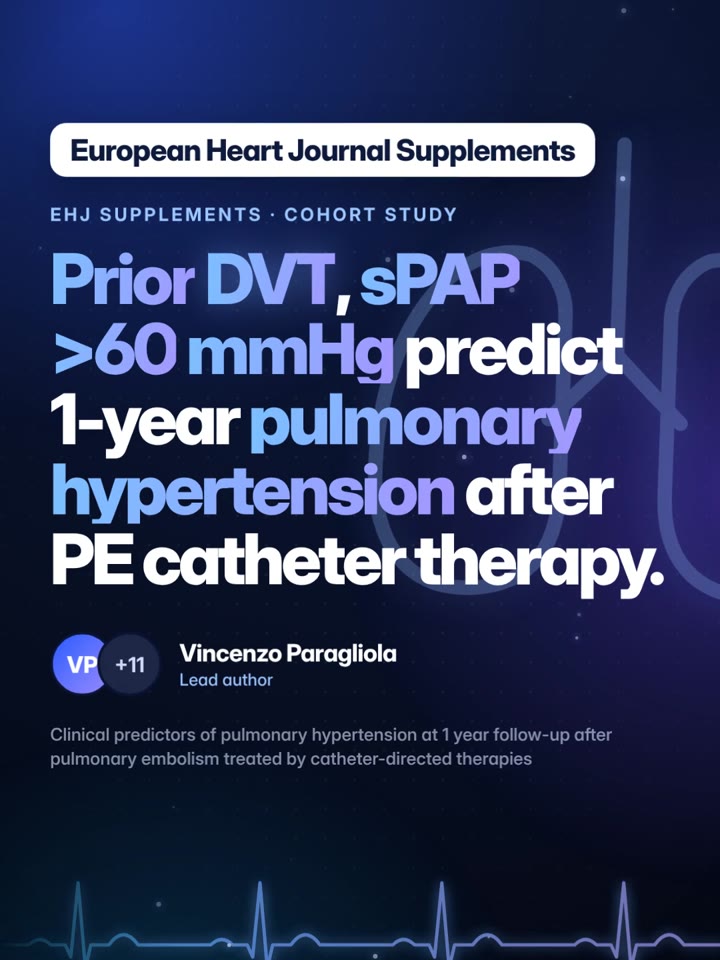
EHJ Supplements · cohort study. Prior DVT, sPAP >60 mmHg predict 1-year pulmonary hypertension after PE catheter therapy. Clinical predictors of pulmonary hypertension at 1 year follow-up after pulmonary embolism treated by catheter-directed therapies 135 patients: PE patients treated with catheter-directed therapy. How the registry cohort was followed: Pulmonary embolism → Catheter-directed therapy → Echo at 1 year → sPAP >40 mmHg. 11.1% of patients: Had residual pulmonary hypertension at 1 year. 12.66 aOR with prior DVT. Baseline sPAP >60 mmHg: aOR 12.20. Bottom line: May warrant closer surveillance; hypothesis-generating pending larger prospective validation.
Discussion
No takes yet. Share an insight, caveat, or question.
Cite This Study
Paragliola et al. (2026) studied this question. Baseline sPAP >60 mmHg (aOR 12.20) and prior deep-vein thrombosis (aOR 12.66) independently predict 1-year residual pulmonary hypertension after catheter therapy for pulmonary embolism.