This research is Trending!
Dapagliflozin and Acute Kidney Injury Following Cardiac Surgery
Maartina J P Oosterom-EijmaelAbraham H. HulstNelson P. Monteiro de OliveiraEd D. NiestenNicobert E. WietsmaBastiaan M. GerritseThierry V. ScohyThijs C. D. RettigFerdinand T. F. SnellenMagiel F VoogdMarc B. GodfriedRients N. de BoerJeroen WinkLisa M. M. van der WerffChrista M. CobbaertL. Renee RuhaakSusanne EberlBenedikt PreckelMarkus W. HollmannJimmy SchenkJeroen HermanidesDaniel van RaalteMERCURI-2 Study GroupTahira El BenhajiCatherine SC BoumanEline F. BruggemansNaomi ChenThomas GV CherpanathGiel CoxMarcel G DijkgraafNimrat GrewalHilde HerremaNathalie J. HuizingYvonne JordensRobert JM KlautzLars G. KnaapWil G KopatzNardo J. M. van der MeerMarcella CA MüllerAbigail J MurrayAlice C PapFrederique PaulusGabriela L PietersJorinde AW PoldermanMerlijn ReijrinkAbby RoestCato SchmitzYouri SchutLars IP SnelNick G SteijnAyla Y. StobbeHajar TaârnitLuuk T TegelMaaike SY ThioDivya PR TikaMartijn TolsmaImran UddinDenise P VeeloMichelle VerhagenAlexander PJ VlaarHenrico JFT Wesselink
Key result
Dapagliflozin before elective cardiac surgery reduces 7-day AKI ~46% versus placebo.
- RR 0.54
- 95% CI 0.45-0.65
- P<.001
- n=784
Why the study?
Postoperative acute kidney injury frequently affects patients undergoing elective cardiac surgery, but medications to prevent it have not been identified.
Does dapagliflozin reduce the incidence of acute kidney injury in adults undergoing elective cardiac surgery?
Key Points
- This trial aims to determine if dapagliflozin reduces acute kidney injury in patients undergoing elective cardiac surgery.
- Multicenter, double-blind, placebo-controlled randomized clinical trial
- Participants were adults undergoing elective cardiac surgery, randomized 1:1 to dapagliflozin or placebo
- Follow-up conducted for 7 days post-surgery to assess AKI incidence.
- Dapagliflozin reduced AKI incidence to 28% compared to 52% in placebo group (relative risk 0.54 [95% CI, 0.45-0.65]; P < .001)
- 96% of participants completed the follow-up and median age was 68 years
- Adverse events included atrial fibrillation (45% in both groups) and reoperation (11% dapagliflozin vs 10% placebo).
Study Design
Type
RCT (n=784)
Blinding
Double-blind
Randomization
1:1
Multicenter
Yes
Structured PICO
Does dapagliflozin reduce the incidence of acute kidney injury in adults undergoing elective cardiac surgery?
P
Population
784 adults (median age 68, 76% male) undergoing elective cardiac surgery, followed for 7 days postoperatively.
I
Intervention
Dapagliflozin 10 mg orally once daily, beginning the day before surgery and continuing through the second postoperative day (total of 4 doses).
C
Comparator
Placebo once daily, beginning the day before surgery and continuing through the second postoperative day (total of 4 doses).
O
Outcome
Incidence of acute kidney injury (AKI) defined by KDIGO criteria (increase in serum creatinine level by at least 0.3 mg/dL [26.5 µmol/L] within 48 hours after surgery, a 1.5-fold creatinine increase within 7 days of surgery, or urine output less than 0.5 mL/kg/h for 6 to 12 hours) during the first 7 postoperative days.composite
Main Result
Relative Risk: 0.54 (95% CI 0.45–0.65)
Absolute Event Rate: 28% vs 52%
p-value: p=<.001
A short perioperative 4-dose course of dapagliflozin significantly reduced the incidence of acute kidney injury in patients undergoing elective cardiac surgery.
Ask about this paper
Answers are grounded in this paper and cite their sources.
Key expert perspectives
Captured external expert commentary on this paper, strongest first. Original sources are linked where available.
“Hereon, investigators should aim to better understand the mechanism(s) by which SGLT2 inhibitors reduce the risk of AKI among patients undergoing elective cardiac surgery as well as those with type 2 diabetes, heart failure, and chronic kidney disease treated with SGLT2 inhibitors longer-term. Moreover, they should briskly and rigorously conduct randomized, placebo-controlled clinical trials of SGLT2 inhibitors in established AKI, aiming to arrest or attenuate its evolution and/or hasten its recovery.”
DMDr. Maartina J.P. Oosterom-Eijmaelanesthesiologist
“Of participants who experienced the primary outcome in this trial, 48% in the placebo group and 21% in the dapagliflozin group met the primary outcome criterion based on reduced urine output. The relatively high incidence of AKI observed in this study was in part due to reductions in urine outcome after surgery.”
Implication
Perioperative dapagliflozin reduces postoperative AKI; extends SGLT2i use to cardiac surgery prevention.
Abstract
Importance: Two percent to 50% of patients undergoing elective cardiac surgery experience acute kidney injury (AKI) postoperatively. Medications to prevent AKI after elective cardiac surgery have not been identified. Objective: In patients undergoing elective cardiac surgery, to evaluate whether initiating dapagliflozin 1 day prior to surgery reduces the incidence of AKI at 7 days after cardiac surgery, compared with placebo. Design, Setting, and Participants: Multicenter, double-blind, placebo-controlled randomized clinical trial conducted at 2 academic medical centers and 5 nonacademic hospitals in the Netherlands. Eligible participants were adults undergoing elective cardiac surgery. Enrollment occurred between June 8, 2023, and January 27, 2025. Final follow-up occurred May 16, 2025. Intervention: Patients were randomized 1:1 to receive either dapagliflozin (10 mg orally; n = 392) or placebo once daily (n = 392), beginning on the day before surgery and continuing through the second postoperative day (total of 4 doses). Main Outcome and Measure: The primary outcome was the between-group difference in AKI (defined as an increase in serum creatinine level by at least 0.3 mg/dL [26.5 µmol/L] within 48 hours after surgery, a 1.5-fold creatinine increase within 7 days of surgery, or urine output less than 0.5 mL/kg/h for 6 to 12 hours according to Kidney Disease: Improving Global Outcomes criteria) during the first 7 postoperative days. Results: Of 784 participants enrolled, 778 (99%) completed follow-up testing (median age, 68 [61-74] years; 76% male; 97% White; median body mass index, 27 [IQR, 25-30]; and median estimated glomerular filtration rate, 80 [IQR, 67-89] mL/min/1.73 m2). Compared with placebo, dapagliflozin reduced the incidence of AKI (28% vs 52%; relative risk, 0.54 [95% CI, 0.45-0.65]; P < .001) over 7-day follow-up after surgery. Atrial fibrillation and reoperation were the most frequent adverse events. The incidence of atrial fibrillation was 45% (176/392) in the dapagliflozin group vs 45% (176/392) in the placebo group, and the incidence of reoperation was 11% (43/392) vs 10% (39/392), respectively. Conclusions and Relevance: In patients undergoing elective cardiac surgery, 4 doses of dapagliflozin, beginning the day before surgery, reduced the incidence of AKI during the 7-day postoperative period. Trial Registration: ClinicalTrials.gov Identifier: NCT05590143.
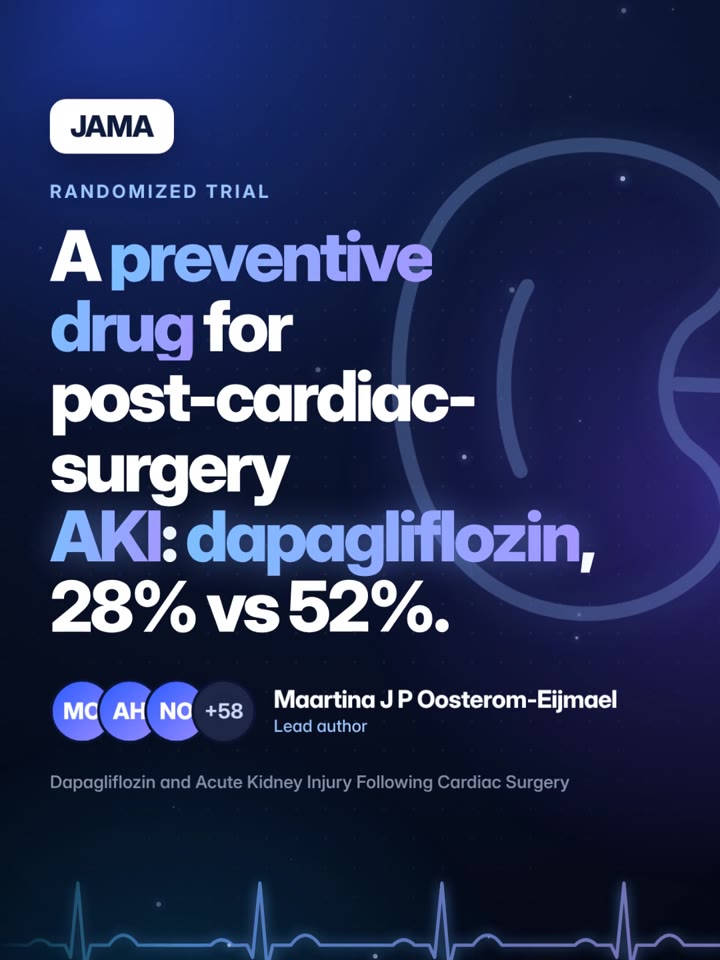
JAMA · randomized trial. A preventive drug for post-cardiac-surgery AKI: dapagliflozin, 28% vs 52%. Dapagliflozin and Acute Kidney Injury Following Cardiac Surgery 784 adults: Elective cardiac surgery, Netherlands, median age 68. 4 doses, starting day before surgery: Dapagliflozin 10 mg vs Placebo. RR 0.54 (95% CI 0.45–0.65), P<.001. AKI by day 7: 28% vs 52%. Adverse events in both groups: AF 45% both, Dapagliflozin reoperation 11%, Placebo reoperation 10%. Dr. Wolfgang C. Winkelmayer (nephrologist · Baylor College of Medicine): “investigators should aim to better understand the mechanism(s) by which SGLT2 inhibitors reduce the risk of AKI among patients undergoing elective cardiac surgery” From their public comments on the paper Bottom line: Perioperative dapagliflozin reduced postoperative AKI after elective cardiac surgery.
Coverage & sources
Journal, society, and media accounts. Useful signal, not independent expert judgment.
Discussion
No takes yet. Share an insight, caveat, or question.
Cite This Study
Oosterom-Eijmael et al. (2026) conducted an RCT in Elective cardiac surgery (n=784). Dapagliflozin vs. Placebo was evaluated on Acute kidney injury (AKI) during the first 7 postoperative days (RR 0.54, 95% CI 0.45-0.65, p=<.001). Dapagliflozin initiated 1 day prior to elective cardiac surgery reduced the incidence of acute kidney injury at 7 days compared with placebo (28% vs 52%; RR 0.54; 95% CI 0.45-0.65; P<.001).