September 4, 2026Cardiology in Review
Percutaneous Coronary Intervention in Patients Undergoing Transcatheter Aortic Valve Implantation: A Systematic Review and Meta-Analysis With Reconstructed Individual Patient Data and GRADE Assessment
Key result
Percutaneous coronary intervention in TAVI candidates with coronary artery disease did not significantly reduce all-cause death (OR 0.88; 95% CI 0.62-1.25) compared to conservative management.
Why the study?
Coronary artery disease coexists in approximately 50% of transcatheter aortic valve implantation candidates, but the role of PCI remains uncertain.
Does percutaneous coronary intervention reduce mortality or cardiovascular events in transcatheter aortic valve implantation candidates with coronary artery disease?
Key Points
- To evaluate the clinical outcomes of percutaneous coronary intervention compared with conservative management or deferral in patients undergoing transcatheter aortic valve implantation.
- Systematic review and meta-analysis of 3 randomized controlled trials (N = 1156 patients) searched across 4 databases from inception to June 2026.
- Odds ratios were pooled using random-effects models with Hartung-Knapp-Sidik-Jonkman adjustment alongside reconstructed individual patient data from Kaplan-Meier curves.
- PCI demonstrated no significant reduction in all-cause death (OR 0.88; 95% CI, 0.62-1.25; I2 = 0%), cardiovascular death (OR 0.72; 95% CI, 0.40-1.29; I2 = 0%), or myocardial infarction (OR 0.85; 95% CI, 0.17-4.18; I2 = 51.8%).
Study Design
Type
Meta-Analysis (n=1,156)
Structured PICO
Does percutaneous coronary intervention reduce mortality or cardiovascular events in transcatheter aortic valve implantation candidates with coronary artery disease?
P
Population
1,156 transcatheter aortic valve implantation candidates with coronary artery disease across 3 randomized controlled trials.
I
Intervention
Percutaneous coronary intervention (PCI)
C
Comparator
Conservative management or deferral
O
Outcome
All-cause deathhard clinical
Main Result
Odds Ratio: 0.88 (95% CI 0.62–1.25)
Implication
In TAVI candidates with coronary artery disease, performing PCI does not significantly reduce mortality or myocardial infarction but is associated with a significant reduction in stroke and a trend toward increased bleeding.
Abstract
Coronary artery disease coexists in approximately 50% of transcatheter aortic valve implantation candidates, yet the role of percutaneous coronary intervention (PCI) remains uncertain. We conducted a systematic review and meta-analysis of randomized controlled trials comparing PCI with conservative management or deferral in transcatheter aortic valve implantation candidates with coronary artery disease. We searched 4 databases from inception to June 19, 2026. Odds ratios (ORs) were pooled using random-effects models with restricted maximum likelihood estimation and Hartung-Knapp-Sidik-Jonkman adjustment. Individual patient data were reconstructed from published Kaplan-Meier curves. Risk of bias and certainty of evidence were assessed. Three randomized controlled trials (n = 1156 patients) were included. PCI showed no significant reductions in all-cause death (OR 0.88; 95% confidence interval [CI], 0.62-1.25; I2 = 0%), cardiovascular death (OR 0.72; 95% CI, 0.40-1.29; I2 = 0%), or myocardial infarction (OR 0.85; 95% CI, 0.17-4.18; I2 = 51.8%). Stroke was significantly reduced with PCI (OR 0.68; 95% CI, 0.48-0.95; I2 = 0%). PCI was associated with a trend toward increased any bleeding (OR 2.26; 95% CI, 0.81-6.29; I2 = 69.8%) and major bleeding (OR 1.70; 95% CI, 0.63-4.60; I2 = 35.9%).
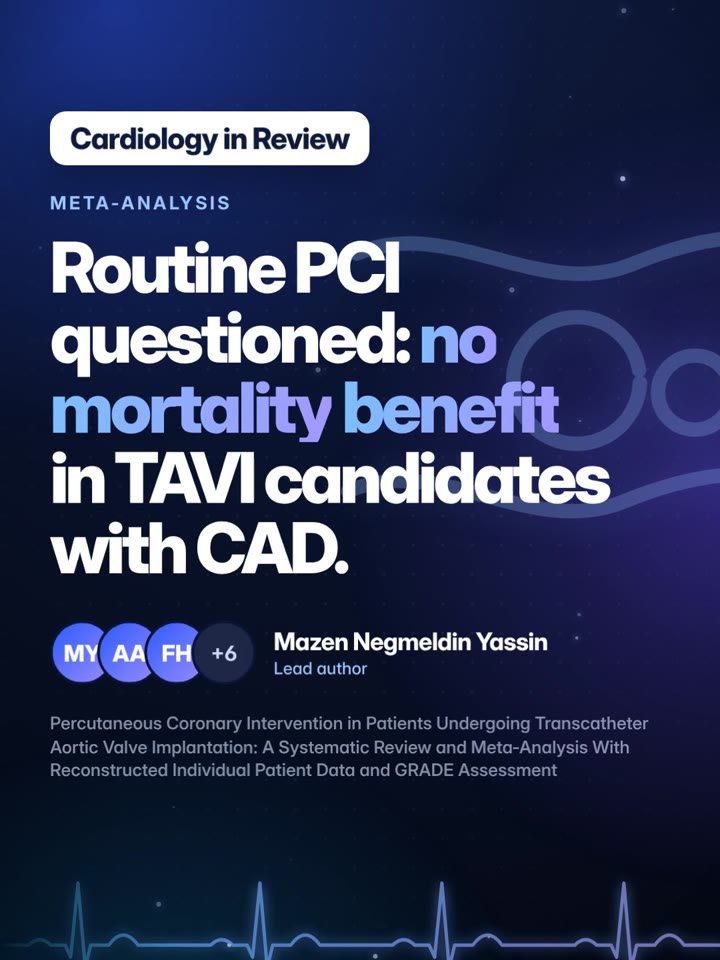
Cardiology in Review · meta-analysis. Routine PCI questioned: no mortality benefit in TAVI candidates with CAD. Percutaneous Coronary Intervention in Patients Undergoing Transcatheter Aortic Valve Implantation: A Systematic Review and Meta-Analysis With Reconstructed Individual Patient Data and GRADE Assessment 50% of candidates: Of TAVI candidates have coronary artery disease. Revascularize or defer?: PCI vs Conservative management. 1,156 TAVI candidates: Pooled from 3 randomized trials. OR 0.88 (95% CI 0.62–1.25). No significant reduction in all-cause death. Stroke lower, bleeding trended higher: Stroke reduced, Bleeding trend up, MI no difference. Bottom line: PCI shows no mortality benefit; supports selective deferral in TAVI candidates.
Discussion
No takes yet. Share an insight, caveat, or question.
Cite This Study
Yassin et al. (2026) conducted a meta-analysis in transcatheter aortic valve implantation candidates with coronary artery disease (n=1,156). percutaneous coronary intervention (PCI) vs. conservative management or deferral was evaluated on all-cause death (OR 0.88, 95% CI 0.62-1.25). Percutaneous coronary intervention in TAVI candidates with coronary artery disease did not significantly reduce all-cause death (OR 0.88; 95% CI 0.62-1.25) compared to conservative management.