This research is Trending!
October 1, 2026Journal of the American College of Cardiology
Occupational Disparities in Cardiovascular Risk and Management in Contemporary China
Zixu ZhaoMingxiao LiZhixian WangZhixian WangTiannan JiangChaohui WangYuan LuoCe RongHuiliang Zhang艾海潮Yao Liang吴尧Jue WangJingrui ZhangSitong LiQifan LiYiwei LaiShijun XiaLi JingyeZhen WangZhen WangLan RenXiaodong PengManlin ZhaoLe ZhouZejun YangFadong LiTing ShenMeiqi ZhaoEnze LiWenyu WangYize ZhaoQianNan YINGYu KongChao JiangCaihua SangXin DuJianzeng DongLiu HeChangsheng MaMD
Key result
Occupational cardiovascular risk varies widely across Chinese workers, with overall CHD prevalence of ~1.3%.
- 95% CI 1.29-1.37
- n=1,421,390
Why the study?
A comprehensive understanding of cardiovascular health across contemporary occupational contexts in rapidly transitioning economies like China remains limited.
Key Points
- To characterize geographic and occupational patterns of cardiovascular risk, risk-factor management, and potential prevention opportunities among employed adults across contemporary China.
- Nationwide cross-sectional analysis of 1,421,390 employees aged 20 to 65 years across 167 health examination centers in 24 provinces in China between 2021 and 2023.
- Categorized participants into 18 occupations across primary, secondary, and tertiary sectors, estimating age- and sex-standardized prevalence of coronary heart disease (CHD), cardiometabolic risk factors, and treatment/control rates.
- Calculated 10-year atherosclerotic cardiovascular disease (ASCVD) risk using the Prediction for ASCVD Risk in China model and simulated risk reductions under optimal risk-factor control scenarios.
- The age- and sex-standardized prevalence of CHD was 1.33% (95% CI: 1.29%-1.37%), showing a marked north-to-south decreasing gradient (P < 0.001); CHD and cardiometabolic burdens were lowest in modern service sectors and highest in secondary sectors like utility production.
- Standardized treatment and control rates were 29.5% and 20.8% for hypertension, 36.6% and 21.9% for diabetes, and 17.0% for hypercholesterolemia treatment with 9.5% for LDL-C control; modern service sectors exhibited the lowest treatment rates across all conditions.
- Among individuals aged ≥35 years without prior ASCVD, 23.3% had moderate-to-high 10-year ASCVD risk, varying from 14.7% in advanced manufacturing services to 30.4% in agriculture, forestry, animal husbandry, and fishery.
Study Design
Type
Cross-Sectional (n=1,421,390)
Multicenter
Yes
Structured PICO
P
Population
1,421,390 employed adults aged 20 to 65 years in China assessed for cardiovascular risk and management across different occupational sectors.
O
Outcome
Geographic and occupational patterns of coronary heart disease (CHD) prevalence, cardiometabolic risk factor prevalence, treatment and control rates for hypertension, diabetes, and hypercholesterolemia, and 10-year ASCVD risk.
Significant occupational and geographic disparities exist in cardiovascular risk and management among Chinese workers, highlighting the need for occupation-specific prevention and risk-factor control strategies.
Key expert perspectives
Captured external expert commentary on this paper, strongest first. Original sources are linked where available.
AJACC Journal Scan
“The next step is to turn surveillance into implementation – using what we learn about where risk and management gaps concentrate to build systems that detect risk early, connect people to effective care and achieve sustained risk-factor control.”
Implication
Occupational CHD disparities may guide targeted prevention in secondary sectors; leaves open whether interventions improve outcomes.
Abstract
BACKGROUND: Although occupational disparities in cardiovascular health are increasingly recognized, a comprehensive understanding of cardiovascular health across contemporary occupational contexts-particularly in rapidly transitioning economies-remains limited. OBJECTIVES: This study aimed to characterize geographic and occupational patterns of cardiovascular risk, risk-factor management, and potential prevention opportunities among employed adults in contemporary China. METHODS: In this nationwide cross-sectional study, we analyzed 1,421,390 employees aged 20 to 65 years who underwent health examinations at 167 centers across 24 provinces in China between 2021 and 2023. Eighteen occupations were defined based on participants' employer registration and industry affiliation, and were classified into primary, secondary, and tertiary sectors, with the tertiary sector further subclassified into modern, public, and life services. Age- and sex-standardized prevalence of coronary heart disease (CHD) and cardiometabolic risk factors was estimated, along with age- and sex-standardized rates of treatment and control for hypertension and diabetes, and treatment for hypercholesterolemia and low-density lipoprotein cholesterol (LDL-C) control. Ten-year atherosclerotic cardiovascular disease (ASCVD) risk was calculated using the Prediction for ASCVD Risk in China model. We then assessed changes in the proportion of individuals classified as having moderate-to-high 10-year ASCVD risk under simulated scenarios that set elevated blood pressure and total cholesterol to target levels and current smoking to noncurrent smoking and compared these reductions across occupations. RESULTS: The mean age of participants was 33.8 years, and 53.4% were male. Overall, the age- and sex-standardized prevalence of CHD was 1.33% (95% CI: 1.29%-1.37%) and demonstrated a pronounced north-south gradient (P < 0.001), with the highest in the North and the lowest in the South. Cardiometabolic risk factors also exhibited a similar geographic distribution. Employees in modern service sectors exhibited the lowest age- and sex-standardized prevalence of CHD and cardiometabolic risk factors, particularly those in "information transmission, software, and information technology," whereas the highest burdens were concentrated in the secondary sector, especially in "production and supply of electricity, heat power, gas and water." The age- and sex-standardized rates of treatment and control were 29.5% and 20.8% for hypertension, 36.6% and 21.9% for diabetes, and 17.0% and 9.5% for hypercholesterolemia treatment and LDL-C control, respectively. Modern services in the tertiary sector had the lowest treatment rates for all 3 cardiometabolic conditions and the lowest control rates for hypertension and LDL-C. Among individuals aged ≥35 years without prior ASCVD, 23.3% were classified as having moderate-to-high 10-year ASCVD risk, with marked occupational variation, highest in "agriculture, forestry, animal husbandry, and fishery" (30.4%) and lowest in "service to advanced manufacturing" (14.7%). Simulated control of elevated blood pressure, hypercholesterolemia, and current smoking revealed substantial occupational variation in potential ASCVD risk reduction. CONCLUSIONS: Occupational context may provide a practical framework for identifying patterns of cardiovascular risk, management gaps, and prevention opportunities among China's working population. Despite lower observed disease burden, modern occupational sectors showed suboptimal risk-factor management, whereas simulated ASCVD risk reductions varied across occupations, highlighting distinct prevention needs and opportunities across occupational contexts.
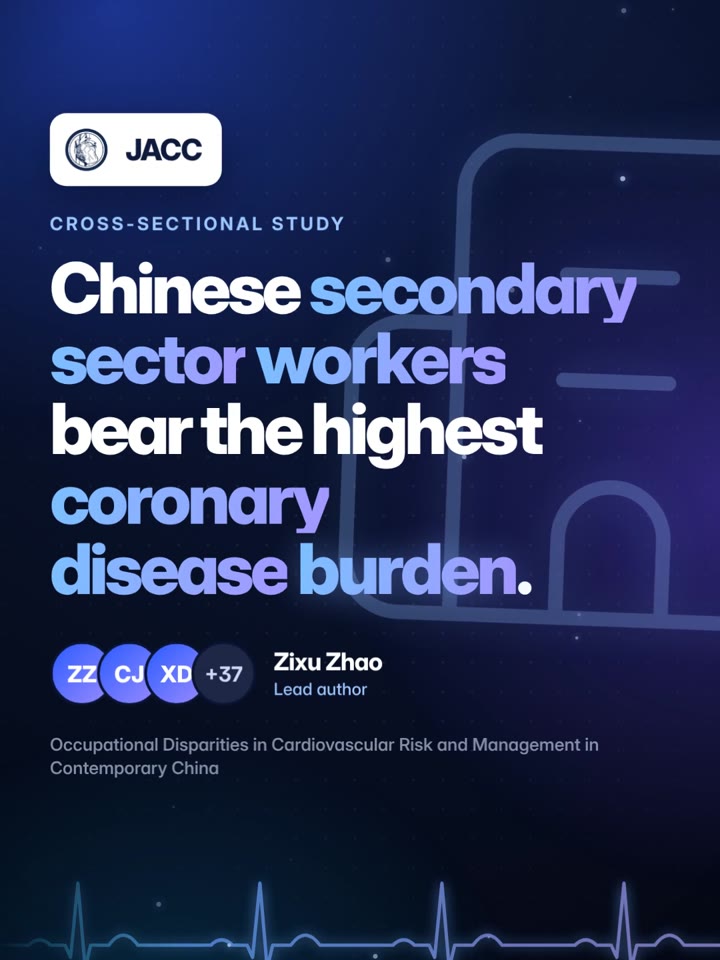
JACC · cross-sectional study. Chinese secondary sector workers bear the highest coronary disease burden. Occupational Disparities in Cardiovascular Risk and Management in Contemporary China 1,421,390 employed adults: Workers examined at 167 centers across 24 provinces. CHD burden varies by occupation and region: Secondary sector: highest, Modern services: lowest, North-to-south gradient. 1.33% CHD prevalence: Age- and sex-standardized CHD prevalence among workers. 9.5% LDL-C control overall (standardized). Only 17.0% treated; modern services had lowest treatment rates. Bottom line: Occupation may guide prevention: even low-burden modern sectors lag on treatment.
Discussion
No takes yet. Share an insight, caveat, or question.
Cite This Study
Zhao et al. (2026) conducted a cross-sectional in Cardiovascular risk and cardiometabolic diseases (n=1,421,390). Occupational sector (primary, secondary, and tertiary) vs. Cross-occupational comparison was evaluated on Age- and sex-standardized prevalence of coronary heart disease (CHD) (95% CI 1.29-1.37). Cardiovascular risk varied markedly by occupation among Chinese workers, with an overall CHD prevalence of 1.33% (95% CI 1.29-1.37%) and highest burdens concentrated in the secondary sector.