
Circulation Arrhythmia and ElectrophysiologyInoue et al.Original Research

Joseph C. Wu
Cross-Cutting Cardiology
Stanford Medicine
About
Joseph C. Wu works in Cross-Cutting Cardiology affiliated with Stanford Medicine.
Joseph C. Wu, MD, PhD, is Director of the Stanford Cardiovascular Institute and the Simon H. Stertzer, MD, Professor of Medicine and Radiology at Stanford University School of Medicine. He is a board-certified cardiologist with clinical interests in adult congenital heart disease and cardiovascular imaging. His laboratory research focuses on induced pluripotent stem cells, organoids, genomics, and drug discovery for cardiovascular diseases.
Research focus
Induced pluripotent stem cells for cardiovascular disease modelingAdult congenital heart diseaseCardiovascular molecular imagingStem cell-derived cardiomyocytes for drug screeningTissue-engineered human myocardium
Impact
1,205 pubs · 62,920 cites · h-index 132
Training
MD
Yale University School of Medicine
1997
PhD
University of California, Los Angeles
2004
BS
University of California, Los Angeles
1993
Affiliations
Work Experience
Director, Stanford Cardiovascular Institute and Simon H. Stertzer, MD, Professor of Medicine and Radiology
Stanford University School of Medicine · 2004 - Present
Publications
CirculationTu et al.preclinical
MM11 drives metabolic maturation in human iPSC cardiomyocytes, substantially increasing oxidative phosphorylation within 2 weeks.
A novel 11-component maturation medium (MM11) induces adult-like mitochondrial structure and metabolism in human iPSC-derived cardiomyocytes, enabling more faithful preclinical modeling of mitochondria-dependent cardiac diseases like Friedreich ataxia cardiomyopathy.
Cardiovascular ResearchGao et al.Original Research
TRAIL promotes ionizing radiation-induced arrhythmogenic dysfunction in human iPSC-derived cardiomyocytes
Cell ReportsZeng et al.Original Research
CCN1-mediated stress signaling underlies intrinsic cardiomyocyte dysfunction in spinal muscular atrophy
Cardiac involvement in spinal muscular atrophy (SMA) is increasingly recognized, but its cellular basis remains poorly defined. Using patient-specific induced pluripotent stem cell-derived cardiomyocytes (iPSC-CMs) and engineered heart tissues (EHTs), we identify reduced survival motor neuron (SMN) expression, mitochondrial respiratory defects, and impaired contractility in SMA. Transcriptomic analyses reveal cellular communication network factor 1 ( CCN1 ) as a top upregulated gene in SMA iPSC-CMs, consistent with its enrichment in cardiomyocytes across cardiomyopathies. Exogenous CCN1 exacerbates contractile dysfunction in SMA iPSC-CMs. Proteomic profiling reveals sustained p38/mitogen-activated protein kinase (MAPK) signaling activation, synergistically amplified by CCN1 and TNFα, thereby linking stress signaling to cardiac dysfunction in SMA. Therapeutic intervention with tanshinone IIA suppresses CCN1 expression, attenuates p38 activation, and improves contractile function. Notably, combining tanshinone IIA with risdiplam produces additive benefits in mitochondrial and contractile performance. Together, these findings identify a CCN1-mediated mechanism underlying SMA cardiac dysfunction and support combination strategies integrating SMN-dependent and independent therapies.
CirculationMukherjee et al.Original Research
ADMET-AI predicts drug-induced cardiotoxicity with ~0.72 AUC, outperforming SwissADME.
ADMET-AI may support early in silico cardiotoxicity screening; leaves open whether it reduces trial failures or improves outcomes.
Journal of Pharmacological and Toxicological MethodsGoßmann et al.Original Research
From neat compounds to complex mixtures: Microphysiological systems for cardiotoxicity safety testing of botanical extracts
Stem Cell ResearchFernandez et al.Original Research
TopiciPSC modeling of hypokalemic periodic paralysis
Generation of two human induced pluripotent stem cell lines from patients with hypokalemic periodic paralysis
Hypokalemic periodic paralysis (HypoPP) is an autosomal dominant disorder caused by a p.Arg528His mutation in the CACNA1S gene, which encodes the α1-subunit of the skeletal muscle L-type calcium channel. The mutation causes leaky ion flow and impairs muscle excitation-contraction coupling. Patients exhibit episodic paralysis, muscle attacks, and hypokalemia. Two human induced pluripotent stem cell (iPSC) lines were generated from HypoPP patients, SCVIi152-A and SCVIi153-A, each carrying the CACNA1S c.1583G>A (p.Arg528His) mutation. Both lines exhibited pluripotency marker expression at gene and protein levels, displayed a normal karyotype, and differentiated into all three germ layers in vitro. These lines are valuable resources for modeling HypoPP.
Stem Cell ResearchLi et al.preclinical
TopiciPSC modeling in dilated cardiomyopathy
Novel patient-derived iPSC lines successfully model dilated cardiomyopathy harboring distinct truncating TTN mutations.
These patient-derived iPSC lines enable mechanistic DCM studies; leaves open clinical translation.
Li et al.preclinical
TopicRBM20 dilated cardiomyopathy genetics
AAV-mediated RBM20 gene replacement partially rescues mis-splicing but fails to improve contractility or calcium handling.
AAV-RBM20 replacement fails to rescue contractility or granules in RBM20-mutant iPSC-CMs; leaves open whether gain-of-function mechanisms require therapies beyond replacement.
Circulation ResearchKojic et al.preclinical
TopicSunitinib cardiotoxicity in iPSC-cardiomyocytesFirst evidence
Sunitinib impairs human iPSC-cardiomyocyte function and transcriptomics, with relaxation velocity tracking toxicity severity.
Supports iPSC platforms for TKI cardiotoxicity research; leaves open clinical translation.
CirculationSallam et al.preclinical

Sirolimus reduced left ventricular mass by 19.91 g clinically and attenuated fibroblast proliferation and collagen production in human cardiac organoids.
Sirolimus may reduce adverse LV remodeling in transplant recipients; leaves open whether randomized trials confirm differential antifibrotic effects.
Journal of Clinical InvestigationPatra et al.review
TopicCardiometabolic preclinical drug development
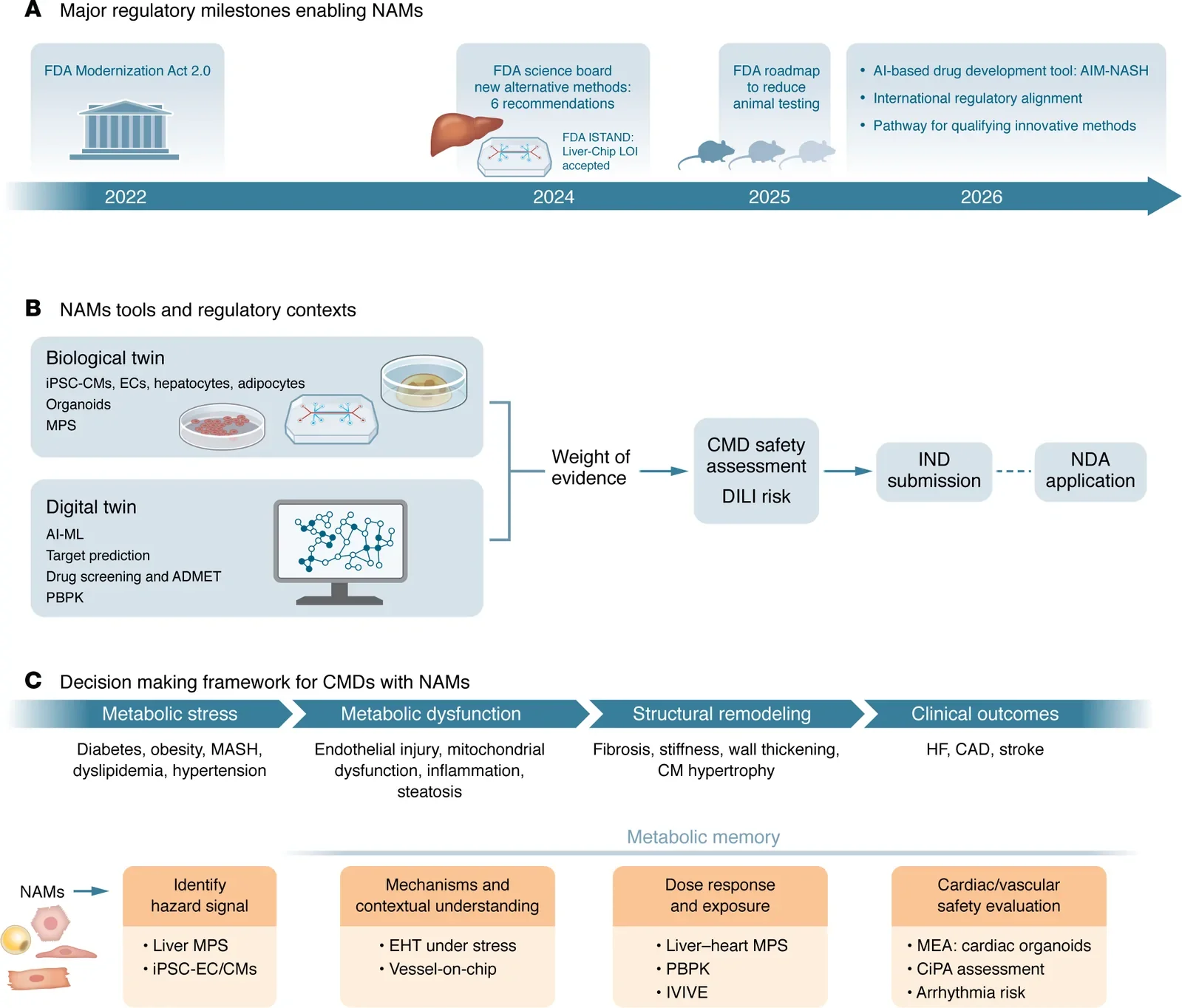
Biological and digital twins enhance cardiometabolic drug development and CV safety prediction over animal models.
Human-based models may better predict cardiotoxicity than animals; leaves open regulatory impact on post-market safety.
CirculationYu et al.preclinical
TopicHeart failureFirst evidence
A defined six-factor cocktail induced durable diastolic dysfunction in iPSC-derived cardiac organoids, prolonging relaxation time by 22.5% and reproducing key electrophysiological abnormalities of HFpEF.
A defined six-factor cocktail successfully induces HFpEF-like diastolic dysfunction in human iPSC-derived cardiomyocytes, providing a scalable preclinical platform that identified BET inhibition as a potential therapeutic strategy.

Joseph C. Wu
Cross-Cutting Cardiology · Stanford Medicine
This study identifies a common signal through which several adenosine receptors can drive cardiac fibroblast activation. By combining human stem-cell models with mechanistic studies and animal experiments, we could connect a screening result to a specific biological pathway that warrants further therapeutic investigation.
ScienceZhang et al.preclinical
An experimental compound cut cardiac fibrosis in cell and animal models.
In this study, researchers used human stem cells to screen for compounds that target cardiac fibrosis, a driver of heart failure. The screen identified CGS15943, a compound that blocked an atypical adenosine receptor pathway and reduced fibrotic gene expression in human heart tissue and animal models. These findings establish this pathway as a potential target for treating heart scarring.
Nature ProtocolsZhang et al.Original Research
TopicCardiac fibrosis drug screening
A new stem cell platform speeds up drug screening for cardiac fibrosis.
This study developed a high throughput screening system using human stem cell derived cardiac fibroblasts to identify potential antifibrotic drugs. It includes a second screen with stem cell derived heart muscle cells to rule out toxic compounds. This scalable workflow can screen roughly 5,000 compounds within six to eight weeks.
JACCLiang et al.preclinical
Brugada syndrome iPSC-derived cardiomyocytes display reduced sodium current density and increased arrhythmogenic triggered activity.
Patient-specific iPSC-CMs successfully recapitulate the single-cell electrophysiological abnormalities of Brugada Syndrome, which can be reversed by CRISPR/Cas9 genome editing of the causative SCN5A variant.
JACCGurvitz et al.review
TopicCongenital heart disease adults
Expert panel outlines top research priorities for adult congenital heart disease
This working group report from the National Heart, Lung, and Blood Institute and the Adult Congenital Heart Association identified top research priorities for adults with congenital heart disease. Congenital heart disease affects 0.8% of live births and over 85% reach adulthood, yet little is known about their late outcomes. The panel flagged heart failure, blood vessel disease and organ complications as the main study areas. Key topics include tetralogy of Fallot, heart pumps and transplants, sudden cardiac death, and pregnancy.
Circulation ResearchZhang et al.Original Research
3-Dimensional Human iPSC-Derived Cardiac Organoids for Antifibrotic Drug Screening
JACCSánchez-Freire et al.preclinical
CPC-derived iPSCs yield ~12 percentage points higher cardiac differentiation than fibroblast-derived iPSCs, but similar post-MI recovery.
Although deriving iPSCs from cardiac progenitor cells enhances in vitro cardiac differentiation efficiency at early passages via epigenetic memory (lower NKX2-5 promoter methylation), easily accessible dermal fibroblasts yield iPSC-CMs with equivalent in vitro electrophysiological function and in vivo post-MI therapeutic efficacy.
EHJNishiga et al.editorial
TopicHeart failure
Extracellular vesicles secreted by iPSC-derived cardiovascular progenitors improved cardiac function in a murine myocardial infarction model, outperforming direct transplantation of parent cells.
Extracellular vesicles derived from iPSC cardiovascular progenitors offer a promising, potentially safer, cell-free alternative to direct stem cell transplantation for treating heart failure.