CM
Cornelia M. van Duijn
Genetic Associations and Epidemiology
Erasmus University Rotterdam
About
Research focus
Genetic Associations and Epidemiology
Impact
1,922 pubs · 230,667 cites · h-index 236
Affiliations
Publications
GWAS
JAN 2015HibarNature
Common genetic variants influence human subcortical brain structures
The highly complex structure of the human brain is strongly shaped by genetic influences. Subcortical brain regions form circuits with cortical areas to coordinate movement, learning, memory and motivation, and altered circuits can lead to abnormal behaviour and disease. To investigate how common genetic variants affect the structure of these brain regions, here we conduct genome-wide association studies of the volumes of seven subcortical regions and the intracranial volume derived from magnetic resonance images of 30,717 individuals from 50 cohorts. We identify five novel genetic variants influencing the volumes of the putamen and caudate nucleus. We also find stronger evidence for three loci with previously established influences on hippocampal volume and intracranial volume. These variants show specific volumetric effects on brain structures rather than global effects across structures. The strongest effects were found for the putamen, where a novel intergenic locus with replicable influence on volume (rs945270; P = 1.08 × 10⁻³³; 0.52% variance explained) showed evidence of altering the expression of the KTN1 gene in both brain and blood tissue. Variants influencing putamen volume clustered near developmental genes that regulate apoptosis, axon guidance and vesicle transport. Identification of these genetic variants provides insight into the causes of variability in human brain development, and may help to determine mechanisms of neuropsychiatric dysfunction.
Original Research
AUG 27WongFrontiers in Dementia
Polygenic score for sleep duration in relation to the risk of Alzheimer’s disease: results from the UK biobank
Cohort study reveals lower Alzheimer's disease risk in adults genetically predisposed to longer sleep duration, suggesting potential neuroprotective effects of sleep.
cohort · n=26,025JACC Highlight
APR 2016KheraJournal of the American College of Cardiology
Familial hypercholesterolemia mutation carriers with LDL ≥190 mg/dl had a 22-fold increased risk of CAD compared to individuals with LDL <130 mg/dl and no mutation (OR 22.3; 95% CI 10.7-53.2).
Although FH mutations are identified in <2% of individuals with severe hypercholesterolemia, mutation carriers face a substantially higher risk of CAD compared to non-carriers with similar LDL cholesterol levels.
Original Research
AUG 1QuenezThe American Journal of Human Genetics
Exome analysis of 22,319 individuals links extremely rare copy-number variants and 22q11.21 dosage to Alzheimer risk
Copy-number variants (CNVs) are major contributors to human disease. In Alzheimer disease (AD), APP duplications cause autosomal-dominant forms, but the role of CNVs in non-monogenic AD remains poorly characterized. We analyzed rare CNVs (frequency <1%) from 22,319 exomes (4,150 early-onset AD [EOAD, ≤65 years], 8,519 late-onset AD [LOAD], 9,650 unaffected control subjects) using harmonized calling and quality control. After identifying 17 individuals with a pathogenic CNV, we performed exome-wide and gene-set burden analyses. EOAD-affected individuals showed increased burdens of rare CNVs affecting coding genes, particularly deletions in AD-related genes. Integrated loss-of-function (LoF) analysis gathering short truncating variants with deletions showed that ABCA1 (odds ratio [OR] = 5.77 [95% confidence interval 2.25; 17.06], p = 0.0002) and ABCA7 deletions contribute to this deletion burden (OR = 2.29 [1.44; 3.65], p = 0.0006), while CTSB LoF alleles appear as candidates (OR = 5.03 [1.50; 20.71], p = 0.0089). We then performed exome-wide gene-level dosage analysis and highlighted 18 genes across five loci with a false discovery rate of <10%, including the 22q11.21 central region, where deletions were restricted to EOAD (including one de novo event) and duplications were enriched in control individuals, with intermediate frequencies in LOAD. We narrowed this locus to the SCARF2 - KLHL22 - MED15 region after integrating short truncating variants. Replication in 33,977 affected individuals and 362,322 control subjects confirmed association for 22q11.21 dosage with exome-wide significance (OR SCARF2 = 0.34 [0.21; 0.53]; mega- p value=5.52 × 10 −7 ). SCARF2 overexpression significantly increased amyloid-β uptake, congruent with duplication-associated decreased AD risk. We conclude that rare coding CNVs in a proportion of AD-associated genes and 22q11.21 deletions, including some found in DiGeorge syndrome, increase AD risk. Conversely, we identify 22q11.21 duplication as a strong AD-risk-decreasing factor.
Original Research
JUL 3BelbasisCommunications Medicine
Integrative proteogenomic analyses identify plasma proteins that impact the risk of ischemic stroke
Identifies causal plasma proteins affecting ischemic stroke risk, suggesting new prevention targets.
Cross-Sectional Study
JUN 24AhmadNature Aging
The blood metabolome of brain health in midlife and influences of genes, microbiome and exposome
Examines cognitive outcomes related to blood metabolites in middle-aged adults, suggesting implications for Alzheimer's disease prevention.
Original Research
JAN 1YuIEEE Transactions on Computational Biology and Bioinformatics
GENIE: A Two-Stage Interpretable Deep Learning Framework for Revealing the High-Order Genetic Interaction Network of Alzheimer's Disease
Reveals high-order gene interactions in Alzheimer's disease, suggesting a novel analytical approach.
Original Research
FEB 12CunhaUniversity of Oxford
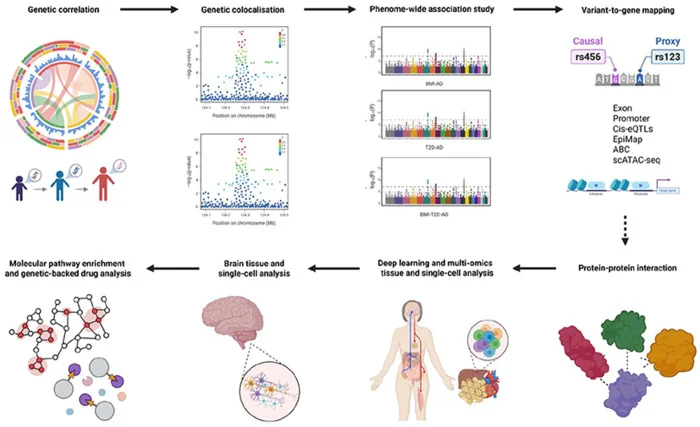
BMI showed significant negative genetic correlation with AD risk (rg = -0.13; p=1x10⁻⁶), and multi-trait analyses identified 35 putative effector genes in 7 independent loci colocalizing between BMI/T2D and AD.
Genomic analyses reveal that BMI and Type 2 Diabetes influence Alzheimer's disease risk through shared sex-specific cardiometabolic pathways, identifying actionable therapeutic targets such as levosimendan.
cohort · n=47,891
DEC 2025XiaoNature Communications
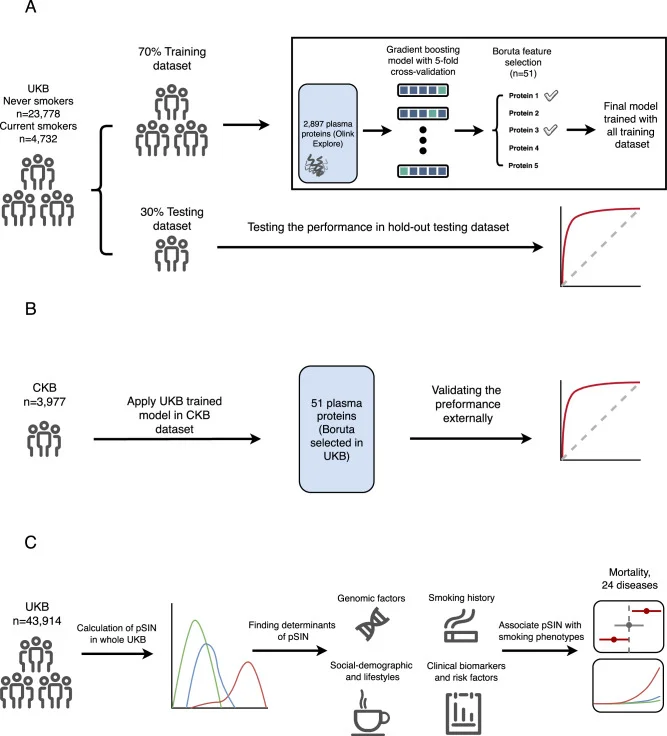
Highly accurate proteomic smoking index predicts mortality and 18 chronic diseases independently of self-reported history.
pSIN may refine smoking exposure assessment beyond self-report; extends biomarker research but leaves open prospective validation before clinical use.
Original Research
DEC 2025AminUniversity of Oxford
Proteomic profiling of Alzheimer’s disease and Vascular dementia reveals unique underlying signatures
INTRODUCTION Alzheimer’s disease (AD) and vascular dementia (VaD) account for most dementia cases. AD biomarkers remain costly and invasive, and no specific biomarkers exist for VaD. METHODS We analyzed plasma and brain proteomics in the UK Biobank (N=53,000) and ROSMAP (N=512) to identify shared and distinct proteomic signatures of AD and VaD and assess the influence of the APOE ε4 variant. RESULTS We identified 55 AD-associated and 49 VaD-associated proteins, with 13 shared. AD proteins were enriched in glycosaminoglycan binding and cholesterol metabolism; VaD proteins in virus receptor activity, cytokine activity and metalloproteinases. Both showed IGF pathway dysregulation. APOE ε4 stratification revealed distinct AD proteomic signatures beyond GFAP and NeFL. Mendelian randomization suggested causal links for SNAP25 in AD, EDA2R and TIMP4 in VaD, and PVR in both. DISCUSSION Findings underscore the importance of APOE genotype and highlight SNAP25, EDA2R, TIMP4, and PVR as potential biomarkers and therapeutic targets.
Original Research
DEC 2025AndersenMolecular Neurodegeneration
Domain mapping of disease mutations reveals pathogenic SORL1 variants in Alzheimer’s disease
BACKGROUND: Protein truncating variants (PTVs) in SORL1 are observed almost exclusively in Alzheimer’s Disease (AD) cases, but the effect of rare SORL1 missense variants is unclear. METHODS: To identify high-priority missense variants (HPVs), we applied ‘domain mapping of disease mutations’ for the 637 unique coding SORL1 variants detected in 18,959 AD-cases and 21,893 non-demented controls. RESULTS: In this sample, PTVs and HPVs associated with respectively a 35- and 10-fold increased risk of early onset AD and 17- and 6-fold increased risk of overall AD. The median age at onset (AAO) of PTV- and HPV-carriers was 62 and 64 years, and APOE-genotype contributed to AAO-variability. The median AAO of PTV- and HPV-carriers is ~8–10 years earlier than wild-type SORL1 carriers, matched for APOE-genotype. Specific HPVs are highly penetrant and lead to earlier AAOs than PTVs, suggesting possible dominant negative effects. CONCLUSION: Our results justify a debate on whether HPV carriers should be considered for clinical counseling.
Original Research
OCT 2025AminTranslational Psychiatry
Interplay between age, APOE Ɛ4 and the metabolome in plasma and brain in Alzheimer’s disease
Age and the ε4 variant of the apolipoprotein E gene (APOE ε4) are two major drivers of Alzheimer's disease (AD). APOE is also the major determinant of longevity. How age and APOE interact in the development of AD is largely unknown. In this study we integrate metabolomics (N = 274,259) and proteomics (N = 54,219) data in plasma from the UK Biobank with the metabolomics (N = 514) and proteomics (N = 618) data in brain from the Religious Orders Study and the Rush Memory and Aging Project (ROSMAP) to understand the interplay of age, APOE ε4 and metabolome in the development of AD. We find that levels of β-hydroxybutyrate (BHBA) and branch-chained amino acids (BCAAs) are dysregulated in plasma and brains of AD patients. APOE ε4 carriers manifest significantly higher plasma concentration of BHBA that is detectable as early as 37 years of age and remains high throughout the studied age range of 37-73 whereas the plasma concentrations of BCAAs decline in APOE ε44 carriers after the age of 58 years. Proteomic signatures of APOE ε4, BHBA and BCAAs suggest downregulation of lysosome, immune and insulin-like growth factor (IGF1) transport/uptake pathways in plasma, and downregulation of the tricarboxylic acid (TCA) cycle, neurexins/neuroligins and clathrin-mediated endocytosis pathways in brain. Our data identifies two major shifts in metabolism occurring decades apart over the age course in AD in APOE ε4 carriers. These include early ketogenesis that manifests around late 30 s and gluconeogenesis, which manifests around the age of 60 years.
Original Research
OCT 2025XiaoUniversity of Oxford
Ticking Differently: Elucidating Sexual Dimorphism in Human Aging through Metabolomics, Proteomics and Genomics
That males and females age differently has been overlooked while developing aging clocks. Here, we developed a sex-specific metabolic aging clock in 390,941 individuals from the UK Biobank and integrated it with genetic, proteomic and epidemiological data to identify mechanisms accelerating/decelerating metabolic aging in males and females. Our findings reveal dysregulation of cholesterol metabolism, immune system, hemostasis, and cell growth, survival and apoptosis as common mechanisms accelerating metabolic aging in males and females, and upregulation of oxidative stress detoxification, cellular resilience and tissue integrity as common mechanisms decelerating metabolic aging. In females, a further dysregulation of carbohydrate/glucose metabolism, circadian rhythm and hormone metabolism accelerating metabolic aging is observed, while dysregulation of energy metabolism, cancer and longevity pathway is specifically observed in males. Among reproductive factors, late puberty and higher parity manifest as protective factors, decelerating metabolic aging in both sexes, and additionally childbirth at older age decelerating metabolic aging in women. Accelerated metabolic age strongly predicted morbidity and mortality in both sexes, except that the magnitude of association was several folds higher in males, and obesity explained most of the disease associations in females, suggesting that obesity influences metabolic aging and subsequent health outcomes differently in males and females. Consistent with the upregulation of molecular mechanisms involved in cancer in males, accelerated metabolic aging predicted several common cancers in males but not females. Our study provides novel insights into the biological mechanisms underlying aging and disease susceptibility in males and females, underscoring the importance of considering sex differences in healthcare strategies and public health policies.
Cohort Study
OCT 2025GaoAge and Ageing
Association of neuroticism with incident dementia and cognitive function: 26-year follow-up of EPIC-Norfolk study
BACKGROUND: Neuroticism is a stable personality trait associated with increased vulnerability to mental and physical disorders. This study examined whether neuroticism is associated with the risk of dementia, particularly across the adult life course and over long-term follow-up. METHODS: We analysed data from 19,678 dementia-free participants (mean [standard deviation, SD] age, 60.8 [9.3] years) who had neuroticism assessed between 1996 and 2000. Incident dementia was identified via linked hospital inpatient, mental health and mortality records through 2022. Cox proportional hazards models estimated hazard ratios (HRs) per 1-SD increase in neuroticism. Secondary analyses examined interactions, mediation and associations with cognitive performance on eight tests. RESULTS: Over a median follow-up of 22.7 years, 2488 participants developed dementia. Neuroticism was associated with increased dementia risk in a dose-response manner (HR per 1-SD: 1.14; 95% CI: 1.10-1.19). The association persisted even after ≥20 years of follow-up (1.09 [1.01-1.17]) and across baseline ages 41-60 (1.16 [1.04-1.30]), 60-70 (1.11 [1.04-1.18]) and 70-81 years (1.14 [1.07-1.22]). Associations were stronger among APOE ε4 carriers and heavy drinkers, and may be partly explained by depression, hypertension and ischaemic heart disease. Higher neuroticism was linked to poorer cognitive function, particularly episodic memory and to impairment across more cognitive domains. DISCUSSION: Neuroticism was associated with increased long-term dementia risk and poorer cognitive performance across mid- and later life, supporting its role in disease development rather than merely reflecting prodromal symptoms. Addressing vascular and mental health in high-neuroticism individuals may offer opportunities for dementia risk reduction.
Original Research
OCT 2025XiaoUniversity of Oxford
Proteomic signatures of smoking and their associations with risk of incident diseases and mortality in diverse populations
Machine learning analysis reveals smoking's impact on mortality and chronic diseases in varied populations, highlighting proteomic potential.
Cohort Study
OCT 2025PoliskyNature Medicine
Varicella-zoster virus reactivation and the risk of dementia
Varicella-zoster virus (VZV) is a neurotropic virus that establishes lifelong latency in humans. VZV reactivation is associated with a wide range of symptoms, including herpes zoster (HZ; also known as shingles), and has been implicated in the development of dementia, although to an unknown extent. Here we present a large-scale longitudinal analysis of health records from more than 100 million individuals in the United States that demonstrates a consistent relationship of VZV reactivation with dementia after controlling for nearly 400 measured characteristics (covering demographics, socioeconomic factors, comorbidities, medications, proxies for healthcare-seeking behavior, shifts in clinical guidelines and completeness of records). We found that recurrent HZ was associated with an increased risk of dementia compared to a single HZ episode. Additionally, exposure to HZ vaccines was associated with a reduced risk of dementia compared to the control 23-valent pneumococcal polysaccharide vaccine. Furthermore, the reduced risk of dementia after administration of the live-attenuated zoster vaccine waned over time and was highly correlated with a waning of the vaccine-mediated protection against HZ. The dementia risk reduction at 3 and 5 years postexposure was also stronger in individuals who received multiple as opposed to only one dose of the recombinant HZ vaccine and those at greater risk of HZ. Our findings strongly implicate VZV reactivation as a modifiable risk factor for dementia.
Original Research
OCT 2025HosseinkhaniAlzheimer s & Dementia
Plasma and feces multiomics unveil cognition‐associated perturbations of chronic inflammatory pathways of the gut‐microbiota–brain axis
INTRODUCTION: Gut-microbiota dysbiosis has been linked to cognitive decline. Given its role in metabolism, immunity, and environmental interactions, broader molecular signaling alterations are likely. METHODS: We analyzed gut microbiota composition, plasma and fecal metabolites, and inflammatory cytokines across cognitive stages, from healthy controls to dementia. RESULTS: Alpha diversity declined with increasing cognitive impairment severity. Short-chain fatty acid-producing Firmicutes and Bacteroidota decreased from 76% and 17% in controls to 59% and 11% in dementia, respectively. Proteobacteria (e.g., Escherichia-Shigella) rose from < 2% to 4%, and Verrucomicrobiota from 3% to 11%. Despite overall Firmicutes decline, Ruminococcus gnavus, a mucus-degrading species, increased in dementia. These shifts correlated with elevated plasma cytokines, suggesting a link between gut dysbiosis and systemic inflammation. Bacteria-associated metabolites, including bile acids, trimethylamine N-oxide, oxylipins, sugars, and fatty acids were significantly altered. Changes were seen as early as subjective cognitive decline. DISCUSSION: Larger studies are needed to validate these findings and explore microbiome-based interventions. HIGHLIGHTS: Examined gut microbiota, inflammation, and metabolic changes in cognitive impairment stages Early metabolic changes in feces detected before plasma alterations Observed shifts in gut microbiota and inflammation associated with cognitive decline Suggests potential for early biomarkers based on gut metabolites Calls for larger, longitudinal studies to validate findings.
Original Research
AUG 2025TaiBrain Communications
Detection of cognitive deficits years prior to clinical diagnosis across neurological conditions
Analysis reveals cognitive deficits years before diagnosis in conditions like schizophrenia and Parkinson's disease, suggesting specific trajectories for each disease.
Cross-Sectional Study
AUG 2025SenffUniversity of Oxford
U.S. public perceptions on Whether Risk of Dementia and Stroke Can Be Modified Through Maintaining or Changing Lifestyle
Survey reveals that a majority of the U.S. population believes lifestyle changes can reduce dementia and stroke risk, indicating significant public awareness.
Original Research
AUG 2025HopewellUniversity of Oxford
Integrative proteogenomic analyses discover novel plasma proteins that impact risk of ischemic stroke
Integrative approaches reveal 21 protein associations with ischemic stroke, suggesting new prevention strategies.