

Kamlesh Khunti
General / Preventive / Lipids
University of Leicester
About
Kamlesh Khunti works in General / Preventive / Lipids affiliated with University of Leicester.
Kamlesh Khunti is Professor of Primary Care Diabetes and Vascular Medicine at the University of Leicester. He is Co-Director of the Leicester Diabetes Centre and a General Practitioner at Hockley Farm Medical Practice in Leicester. He also serves as Director of the NIHR Applied Research Collaboration East Midlands and Director of the Centre for Ethnic Health Research.
Research focus
Cardiometabolic disease preventionType 2 diabetes and cardiovascular riskEthnic disparities in diabetes and cardiovascular outcomesReal-world evidence for cardiometabolic therapiesMultimorbidity in cardiometabolic conditions
Impact
2,059 pubs · 107,562 cites · h-index 155
Training
MBChB
University of Dundee
1984
Honorary LLD
University of Dundee
2023
Affiliations
Work Experience
Professor of Primary Care Diabetes and Vascular Medicine
University of Leicester · 2007 - Present
Co-Director
Leicester Diabetes Centre · 2013 - Present
Director
NIHR Applied Research Collaboration East Midlands · 2019 - Present
Director
Centre for Ethnic Health Research · 2016 - Present
General Practitioner
Hockley Farm Medical Practice · 1990 - Present
Publications
Systematic Review
NOV 3DashPLoS ONE
Strengthening continuity of care for multiple long-term conditions in India through integrated referral and follow-up systems (SYNC-RF): A mixed-methods study protocol
Introduction Multiple long-term conditions (MLTC) or multimorbidity are becoming increasingly common in low- and middle-income countries, such as India, placing demands on constrained primary healthcare systems that are still predominantly organised around acute care and single-condition management. Weak referral, counter-referral, and follow-up processes contribute to fragmented care and poor continuity for people living with MLTC. This programme of work aims to develop an integrated referral and follow-up model for people with MLTC who seek care in the primary healthcare system in India. Methods This sequential, multistage mixed-methods research programme will be conducted in three interlinked phases. First, a systematic review of global literature will be conducted, which will synthesise evidence on referral and follow-up models or systems for providing MLTC care. Second, a convergent mixed-methods assessment will be undertaken in Jodhpur district, Rajasthan, including facility assessments of Primary Health Centres and linked referral facilities, a cross-sectional survey of adults with MLTC, and in-depth interviews with patients, caregivers, healthcare providers, and policymakers. Quantitative data will be analysed using descriptive and inferential statistics, while qualitative data will be analysed using reflexive thematic analysis. Third, an integrated referral and follow-up model, SYNC-RF (SYstem for Navigation, Coordination, Referral, and Follow-up), will be developed based on the triangulated evidence and refined through expert consultation to ensure feasibility and contextual relevance. Conclusion The study will generate context-specific evidence on gaps, barriers, and enabling factors affecting referral and follow-up for MLTC care. The integrated model developed through this research is expected to strengthen continuity of care, improve coordination across various levels of the health system, and improve health outcomes for those living with MLTC.
Original Research
JUN 2025MisraThe Lancet
Managing early-onset type 2 diabetes in the individual and at the population level
Early-onset type 2 diabetes (defined as type 2 diabetes diagnosed in people aged <40 years) is an increasingly prevalent condition with a more aggressive disease trajectory than late-onset type 2 diabetes. It is associated with accelerated microvascular and macrovascular complications, reduced life expectancy, and adverse pregnancy outcomes. Despite its rising incidence, global management strategies have mostly been extrapolated from studies in older adults with limited evidence specific to younger populations. In this Series paper, we aim to highlight the unique challenges in the management of early-onset type 2 diabetes and why current models of care are inadequate. We emphasise that early-onset type 2 diabetes necessitates proactive and combination treatment strategies to address weight, faster β-cell decline, worse insulin resistance, and rapidly progressing hyperglycaemia compared with late-onset type 2 diabetes. However, there is minimal evidence on how best to address these factors and clinical inertia risks contributing to glycaemic burden. Cardiovascular risk assessment tools underestimate long-term risk, contributing to low use of statin and antihypertensive therapy. Reproductive health remains a key concern, yet preconception and pregnancy care are inadequate, with low adherence to recommended interventions. Health-care systems are not optimised to address the distinct needs of young adults, and gaps in transitional care (from paediatric to adult services) contribute to disengagement and adverse outcomes. Addressing these challenges requires tailored management strategies that consider the unique metabolic and psychosocial factors in this population. In this Series paper, we summarise the evidence base for the management of early-onset type 2 diabetes, key evidence gaps, and discuss the multisectoral and transdisciplinary elements needed to achieve population-level prevention to reverse these concerning trends.
Original Research
OCT 1DasguptaThe Lancet Regional Health - Americas
Low energy diet plus supervised exercise vs. usual care alone in people with early-onset type 2 diabetes (RESET for Remission): a randomised, open-label, blinded-endpoint efficacy trial
Background Low energy diets (LED) can induce type 2 diabetes remission but have not been studied in combination with structured supervised exercise. We aimed to determine if a combined intervention could induce remission in early-onset type 2 diabetes (EOT2D ≤ 45 years of age), a population with high lifetime risk of complications. Methods Across 3 centres in England and Canada, we conducted a randomised, open-label, blinded endpoint efficacy trial among adults 18–45 years of age with EOT2D and obesity, not on insulin therapy. The groups were usual care alone vs. an intervention combining 800–900 kcal/day LED, twice-weekly supervised (aerobic, resistance) and once-weekly independent exercise (weeks 1–12), followed by a weight-maintenance diet with independent exercise (weeks 13–24). An independent statistician generated web-based randomisation sequences (1:1, country- and sex-stratified, variable block size). The primary outcome was remission at 24 weeks (Hb A1c < 6.5% [48 mmol/mol], without glucose-lowering medication ≥12 weeks). The primary efficacy and harms analysis was in all randomised individuals, assuming no remission when data were unavailable. Secondary endpoints included cardiorespiratory fitness, body composition, and cardiac structure. The trial is registered at ISRCTN (15487120) and is now closed. Findings We randomised 96 participants (mean age 38 years, BMI 35.2 kg/m 2 ) between September 24, 2021 and June 6, 2025 (intervention group: 24 female, 26 male with 18 European, 17 South Asian, 15 Other ethnicity; control group: 21 female, 25 male with 19 European, 10 South Asian, 17 Other ethnicity). In total, 86 (90%) attended final assessments. Remission at 24 weeks occurred in 27/50 (54%) of intervention participants vs. 2/46 (4%) control participants (50% difference, 95% CI 33%–64%; adjOR 21.6, 95% CI 6.2 to 114.5), without serious adverse events. Most intervention group participants experienced at least one adverse event (43/50 vs. 6/46), mainly early LED effects (e.g., constipation, headache, dizziness, fatigue) that resolved. Interpretation High remission rates signal feasibility and efficacy of a combined LED and intensive exercise intervention in EOT2D, justifying examination of synergistic benefits beyond remission. Funding United Kingdom Medical Research Council, Canadian Institutes of Health Research, John R. McConnell Foundation.
Original Research
OCT 1LoughERJ Open Research
Identifying fibrotic interstitial lung disease risk in COPD, asthma and heart failure
Background Fibrotic interstitial lung disease (fILD) is often diagnosed late and can be difficult to recognise in people with common respiratory or cardiac long-term conditions. We examined whether baseline routine blood-test profiles and leucocyte telomere length (LTL) identified groups at higher risk of subsequent hospital-recorded fILD among people with COPD, asthma or heart failure. Methods We analysed 396 516 UK Biobank participants with complete baseline C-reactive protein, albumin, haemoglobin, platelet count, estimated glomerular filtration rate, LTL and core covariates. The primary outcome was first post-baseline hospital recording of ICD-10 J84.1; other coded ILD diagnoses and death were treated as competing events. Cause-specific Cox models assessed associations and discrimination. Risk-enrichment analyses included 53 661 participants with pre-baseline COPD, asthma or heart failure. Results Adding the biomarker panel improved the C-index from 0.783 to 0.803; the combined model reached 0.816. Among participants with at least two of four prespecified abnormal blood-test results and shortest-decile LTL, 10-year fILD cumulative incidence was 5.00% (14/280; 95% CI 2.50–7.50%), versus 0.43% (201/46 474; 0.38–0.49%) in the reference group. Elevated risk persisted beyond two years of follow-up. Adverse biomarker/LTL profiles were disproportionately represented among more deprived participants; fILD incidence was 0.50% versus 0.85% in the least versus most deprived quintiles, while competing mortality was 4.70% versus 10.78%. Conclusions Routine blood-test profiles and LTL identified groups at increased risk of subsequent hospital-recorded fILD among people with COPD, asthma or heart failure. These findings support long-term risk enrichment and require external clinical validation before use in diagnostic pathways.
meta-analysis · n=2,150
SEP 14JamesDiabetologia
Lifestyle interventions boost physical activity by ~808 steps/day in combined IFG/IGT, but fail in isolated IFG.
Structured group-based lifestyle interventions elicit clinically meaningful increases in physical activity in individuals with IGT (with or without IFG) but not in those with isolated IFG, suggesting that differential behavioural responses may underlie phenotype-specific differences in diabetes prevention efficacy.
Cohort Study
SEP 11KhuntiUniversity of Leicester

Randomised controlled trial of near-patient testing for glycated haemoglobin in people with type 2 diabetes mellitus
BACKGROUND: Tight glycaemic control in people with type 2 diabetes can lead to a reduction in microvascular and possibly macrovascular complications. The use of near-patient (rapid) testing offers a potential method to improve glycaemic control. AIM: To assess the effect and costs of rapid testing for glycated haemoglobin (HbA1c) in people with type 2 diabetes. DESIGN OF STUDY: Pragmatic open randomised controlled trial. SETTING: Eight practices in Leicestershire, UK. METHOD: Patients were randomised to receive instant results for HbA1c or to routine care. The principal outcome measure was the proportion of patients with an HbA1c <7% at 12 months. We also assessed costs for the two groups. RESULTS: Of the 681 patients recruited to the study 638 (94%) were included in the analysis. The mean age at baseline was 65.7 years (SD = 10.8 years) with a median (interquartile range) duration of diabetes of 4(1-8) years. The proportion of patients with HbA1c < 7% did not differ significantly between the intervention and control groups (37 versus 38%, odds ratio 0.95 [95% confidence interval = 0.69 to 1.31]) at 12 months follow up. The total cost for diabetes-related care was 390 UK pounds per patient for the control group and 370 UK pounds for the intervention group. This difference was not statistically significant. CONCLUSION: Near-patient testing for HbA1c alone does not lead to outcome or cost benefits in managing people with type 2 diabetes in primary care. Further research is required into the use of rapid testing as part of an optimised patient management model including arrangements for patient review and testing.
Cohort Study
SEP 7ChudasamaJournal of Public Health
Increasing burden of multiple long-term conditions and mortality risk following COVID-19 diagnosis: a national cohort study of one million adults with cardiovascular disease in England
A cohort study reveals escalating mortality with multiple long-term conditions after COVID-19 in adults with cardiovascular disease, highlighting the need for integrated chronic care models.
cohort · n=303,199
AUG 17Carretero-AnibarroDiabetes Obesity and Metabolism
Lipid ratios show U-shaped link to CV outcomes, with extremes raising risk in T2D.
Extremes of lipid ratios (both high and very low) are associated with increased cardiovascular risk and mortality in adults with Type 2 diabetes, suggesting moderate ranges are optimal for risk stratification.
Cohort Study
AUG 13OsmanDiabetic Medicine
Conventional adherence assessment methods are low‐sensitivity diagnostic tests in people with type 2 diabetes: The TARGET study
Prospective cohort study shows conventional adherence tools have low diagnostic sensitivity in type 2 diabetes, highlighting chemical testing as a superior detection method.
Cohort Study
JUL 29NormahaniDiabetes Care
Diagnostic Tools to Establish the Presence of Peripheral Arterial Disease in People With Diabetes (DMPAD): A Multicenter Comparative Diagnostic Accuracy Study
Comparative diagnostic accuracy study assesses bedside tests for PAD diagnosis in diabetic individuals, revealing poor performance.
Cohort Study2 mentionsJACC Highlight
MAR 2005NgJournal of the American College of Cardiology
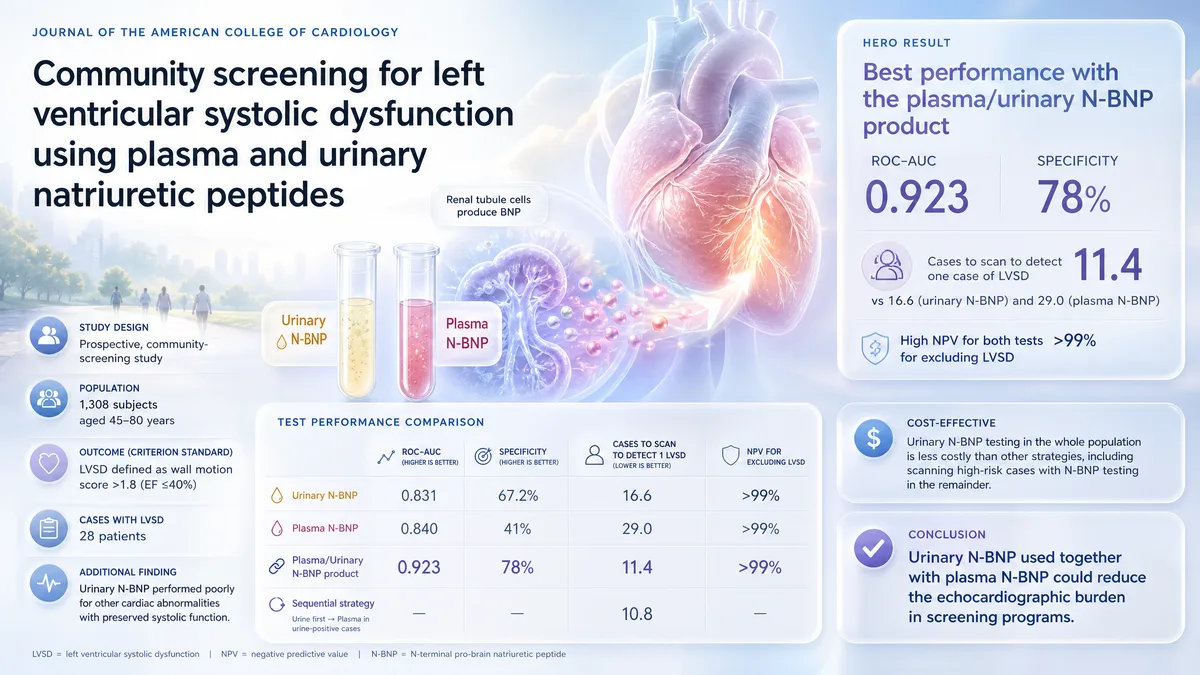
The plasma/urinary N-BNP product yielded a high ROC-AUC (0.923) and specificity (78%) for detecting left ventricular systolic dysfunction, reducing the number of echocardiograms needed to detect one case to 11.4.
May support community natriuretic peptide screening for LV dysfunction; hypothesis-generating, needs randomized confirmation before practice change.
Original Research
JUL 7JonesDiabetic Medicine
Effect of recommended footwear fit upon in‐shoe pressures in feet with diabetes—An exploratory study
Exploratory study assesses in-shoe pressures in diabetic patients using different toe gap footwear, indicating potential ulceration risk.
RCT
JUL 3PradhanGlobal Health Action
Effectiveness of tobacco cessation interventions delivered in clinical settings in South Asia: a systematic review and meta-analysis
Systematic review evaluates tobacco cessation interventions in South Asia, indicating effectiveness with combined approaches.
Meta-Analysis
JUN 23BannuruDiabetes Obesity and Cardiometabolic CARE
SGLT2 Inhibitors for the Primary Prevention of CKD in Type 2 Diabetes: A Systematic Review and Meta-analysis
Randomized trials evaluate SGLT2 inhibitors' effectiveness in preventing CKD in type 2 diabetes, suggesting beneficial outcomes.
Original ResearchThe Lancet Highlight
JUN 1LimThe Lancet
Biological and mechanistic pathways of cardiometabolic multiple long-term conditions
This article explores biological pathways and mechanisms contributing to cardiometabolic multiple long-term conditions, suggesting new approaches to health care.
Systematic Review
JUN 18GhafoorDiabetic Medicine
Comparative predictive accuracy of machine learning versus traditional statistical methods for diabetes‐related complications: A systematic review and analysis
Systematic review compares predictive accuracy of machine learning versus traditional methods for diabetes complications, suggesting methodological improvements are needed.
Literature Review
JUN 1KachaJournal of Multidisciplinary Healthcare
The Impact of the Multidisciplinary Team on Medication Adherence in Type 2 Diabetes: A Narrative Review
Narrative review reveals that multidisciplinary team interventions enhance medication adherence in type 2 diabetes, suggesting improved patient outcomes.
Original Research
JUN 15DaleNature Health
Patterns of medication use across society from national primary care dispensing data
Analysis of national medication dispensing finds pandemic effects and health disparities in different groups.
cohort · n=420,727European Heart Journal Highlight
JUL 2017YatesENLIGHTEN (Jurnal Bimbingan dan Konseling Islam)
Slow walking pace is linked to ~116% higher all-cause mortality, highest in underweight women.
A simple self-reported measure of slow walking pace is a strong predictor of all-cause and cardiovascular mortality, aiding risk stratification in the general population.
Cohort Study
MAY 8InjetyOphthalmology Science
Ethnicity-Stratified Normative Retinal Vascular Features from the UK Biobank Using Deep Learning
Purpose: Retinal vascular features provide noninvasive biomarkers of systemic vascular health, and deep learning tools such as AutoMorph now enable their large-scale quantification. However, researchers still lack normative data across diverse ethnic populations. Design: A prospective cohort study. Participants: We analyzed 6843 UK Biobank participants who reported no disease or medical condition according to the World Health Organization's International Classification of Diseases and Related Health Problems. Methods: We analyzed retinal images from the UK Biobank using the AutoMorph deep learning pipeline, which extracted retinal morphometric features such as vessel caliber, fractal dimension, vessel density, and tortuosity. We then used these data to define ethnicity-stratified normative ranges for retinal morphometric features in healthy UK Biobank participants. We examined associations with demographic covariates (age, sex, and ethnicity) using multivariate regression. Main Outcome Measures: We determined normal ranges for retinal morphometric features in the healthy UK Biobank population and assessed associations with age, sex, and ethnicity. Results: < 0.0001 for both). Across all metrics, ethnicity, followed by sex, exerted the strongest influence on vascular morphometrics. Conclusions: We established the first ethnicity-stratified normative dataset of retinal vascular features derived from the UK Biobank using deep learning. These data provide a reference framework for oculomic biomarkers in multi-ethnic populations and could support precision-medicine approaches to systemic disease risk assessment. Financial Disclosures: Proprietary or commercial disclosure may be found in the Footnotes and Disclosures at the end of this article.