
CirculationZipes et al.Original Research

Michael J. Ackerman
Electrophysiology
Mayo Clinic
About
Michael J. Ackerman works in Electrophysiology affiliated with Mayo Clinic.
Michael J. Ackerman, M.D., Ph.D., is a pediatric cardiologist at Mayo Clinic in Rochester, Minnesota. He serves as professor of medicine, pediatrics, and pharmacology, and directs the Windland Smith Rice Sudden Death Genomics Laboratory and the Long QT Syndrome/Inherited Arrhythmia Clinic. His research focuses on genomics and genotype-phenotype relationships in heritable cardiovascular diseases predisposing to sudden death.
Research focus
Long QT Syndrome (LQTS)Catecholaminergic Polymorphic Ventricular Tachycardia (CPVT)Hypertrophic Cardiomyopathy (HCM)Sudden Cardiac Death GenomicsInherited Arrhythmia Syndromes
Impact
1,422 pubs · 80,398 cites · h-index 153
Training
MD/PhD
Mayo Clinic College of Medicine
1995
BA Chemistry and Mathematics
Luther College
1988
Affiliations
Work Experience
Consultant, Division of Heart Rhythm Services, Department of Cardiovascular Medicine
Mayo Clinic
Consultant, Division of Pediatric Cardiology, Department of Pediatrics
Mayo Clinic
Consultant, Department of Molecular Pharmacology and Experimental Therapeutics
Mayo Clinic
Professor of Medicine, Pediatrics, and Pharmacology
Mayo Clinic College of Medicine
Publications

Medicine & Science in Sports & ExerciseGray et al.Guideline
Task Force 9: Clinical Considerations for the Care of Athletes with Cardiac Channelopathies
May support return to play for athletes with channelopathies through shared decision-making; challenges historical blanket disqualification policies.
Medicine & Science in Sports & ExerciseGati et al.Guideline

Task Force 4: Clinical Considerations for the Care of Athletes with Genetic Cardiomyopathies
Shifts eligibility decisions from disqualification to individualized, genotype-informed assessment in athletes with cardiomyopathies; extends 2020 consensus with shared decision-making emphasis.
JACCRohatgi et al.cohort
Prior symptoms in LQTS linked to a ~12-fold higher rate of breakthrough cardiac events.
Specialty-center LQTS management yields low BCE rates; leaves open optimization needs for the 25% of symptomatic patients with subsequent events.
JACCSpazzolini et al.cohort
ACA before age 1 year was associated with an HR of 23.4 for subsequent ACA or SCD during ages 1-10 years, while beta-blocker therapy reduced ACA/SCD only in those with recent syncope within 2 years and not in survivors of infantile ACA.
Infants with LQTS who survive an aborted cardiac arrest in the first year of life are at extremely high risk (HR 23.4) for recurrent arrest or sudden death before age 10, and beta-blocker monotherapy appears insufficient to protect this high-risk subset.
Heart RhythmCastrichini et al.Original Research
The artificial intelligence-derived electrocardiographic age gap is associated with adverse clinical outcomes in LMNA-related cardiomyopathy
JACCSiontis et al.case-control

The AUC of the AI-ECG model for HCM detection was 0.98 with a sensitivity of 97% and specificity of 91%.
Supports AI-ECG evaluation for pediatric HCM detection; leaves open prospective validation before screening use.
Heart RhythmCoderre et al.Original Research
Mitral Valve Prolapse and Ventricular Arrhythmia Risk in TTN-Mediated Cardiomyopathy: A Single Center Experience
Arthur A.M. Wilde
Cardiologist, Amsterdam University Medical Centers · Amsterdam University Medical Centers
to make hasty diagnosis of a disease that requires life-long treatment is inappropriate, especially when this is done without the support of adequate specific experience.
Phenotypes of Overdiagnosed Long QT Syndrome
Journal of the American College of CardiologyBains et al.
Thomas H. Marwick
Cardiologist and Director, Baker Heart and Diabetes Institute · Baker Heart and Diabetes Institute
The current paper confirms these findings in a larger group, shows that EMW outperformed QTc in predicting symptomatic patients (area under the curve: 0.78 vs. 0.70; p = 0.01), and confirms that EMW increases as the number of genetic abnormalities increases but was not clearly linked to a particular genotype. Importantly, it confirms the reliability of measuring this signal at routine echocardiography, with an intraclass correlation coefficient (ICC) of 0.93 (95% confidence interval: 0.89 to 0.96) among 22 sonographers who underwent a short training process.
Echocardiography-Guided Risk Stratification for Long QT Syndrome
Journal of the American College of CardiologySugrue et al.
JACCDineen et al.Guideline

A new scientific statement outlines cardiovascular care for tactical athletes like firefighters and military personnel.
This scientific statement from the ACC and AHA provides a framework for evaluating tactical athletes, including firefighters and military personnel, with or at risk for heart disease. It comprises 11 sections covering preparticipation screening, ethical aspects, and specific conditions like cardiomyopathies and arrhythmias. The document guides fit for full duty assessments by factoring in how a heart event might impact teammates, community safety, and mission success.
JACC. Clinical electrophysiologyCoderre et al.cohort
DCM phenotype shows no association with new-onset ventricular arrhythmias in Titin truncating variant carriers.
Ventricular arrhythmia risk appears comparable across titin truncating variant phenotypes; leaves open arrhythmia surveillance needs in phenotype-negative carriers pending prospective data.
JACC. Clinical electrophysiologyCastrichini et al.cohort
Transmural LGE is linked to ~90% higher risk of major arrhythmic and HF events.
Transmural LGE may identify higher-risk genotype-positive cardiomyopathy patients; leaves open its incremental value for risk stratification or management decisions.
Heart RhythmNouraee et al.cohort
Multiple pathogenic variants in ALVC/DCM genes linked to ~2.5-fold higher risk of major arrhythmic events.
May warrant closer monitoring in multiple-variant carriers; extends single-study evidence but leaves open therapeutic implications.
EP EuropaceGao et al.preclinical
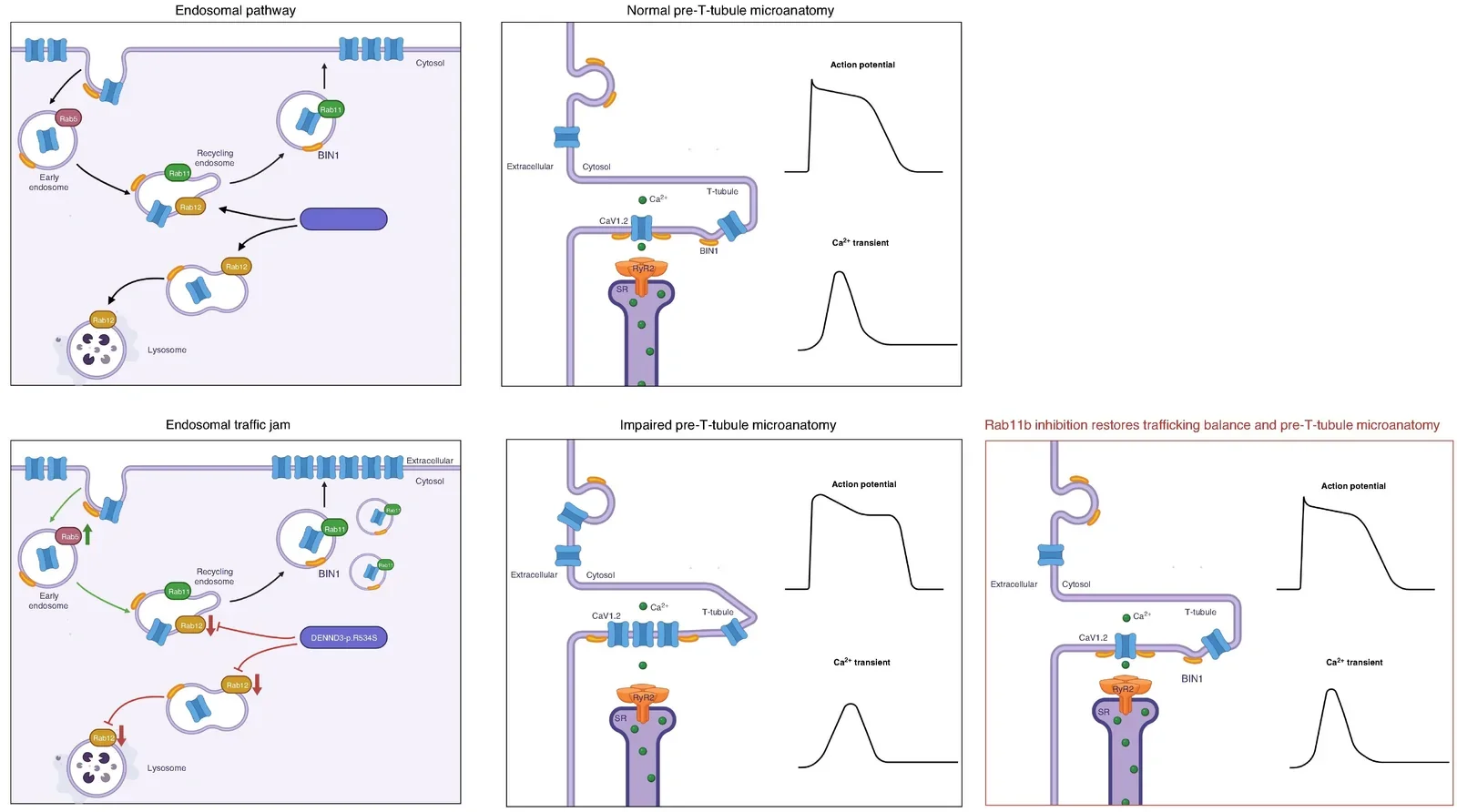
The DENND3-p.R534S variant increased arrhythmic activity in iPSC-CMs by disrupting BIN1-dependent microdomain architecture, which was rescued by Rab11b inhibition.
DENND3-p.R534S promotes arrhythmia in iPSC-CMs via microdomain disruption; hypothesis-generating for Rab11b inhibition in VF, not yet for clinical use.
Heart Rhythm O2Ezzeddine et al.Original Research

Desmoplakin cardiomyopathy reveals distinct myocardial immune cell infiltration patterns in explanted hearts.
May support immunomodulatory strategies in DSP cardiomyopathy; leaves open whether this alters progression or arrhythmias.
JACCFatunde et al.Original Research
AI-ECG predicts age and sex in athletes but fails to identify structural heart disease or AF.
AI-ECG sex/age signals in athletes should not change screening; leaves open validation for low EF, HCM, or AF detection.
Circulation Arrhythmia and ElectrophysiologyHuynh et al.preclinical
KCNH2-G604S variant prolongs action potential duration ~2-fold in iPSC-CMs via IKr loss and persistent ICa,L.
Secondary ICa,L remodeling may amplify LQT2 repolarization defects; hypothesis-generating for combined channel blockade in patient-derived models.
JACCBeavers et al.preclinical
JPH2 E169K mutation increases pacing-induced AF susceptibility to 60% via impaired RyR2 stabilization.
The JPH2 E169K mutation causes atrial fibrillation by impairing RyR2 stabilization, highlighting a novel mechanism of arrhythmogenesis and a potential therapeutic target.
