JACCVachiéry et al.review
Diastolic pulmonary gradient better distinguishes combined from isolated post-capillary PH in left heart disease.
May refine PH-LHD phenotyping in practice; leaves open prospective validation of the proposed definition.

946 pubs · 114,056 cites · h-index 150
JACCVachiéry et al.review
May refine PH-LHD phenotyping in practice; leaves open prospective validation of the proposed definition.
JACCPerros et al.Original Research
JACCSimonneau et al.Guideline
Refines PH categorization for prognosis and therapy selection; extends prior classifications by integrating genetic subgroups into Group 1.
JACCSimonneau et al.Original Research
Consensus review demonstrates updated categorization criteria for pulmonary hypertension in affected cohorts, highlighting refined diagnostic boundaries for tailored therapeutic management.
CirculationHumbert et al.Original Research
JACCCastelain et al.cross-sectional
This study compared pulmonary artery pressure waveforms in 14 patients with either chronic pulmonary thromboembolism or primary pulmonary hypertension. While overall pulse pressures were similar, the thromboembolism group had a shorter time to wave reflection at 90 milliseconds versus 126 milliseconds, and a higher augmentation index at 0.26 versus 0.09. This suggests the pulsatile component of right ventricular afterload differs between the two conditions.
European Respiratory JournalGaine et al.RCT
Randomized trial evaluates selexipag's impact on morbidity/mortality in connective tissue disease patients, suggesting significant benefits.
NEJMSitbon et al.RCT
Supports selexipag addition in PAH to reduce events; confirms benefit in large Phase 3 RCT.
Pulmonary Hypertension Research and Treatments · Inserm
Speaking to the importance of the patient associations across the world, specifically mentioning PHA and PHA Europe.
Journal of the American College of CardiologyGaliè et al.
JACCJaïs et al.RCT
In patients with inoperable or persistent/recurrent CTEPH, 16 weeks of bosentan therapy significantly improved pulmonary hemodynamics but did not improve exercise capacity.
JACCOudiz et al.cohort
Long-term treatment with tadalafil 20 mg or 40 mg is well tolerated and maintains exercise capacity improvements for up to 52 weeks in patients with pulmonary arterial hypertension.
JACCGaliè et al.RCT
Supports oral beraprost sodium in PAH; extends RCT evidence for prostacyclin analogues on hemodynamics and exercise capacity.
JACCSitbon et al.cohort
May support epoprostenol consideration in primary pulmonary hypertension; hypothesis-generating pending larger confirmatory trials.
JACCGaliè et al.RCT
Ambrisentan significantly improves exercise capacity, symptoms, and hemodynamics in patients with pulmonary arterial hypertension across multiple doses, with a low incidence of liver enzyme abnormalities.
ERJ Open ResearchDelcroix et al.Original Research
Analysis evaluates survival effects of guanylate cyclase stimulator in CTEPH patients treated with and without intervention.
JACCLang et al.cohort
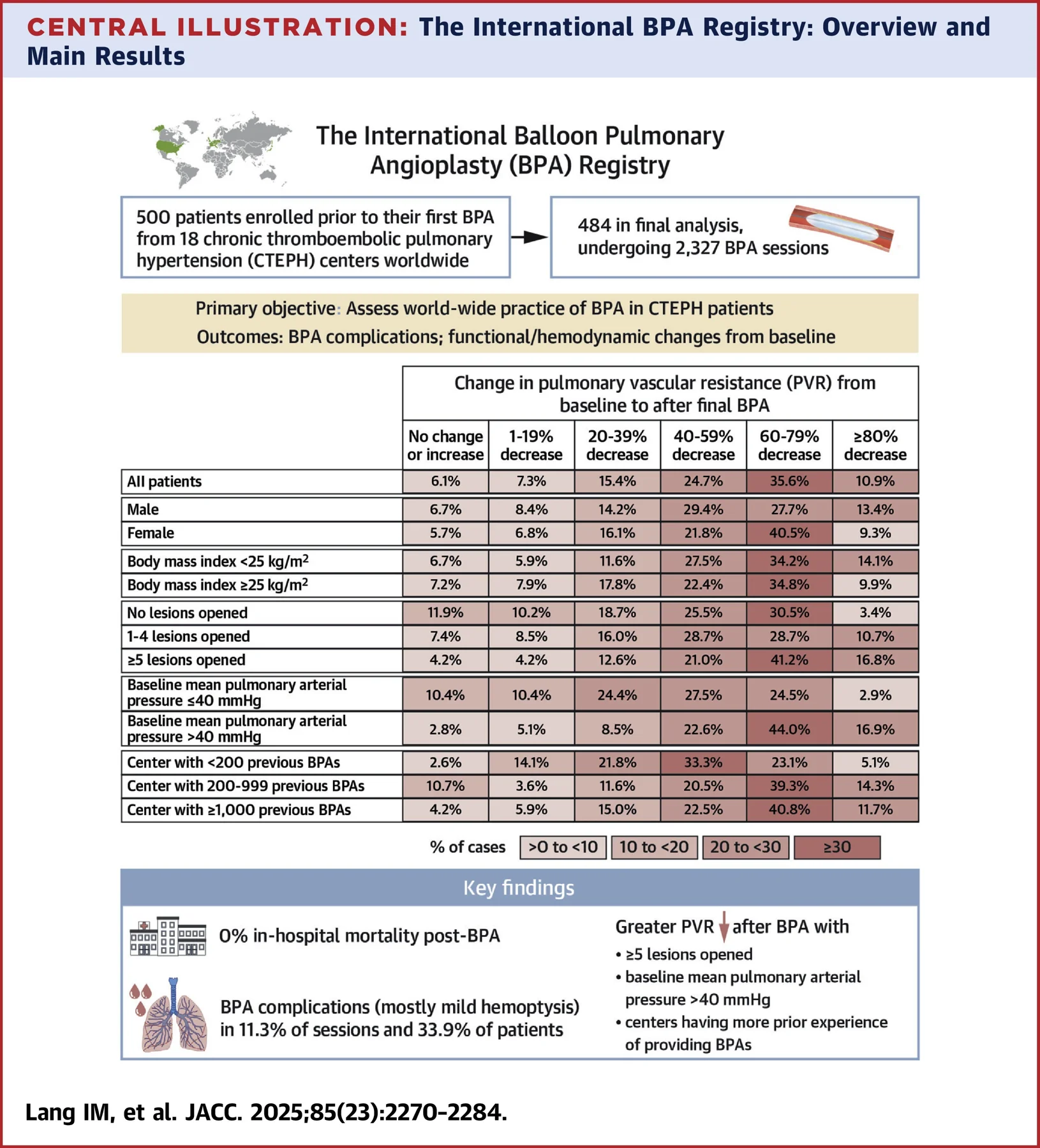
Balloon pulmonary angioplasty significantly improves hemodynamics and functional capacity in patients with inoperable chronic thromboembolic pulmonary hypertension, with acceptable complication rates.
Circulation Cardiovascular InterventionsGerges et al.cohort
BPA may confer greater RV afterload reduction and function gains than riociguat; leaves open optimal sequencing and clinical outcomes in inoperable CTEPH.
CirculationDelcroix et al.cohort
In a global registry of newly diagnosed CTEPH patients, 3-year survival was excellent for those undergoing pulmonary endarterectomy (94%) or balloon pulmonary angioplasty (92%), significantly higher than those receiving no mechanical intervention (71%).
European Respiratory JournalKim et al.review
May support multimodal CTEPH strategies; leaves open optimal sequencing and durability.