European Heart Journal - Quality of Care and Clinical OutcomesMascolo et al.Original Research

Massimo Piepoli
Heart Failure / Cardiomyopathy
Guglielmo da Saliceto Hospital
About
Massimo Piepoli works in Heart Failure / Cardiomyopathy affiliated with Guglielmo da Saliceto Hospital.
Massimo Francesco Piepoli is a Professor of Cardiology at the University of Milan and Director of the Clinical Cardiology Unit at IRCCS Policlinico San Donato. His research focuses on the pathophysiology of heart failure, neuro-hormonal imbalance in cardiovascular disease, and cardiovascular prevention. He has been extensively involved with the European Society of Cardiology (ESC), serving as Vice President and contributing to numerous clinical practice guidelines.
Research focus
Chronic Heart FailureCardiovascular Disease PreventionExercise Physiology in Heart DiseaseArterial HypertensionCardio-Oncology
Impact
943 pubs · 252,589 cites · h-index 148
Training
PhD
Imperial College London
1996
Specialization in Cardiology
Università di Pavia
1991
MD
Università di Pavia
1987
Affiliations
Work Experience
Director of Clinical Cardiology Unit
IRCCS Policlinico San Donato, University of Milan
Professor of Cardiology
University of Milan
Teaching Professor
Scuola Superiore Sant'Anna in Pisa
Editor-in-Chief
European Journal of Preventive Cardiology · 2017 - Present
Head of the Heart Failure Unit
Ospedale Guglielmo da Saliceto, Piacenza
Publications
The American Journal of CardiologyCarluccio et al.Original Research
Differential Reverse Remodeling but Preserved Clinical Benefit of Sacubitril/Valsartan in Ischemic vs Non‑Ischemic HFrEF
Claudio Passino
Heart Failure & Transplant · University of Pisa
Reversing neurohormonal activation by physical training adds to the current clinical practice a novel non-pharmacological aid. Out of 85 patients who completed the protocol, only the 44 randomized to the training program improved functional capacity, systolic function, and quality of life, in contrast to the controls. These beneficial effects were associated with a decrease in plasma level of BNP, NT-proBNP, and norepinephrine, only in the training group.
Aerobic Training Decreases B-Type Natriuretic Peptide Expression and Adrenergic Activation in Patients With Heart Failure
Journal of the American College of CardiologyPassino et al.
European Heart Journal - Quality of Care and Clinical OutcomesPalazzuoli et al.review
Answers
How does tissue congestion differ pathophysiologically and diagnostically from intravascular congestion in heart failure?
Multimodal assessment combining ultrasound, invasives, and biomarkers improves evaluation of congestion in acute heart failure.
May refine acute HF congestion assessment; leaves open whether multimodal evaluation improves outcomes.
European Journal of Heart FailureAttanasio et al.Original Research
Pharmacological optimization in the treatment of Heart Failure in Women (PopS-HF): rationale and design of a prospective pragmatic, multicentre, randomized trial
European Heart Journal - Quality of Care and Clinical OutcomesGuida et al.Original Research
Pharmacological therapies and clinical outcomes
European Heart Journal SupplementsMapelli et al.cohort
Answers
Does a specific MECKI score threshold identify ambulatory heart failure patients with a 5-year prognosis worse than heart transplant recipients?
High MECKI score identifies ambulatory heart failure patients with worse 5-year survival than heart transplant recipients.
MECKI ≥0.1368 may identify ambulatory HF patients warranting HTX consideration; leaves open need for prospective validation before practice change.
JACCGiannoni et al.cohort

Answers
Does enhanced chemosensitivity to hypoxia and hypercapnia predict the composite of cardiac death and aborted cardiac death in patients with systolic heart failure?
Enhanced chemosensitivity to hypoxia and hypercapnia is linked to ~51% lower 4-year survival in HFrEF.
Combined chemosensitivity testing may aid risk stratification in systolic HF; leaves open whether it guides therapy or requires prospective validation.
LancetPonikowski et al.RCT

Answers
Does intravenous ferric carboxymaltose reduce total heart failure hospitalisations and cardiovascular death in patients stabilised after an episode of acute heart failure with iron deficiency and LVEF <50%?
Ferric carboxymaltose did not reduce the composite of total heart failure hospitalizations and cardiovascular death compared to placebo.
In patients with LVEF <50% and iron deficiency stabilized after acute heart failure, intravenous ferric carboxymaltose narrowly missed statistical significance for the primary composite of total HF hospitalizations and CV death, but significantly reduced total HF hospitalizations.
EHJBrignole et al.Guideline

Answers
What are the evidence-based clinical indications for cardiac pacing?
2013 ESC Guidelines on cardiac pacing and cardiac resynchronization therapy
Guidelines advise but do not dictate care; leaves open how clinicians weigh them in individual cases.
JACCCaminiti et al.RCT
Answers
Does long-acting testosterone improve functional exercise capacity, skeletal muscle performance, insulin resistance, and baroreflex sensitivity in elderly patients with chronic heart failure?
Testosterone improves exercise capacity, muscle strength, and insulin sensitivity in elderly men with heart failure.
Long-acting testosterone therapy improves exercise capacity, muscle strength, glucose metabolism, and baroreflex sensitivity in elderly men with moderately severe chronic heart failure.
EHJMembers et al.Guideline
Answers
What are the current evidence-based recommendations for the diagnosis of acute pulmonary embolism?
2014 ESC Guidelines on the diagnosis and management of acute pulmonary embolism
Provides the 2014 European Society of Cardiology standard of care for diagnosing and managing acute pulmonary embolism.
EHJSalvioni et al.cohort
Answers
Does a gender re-calibrated MECKI score improve prognostic accuracy for the composite of all-cause mortality, urgent heart transplant, and LVAD implant in patients with HFrEF compared to the native MECKI score?
Gender-recalibrated MECKI score modestly improves 2-year prognostic accuracy for major events versus the native score.
Gender recalibration may modestly enhance MECKI prognostication; leaves open clinical impact pending prospective validation.
ENLIGHTEN (Jurnal Bimbingan dan Konseling Islam)Taylor et al.meta-analysis
AnswersConfirms guidelines
Does exercise-based cardiac rehabilitation improve health-related quality-of-life and exercise capacity in patients with heart failure?
Exercise-based cardiac rehab improves walking distance by ~21 meters and HF quality of life.
May improve functional capacity with therapy; confirms primary endpoint benefit in large RCT.
EHJGuzik et al.editorial

Answers
How does artificial intelligence affect scientific integrity and editorial workflows in biomedical publishing?
Artificial intelligence in biomedical publishing offers opportunities to accelerate knowledge generation but introduces risks requiring transparency, provenance, and enforceable human responsibility.
This commentary highlights the need for transparency, provenance, and enforceable human responsibility to mitigate the risks of AI in biomedical publishing.
EHJGuasti et al.Guideline
Ultra-processed foods, lifestyle management, and cardiovascular diseases
This ESC clinical consensus statement provides actionable advice for cardiologists to incorporate assessment and counselling regarding the cardiovascular risks of ultra-processed foods into routine care.
European Heart Journal - Quality of Care and Clinical OutcomesMascolo et al.editorial
Answers
How does the application of risk stratification scores and quality indicators improve outcomes across heart failure and predisposing cardiovascular diseases?
Data from multiple registries and cohorts underscore the importance of quality indicators and risk stratification, noting nearly 20% of children with repaired PAH-CHD died within ten years.
Provides a broad overview of contemporary cardiovascular research, emphasizing the implementation of precision medicine, advanced imaging, and quality indicators to improve patient outcomes.
European Heart Journal - Quality of Care and Clinical OutcomesAndrea et al.Original Research
Quality of care and clinical outcomes in invasive and interventional cardiology
European Heart Journal - Quality of Care and Clinical OutcomesChen et al.Cost-Effectiveness Analysis
First systematic screening of cardiac amyloidosis in the elderly: findings and cost-effectiveness profile
AIMS: Wild-type transthyretin cardiac amyloidosis (ATTRwt-CA) is increasingly recognized in older adults. Nonetheless, its true prevalence in unselected subjects is unclear. We performed a systematic screening in 1000 individuals aged 65-90 years to identify CA and assess the clinical and economic impact of diagnosing both CA and incidental findings. METHODS AND RESULTS: All participants underwent a cardiology visit, electrocardiogram, echocardiogram, and measurement of cardiac biomarkers. Patients with any red flag proceeded to bone scintigraphy and monoclonal protein testing. We catalogued incidental cardiac or renal abnormalities, referred individuals for further evaluation, and estimated total screening costs. We then incorporated tafamidis therapy for the newly diagnosed patients with CA and conducted two cost-effectiveness analyses: one excluding quality-adjusted life years (QALYs) from incidental diagnoses and another one including them. Four new cases of ATTRwt-CA were diagnosed (0.46%). Additional findings included moderate-to-severe valvular disease, conduction abnormalities requiring device implantation, and previously unknown Stage 3-5 chronic kidney disease in 15.6% of participants. The total non-drug screening cost was around €252 000, while tafamidis (5 years, four patients) added €1 080 000. Excluding incidental benefits, the incremental cost-effectiveness ratio (ICER) was around €94 000 per QALY. With an estimated 15-20 extra QALYs from incidental findings, the ICER fell to €39 000-€46 000 per QALY. CONCLUSION: A structured screening programme for CA in elderly subjects can uncover important comorbidities but remains expensive, with an incremental cost of approximately €39 000-€94 000 per QALY; the overall value of such a strategy will therefore depend on tafamidis pricing and the willingness-to-pay threshold adopted by individual health systems.
European Journal of Heart FailureInciardi et al.cohort

Answers
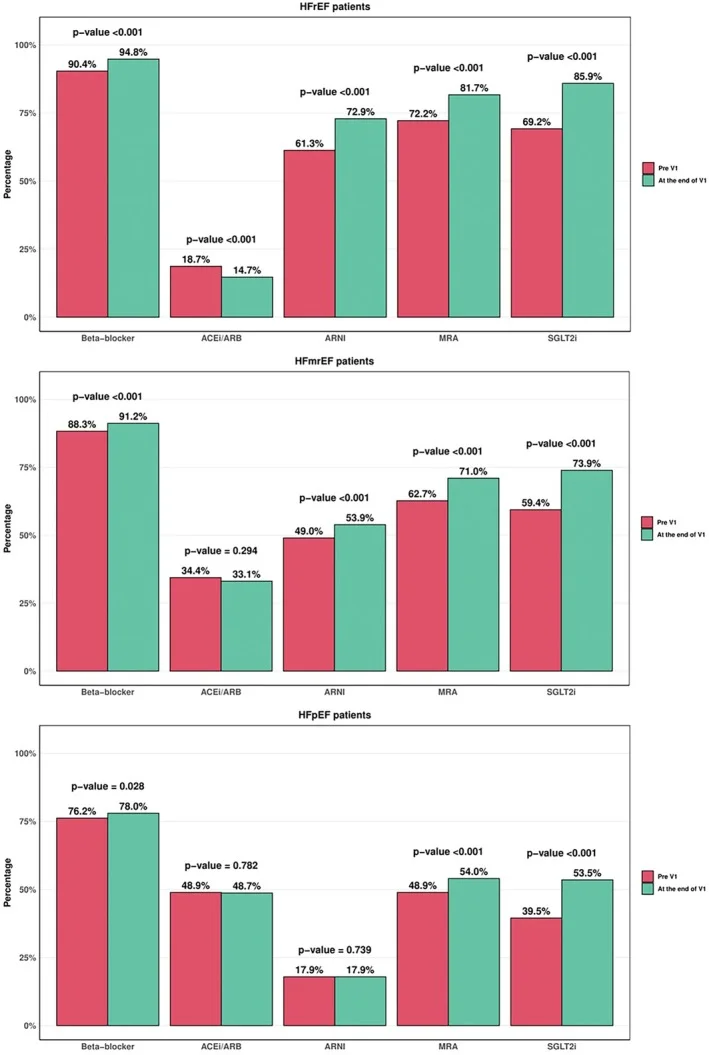
What are the prescription and dosing rates of guideline-directed medical therapy across the ejection fraction spectrum in contemporary heart failure clinical practice?
Quadruple GDMT remains underused in HFrEF, with only ~47% of patients receiving all four classes.
GDMT underuse persists in contemporary Italian HF registry; leaves open effective implementation strategies for prospective trials.