This research is Trending!
June 1, 2026Journal of the American College of Cardiology
AHA/ACC/ESC/WHF Expert Consensus Document: Second Universal Definition of Heart Failure (2026)
View Full Paper
Ask AI
Bookmark
Share
Why the study?
Subjectivity and ambiguity in defining heart failure and its antecedent stages have limited research, surveillance, and prevention programs, necessitating an updated, standardized terminology reflecting clinical realities and advances.
Key Points
- The updated framework reclassifies heart failure phenotypes into reduced, preserved, and improved left ventricular ejection fraction categories, mirroring clinical realities.
- Since the 2021 standardization designating stage B pre-heart failure, clinical surveillance reveals growing disease prevalence, particularly among patients with preserved ejection fraction.
- Expert consensus document convened across major societies defines heart failure by integrating natriuretic peptide levels and imaging evidence of elevated pulmonary congestion.
- May enable improved prevention and global surveillance of heart failure, while addressing dynamic trajectories of remission and disparities driven by social determinants of health.
PICO
P
Population
Heart failure
Limitations
- There remains a shortage of high-quality data on heart failure prevalence, causes, and outcomes in many low- and middle-income countries.
- The full extent of the influence of socioeconomic determinants on presentation, management, and outcomes of heart failure remains poorly understood.
Key expert perspectives
Captured external expert commentary on this paper, strongest first. Original sources are linked where available.

“Heart failure remains a major challenge that continues to grow globally, and inconsistencies in how it is defined have limited progress in research and treatment. This updated definition provides a clearer, more consistent framework to help clinicians identify risk earlier and guide more personalized treatment approaches that can help improve patient outcomes worldwide.”
“The new framework recognizes that heart failure is not a static condition. By focusing on stages of disease, underlying causes and disease trajectories—including improvement, remission and recovery—we can better tailor care and advance prevention efforts.”

“The updated universal definition of heart failure matters because it finally brings global consistency to how we diagnose and describe heart failure. By modernizing the definition, clinicians can improve early detection, tailor treatment more precisely, and ultimately improve outcomes for millions of people worldwide at risk and with heart failure.”
Implication
This updated consensus document provides a comprehensive, standardized framework for defining and classifying heart failure phenotypes and causes to facilitate uniform global approaches to diagnosis, research, and management.
Abstract
Heart failure (HF) remains a pressing health concern, with rising prevalence globally. Subjectivity and ambiguity in the definition of HF and its antecedent stages have limited research, global surveillance, and prevention programs. To address this, several cardiac societies and foundations convened to standardize the definition of HF in 2021 and designated stage B or pre-HF to identify individuals at risk of developing HF. In subsequent years, substantial progress and changes have been made in aspects of preventing HF, improving HF diagnosis and management, and recognizing the importance of the affected individual's voice. Global differences and disparities in HF are better understood, as are causes and comorbidities leading to differences in care, which are also influenced by access to care. This consensus document presents the Second Universal Definition of Heart Failure, aiming to standardize terminology and facilitate a uniform approach for clinicians, researchers, health systems, and policymakers. In this definition, the classification of HF phenotypes moves away from rigid left ventricular ejection fraction cutoffs, instead grouping HF into reduced, preserved, and improved ejection fraction categories to better reflect clinical realities. A universal classification of HF causes is also proposed. The document also addresses the dynamic trajectories of HF-improvement, remission, and recovery-and highlights the impact of social determinants and geographic variation on HF risk and outcomes. By providing a comprehensive, standardized framework for HF definition and classification, this document seeks to improve prevention, early detection, and management of HF worldwide, ultimately enhancing patient care and advancing global cardiovascular health.
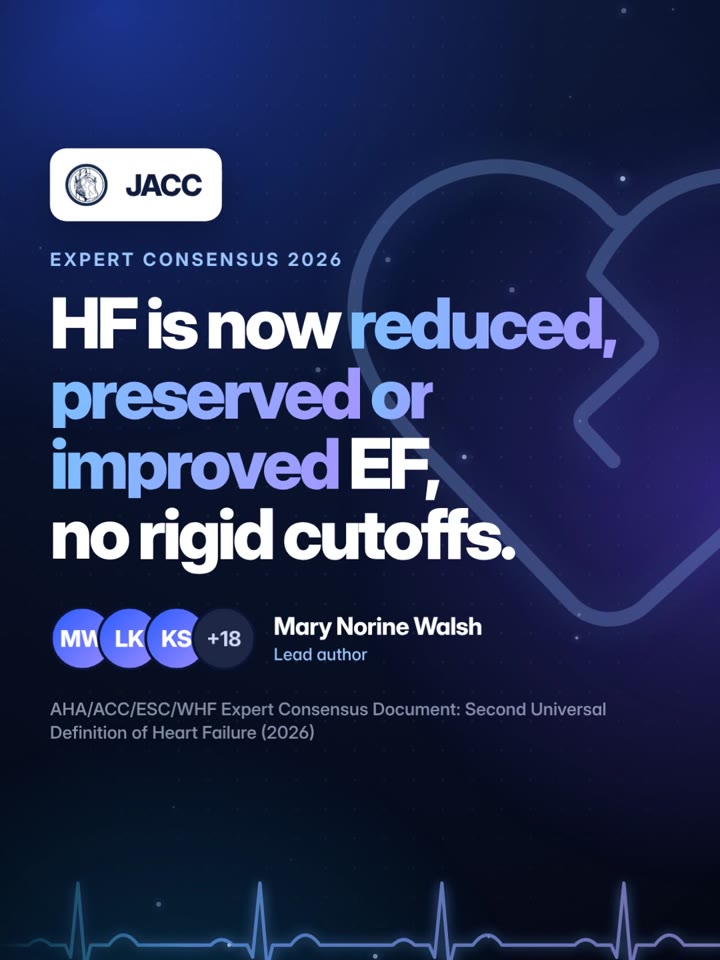
JACC · expert consensus 2026. HF is now reduced, preserved or improved EF, no rigid cutoffs. AHA/ACC/ESC/WHF Expert Consensus Document: Second Universal Definition of Heart Failure (2026) Inconsistent HF definitions limited progress: Research, Surveillance, Prevention. Categories replace rigid cutoffs: EF categories vs Rigid LVEF cutoffs. Plus a universal classification of HF causes: Reduced EF, Preserved EF, Improved EF, Classified causes. Gregg Fonarow (Interim chief of cardiology, University of California Los Angeles · University of California Los Angeles): “The updated universal definition of heart failure matters because it finally brings global consistency to how we diagnose and describe heart failure.” From their public comments on the paper Bottom line: Standardized HF categories should now guide diagnosis, management and trial design.
Discussion
No takes yet. Share an insight, caveat, or question.
Cite This Study
Walsh et al. (2026) conducted a review in Heart failure. The Second Universal Definition of Heart Failure standardizes terminology by classifying heart failure into reduced, preserved, and improved ejection fraction categories rather than using rigid cutoffs.
View Full Paper
Ask AI
Bookmark
Share