This research is Trending!
Key result
DOAC therapy cuts major cardiovascular and bleeding events ~69% versus no anticoagulation.
- HR 0.31
- 95% CI 0.10 to 0.94
- P=0.03
- n=1,803
Why the trial?
Guidelines firmly recommend anticoagulation at high stroke risk and against it at low risk, but atrial fibrillation with intermediate risk (CHA2DS2-VA 1) sits in an evidence gap. Whether the stroke protection of a DOAC outweighs its bleeding cost in these patients had never been settled in a dedicated randomised trial.
Does DOAC therapy reduce the composite of stroke, systemic embolism, major bleeding, or cardiovascular death in patients with atrial fibrillation at intermediate risk for stroke compared to no anticoagulation?
Key Points
- To determine whether direct oral anticoagulant therapy reduces cardiovascular events compared with no anticoagulation in patients with atrial fibrillation at intermediate risk for stroke.
- Randomized trial (SINGLE-AF, NCT04437654) enrolling 1803 patients with atrial fibrillation and intermediate stroke risk, assigned 1:1 to direct oral anticoagulant (DOAC) therapy (N=902) or no anticoagulation (N=901).
- Follow-up lasted 24 months to assess the primary composite end point of stroke, systemic embolism, major bleeding, or cardiovascular death.
- The primary composite end point occurred in 4 patients (cumulative incidence, 0.5%) in the DOAC group versus 13 patients (cumulative incidence, 1.5%) in the no-anticoagulation group (difference, -1.0 percentage points; 95% CI, -2.0 to -0.1; P = 0.03; HR, 0.31; 95% CI, 0.10 to 0.94).
- Stroke occurred in 3 patients (0.3%) in the DOAC arm versus 10 patients (1.1%) in the control arm, with similar rates of systemic embolism and major bleeding between groups and no cardiovascular deaths in either group.
- Serious adverse events occurred in 80 patients (8.9%) in the DOAC group and 84 patients (9.3%) in the no-anticoagulant group.
Evidence details
What drove the result?
| Outcome | DOAC | No OAC |
|---|---|---|
| Stroke, systemic embolism, major bleeding, or CV death | 4 (0.5%) | 13 (1.5%) |
| HR 0.31 (95% CI 0.10-0.94); difference -1.0 pp (-2.0 to -0.1); P=0.03 | ||
| Stroke | 3 (0.3%) | 10 (1.1%) |
| Composite component - drove the result | ||
| Death from cardiovascular causes | 0 | 0 |
| No cardiovascular deaths in either group | ||
Limitations & tradeoffs
Safety
Serious adverse events 80/902 (8.9%) vs 84/901 (9.3%).
Statistical certainty
only 17 primary end-point events occurred, and the wide CI (0.10-0.94) is compatible with anything from a large to a minimal benefit.
Representation
patients were relatively young (mean 60.4 years) and enrolled in South Korea.
Structured PICO
Does DOAC therapy reduce the composite of stroke, systemic embolism, major bleeding, or cardiovascular death in patients with atrial fibrillation at intermediate risk for stroke compared to no anticoagulation?
P
Population
1,803 patients (mean age 60.4 years, 23.7% women) with atrial fibrillation at intermediate risk for stroke, followed for 24 months.
I
Intervention
Direct oral anticoagulant (DOAC) therapy
C
Comparator
No anticoagulation
O
Outcome
Composite of stroke, systemic embolism, major bleeding, or death from cardiovascular causes at 24 monthscomposite
Main Result
Hazard Ratio: 0.31 (95% CI 0.1–0.94)
Absolute Event Rate: 0.5% vs 1.5%
Absolute Risk Reduction: 1%
p-value: p=0.03
In patients with atrial fibrillation at intermediate stroke risk, DOAC therapy significantly reduced the composite risk of stroke, systemic embolism, major bleeding, or cardiovascular death at 24 months compared to no anticoagulation.
Discussion
Key questions
No takes yet. Share an insight, caveat, or question.
Where experts stand
Experts broadly read SINGLE-AF as the first randomized evidence supporting DOAC therapy in intermediate-risk AF, with several calling it practice-changing, though some flag the low event rates and single-country cohort as reasons for caution.
Cardiologists and electrophysiologists welcomed SINGLE-AF as filling a long-standing evidence gap for anticoagulation in AF patients with only one non-sex stroke risk factor. Most see the result as reinforcing or upgrading what had been a guideline suggestion based on observational data alone. The live question is whether the finding, drawn from a Korean-only cohort with very low event rates, will generalize enough to shift global practice and guideline strength.
Agreement
Multiple clinicians agree that SINGLE-AF provides the first randomized trial evidence supporting DOAC therapy in AF patients at intermediate stroke risk, filling an important evidence gap that previously relied on observational data.
4 clinicians say this directly
What they’re arguing about
supportiveneutralcautiouscritical
Counts are expert takes we classified by axis. Tap a row to see the takes behind its count.
Still unclear
Whether results from a Korean-only cohort with very low absolute event rates will generalize to more diverse populations. Whether the finding will strengthen the current class IIa recommendation to a firmer guideline endorsement. Whether longer follow-up or larger trials are needed given the small number of primary endpoint events.
Key expert perspectives

“The key impact on clinical practice is that the level of evidence about this population was actually very low, and this is the first [randomized controlled trial] to support that DOAC therapy can give benefit to this patient population.”

SINGLE-AF is practice-changing and warns against undertreating intermediate-risk AF
Calls SINGLE-AF the first randomized evidence supporting DOAC therapy in intermediate-low stroke risk AF and labels it practice-changing. Argues the trial's most important message is that while the field debates when not to anticoagulate, undertreatment also carries real consequences.

RCT evidence now backs the class IIa guideline recommendation to anticoagulate
Notes that DOAC beat no anticoagulation at 24 months with an HR of 0.31 and frames the result as randomized trial evidence finally supporting what had been a class IIa guideline call built on observational data.
Distilled from their postX post
Implication
Supports DOAC use in intermediate-risk AF; extends randomized evidence beyond high-risk populations.
Abstract
BACKGROUND: Current U.S. and European guidelines recommend oral anticoagulation as a class IIa indication in patients with atrial fibrillation at intermediate risk for stroke; however, evidence from randomized trials is needed. METHODS: -VASc scale; range, 0 to 9, with higher scores indicating a greater risk of stroke). Patients were randomly assigned in a 1:1 ratio to receive either direct oral anticoagulant (DOAC) therapy or no anticoagulation. The primary end point was a composite of stroke, systemic embolism, major bleeding, or death from cardiovascular causes at 24 months. RESULTS: Of 1803 patients who underwent randomization, 902 were assigned to receive DOAC therapy and 901 were assigned to receive no anticoagulant therapy. The mean age of the patients was 60.4 years, and 23.7% were women. At 24 months, a primary end-point event had occurred in 4 patients (cumulative incidence, 0.5%) in the DOAC group and in 13 (cumulative incidence, 1.5%) in the no-anticoagulant group (difference, -1.0 percentage points; 95% confidence interval [CI], -2.0 to -0.1; P = 0.03; hazard ratio, 0.31; 95% CI, 0.10 to 0.94). Stroke occurred in 3 patients (cumulative incidence, 0.3%) in the DOAC group and in 10 (cumulative incidence, 1.1%) in the no-anticoagulant group. The incidence of systemic embolism and major bleeding appeared to be similar in the two trial groups, and no deaths from cardiovascular causes occurred in either group. Serious adverse events occurred in 80 patients (8.9%) in the DOAC group and in 84 (9.3%) in the no-anticoagulant group. CONCLUSIONS: Among patients with atrial fibrillation at intermediate risk for stroke, DOAC therapy led to a lower risk of stroke, systemic embolism, major bleeding, or death from cardiovascular causes at 24 months than no anticoagulation. (Funded by the Ministry of Health and Welfare, South Korea, and others; SINGLE-AF ClinicalTrials.gov number, NCT04437654.).
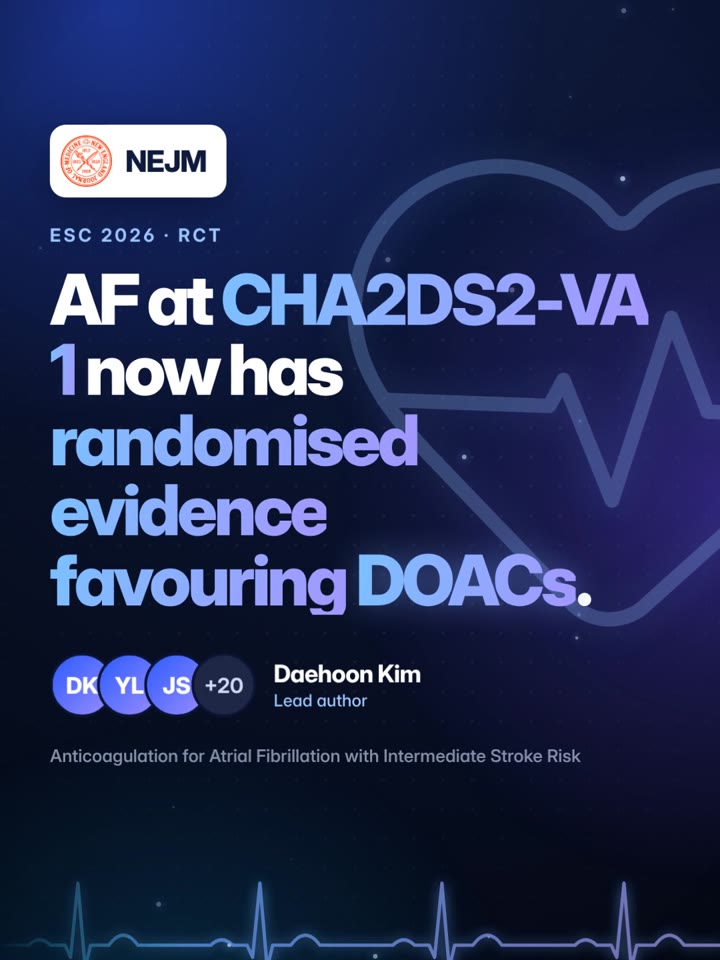
NEJM · ESC 2026 · RCT. AF at CHA2DS2-VA 1 now has randomised evidence favouring DOACs. SINGLE-AF: Anticoagulation for Atrial Fibrillation with Intermediate Stroke Risk 1,803 patients: AF at intermediate stroke risk, mean age 60.4. Randomised, followed for 24 months: DOAC vs No anticoagulation. Stroke, embolism, major bleeding or CV death: DOAC 0.5% vs No OAC 1.5%. HR 0.31 (95% CI 0.10–0.94). Composite events lower with DOAC. Stroke drove the difference: Fewer strokes, Similar major bleeding, No CV deaths. Bottom line: Randomised evidence now supports DOACs in intermediate-risk AF.
Coverage & sources
Journal, society, and media accounts. Useful signal, not independent expert judgment.
Cite This Study
Kim et al. (2026) conducted an RCT in Atrial fibrillation with intermediate stroke risk (n=1,803). Direct oral anticoagulant (DOAC) therapy vs. No anticoagulation was evaluated on Composite of stroke, systemic embolism, major bleeding, or death from cardiovascular causes at 24 months (HR 0.31, 95% CI 0.10 to 0.94, p=0.03). In patients with intermediate-risk atrial fibrillation, DOAC therapy reduced stroke, systemic embolism, major bleeding, or CV death compared to no anticoagulation (HR 0.31; 95% CI 0.10-0.94; P=0.03).