This research is Trending!
View all ESC 2026 trials
Timing of PCI in Patients Undergoing Transcatheter Aortic-Valve Implantation
Barbara Elisabeth StähliFrank RuschitzkaDirk WestermannAxel LinkeNorman MangnerNicolas M. Van MieghemRahel KesterkeLaura OberholzerJürgen RotheConstantin von zur MühlenTobias ZeusWon‐Keun KimPhilipp LautenNikos WernerChristof BurgdorfHannes AlberP. Christian SchulzeMichael JonerJonathan MichelAlessandro CandrevaPhilipp JakobMichael WürdingerJulia StehliAlexander GotschyChristian TemplinOmer DzemaliLuise GaedeSteffen MaßbergAlexander LautenFrank van der KleyAydan EwersThomas NestelbergerMohamed Abdel‐WahabGiuseppe MusumeciSebastian BarthMichael HansenAndreas MüggeMoritz SeiffertD L David Manuel LeistnerThomas CuissetSteffen SchneiderAdnan KastratiIan FordMarkus A. Kasel
Key result
A TAVI-first strategy was noninferior to a PCI-first strategy in severe aortic stenosis with concomitant coronary artery disease: the primary composite endpoint occurred in 22.2% vs 24.2% at 1 year (risk difference -2.0 percentage points; 95% CI -7.4 to 3.4; p for noninferiority <0.001) among 986 patients.
Why the trial?
Many patients undergoing TAVI have concomitant coronary artery disease, yet whether PCI should be performed before or after the valve procedure had never been randomised, leaving the sequencing decision to local practice.
Does a strategy of TAVI before PCI reduce adverse clinical events in patients with severe aortic stenosis and coronary artery disease compared to PCI before TAVI?
Key Points
- To evaluate whether performing transcatheter aortic-valve implantation (TAVI) before percutaneous coronary intervention (PCI) is noninferior to performing PCI before TAVI in patients with severe aortic stenosis and coronary artery disease.
- International, open-label, randomized noninferiority trial conducted across 48 centers in Europe (N=986; NCT04310046).
- Participants were randomly assigned in a 1:1 ratio to receive either TAVI before PCI (TAVI-first group, n=498) or PCI before TAVI (PCI-first group, n=488).
- The primary end point was a 1-year composite of all-cause mortality, nonfatal myocardial infarction, ischemia-driven revascularization, rehospitalization related to the valve, procedure, or heart failure, or major/disabling/life-threatening bleeding (noninferiority margin: 6.6 percentage points).
- A primary end-point event occurred in 105 patients (22.2%) in the TAVI-first group and 112 patients (24.2%) in the PCI-first group (risk difference, −2.0 percentage points; 95% CI, −7.4 to 3.4; P<0.001 for noninferiority).
- Serious adverse events were reported in 264 patients in the TAVI-first group and in 273 patients in the PCI-first group.
Evidence details
What drove the result?
| Outcome | TAVI first | PCI first |
|---|---|---|
| Death, MI, revascularization, rehospitalization, or major bleeding | 105 (22.2%) | 112 (24.2%) |
| Primary composite · RD −2.0 pp (95% CI −7.4 to 3.4); noninferior (margin 6.6 pp; p<0.001) | ||
Limitations & tradeoffs
Safety
Serious adverse events occurred in 264 vs 273 patients (of 498 vs 488 randomized).
Design limitations
The trial was open-label, and individual components of the composite are not reported in the abstract.
Statistical certainty
Noninferiority was defined against a wide 6.6-percentage-point margin, and reported percentages do not match crude counts over the randomized Ns, implying an analysis population not detailed in the abstract.
Structured PICO
Does a strategy of TAVI before PCI reduce adverse clinical events in patients with severe aortic stenosis and coronary artery disease compared to PCI before TAVI?
P
Population
986 patients with severe aortic stenosis and coronary artery disease followed for 1 year.
I
Intervention
Transcatheter aortic-valve implantation (TAVI) performed before percutaneous coronary intervention (PCI) (TAVI-first strategy)
C
Comparator
Percutaneous coronary intervention (PCI) performed before TAVI (PCI-first strategy)
O
Outcome
Composite of death from any cause; nonfatal myocardial infarction; ischemia-driven revascularization; rehospitalization related to the valve, procedure, or heart failure; or life-threatening, disabling, or major bleeding at 1 year after randomizationcomposite
Main Result
Effect estimate: risk difference -2.0 percentage points (95% CI -7.4 to 3.4)
Absolute Event Rate: 22.2% vs 24.2%
Absolute Risk Reduction: 2%
p-value: p=<0.001 for noninferiority
In patients with severe aortic stenosis and concomitant coronary artery disease, a strategy of performing TAVI before PCI is noninferior to PCI before TAVI regarding a 1-year composite clinical endpoint.
Discussion
Key questions
No takes yet. Share an insight, caveat, or question.
Where experts stand
Experts broadly accept the TAVI PCI noninferiority result as validating a TAVI-first approach, though several flag that the trial's low-complexity coronary disease and broad composite leave the question open for sicker patients.
The reaction is largely one-directional: clinicians read this as confirmatory evidence that doing the valve first is at least as safe as stenting first, and some see it as freeing heart teams to individualize sequencing. The main caution is that the enrolled population had relatively simple coronary disease, so whether TAVI-first holds in complex multivessel disease remains unanswered. The live question is whether these findings will shift guidelines or whether additional data in higher-risk coronary anatomy is needed first.
Agreement
Multiple clinicians agree that TAVI-first is a viable default when both TAVI and PCI are planned, effectively removing the obligation to stent before valve replacement.
2 clinicians say this directly
2 takes classified by contention axis so far — the map appears as more land.
Still unclear
Experts note the trial enrolled patients with low SYNTAX scores and predominantly balloon-expandable valves, leaving uncertainty about whether TAVI-first holds in complex multivessel coronary disease or with self-expanding valves. Whether these results are sufficient to change formal guideline recommendations on procedural sequencing remains an open question.
Key expert perspectives
AJACC Journal Scan
“Importantly, this was not because coronary access was impaired after TAVI. Rather, once the valve had been treated, the clinical decision about whether PCI was still necessary sometimes changed.”
 Stefano GarzonInterventional / Structural Cardiology · Hospital Israelita Albert EinsteinPractice takeAug 30
No need for upfront PCI in TAVI patients unless clinically indicated
Reads the result as eliminating the rationale for routine PCI before TAVI. Argues PCI should only follow TAVI when clinically indicated. Notes more bleeding in the PCI-first group, though nonsignificant.
Distilled from their postX post
 Giuseppe Biondi‐ZoccaiInterventional / Structural Cardiology · Sapienza University of RomeResults readoutAug 30
Similar outcomes at 1 year, but only 25% had multivessel disease
Summarizes TAVI-first as yielding similar outcomes to PCI-first at 1 year but highlights that only 25% of the population had multivessel disease, tempering the generalizability of the finding.
Distilled from their postX post
Implication
PCI timing in TAVR patients with CAD remains unresolved; leaves open whether omitting routine pre-TAVR PCI is safe.
Abstract
BackgroundApproximately one half of patients undergoing transcatheter aortic-valve implantation (TAVI) have concomitant coronary artery disease. Although percutaneous coronary intervention (PCI) is often performed before TAVI, the preferred treatment strategy has not been established. MethodsWe conducted an international, open-label, randomized, noninferiority trial at 48 centers in Europe. Patients with severe aortic stenosis and coronary artery disease were randomly assigned in a 1:1 ratio to a strategy of either TAVI before PCI (TAVI-first group) or PCI before TAVI (PCI-first group). The primary end point was a composite of death from any cause; nonfatal myocardial infarction; ischemia-driven revascularization; rehospitalization related to the valve, procedure, or heart failure; or life-threatening, disabling, or major bleeding at 1 year after randomization. The noninferiority margin was 6.6 percentage points, with testing for noninferiority of TAVI first as compared with PCI first. ResultsA total of 986 patients underwent randomization: 498 were assigned to the TAVI-first group and 488 to the PCI-first group. A primary end-point event occurred in 105 patients (22.2%) in the TAVI-first group and in 112 patients (24.2%) in the PCI-first group (risk difference, −2.0 percentage points; 95% confidence interval, −7.4 to 3.4; P<0.001 for noninferiority). Serious adverse events occurred in 264 patients in the TAVI-first group and in 273 patients in the PCI-first group. ConclusionsAmong patients with severe aortic stenosis and coronary artery disease, a strategy of TAVI before PCI was noninferior to a strategy of PCI before TAVI with respect to the primary end point at 1 year. (Funded by University Hospital Zurich and others; TAVI PCI ClinicalTrials.gov number, NCT04310046.)
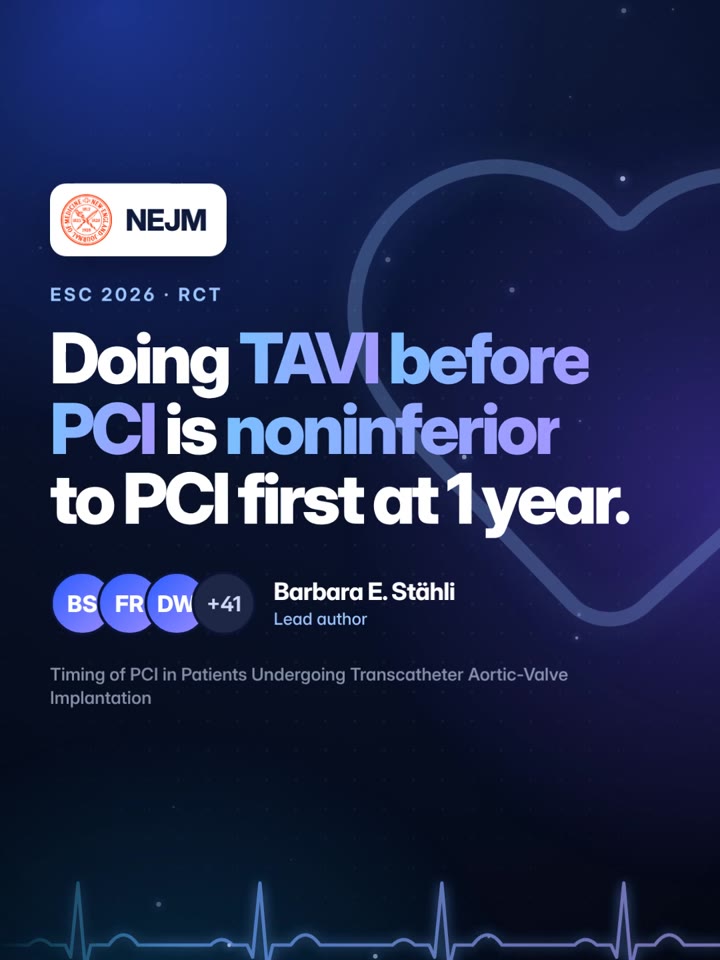
NEJM · ESC 2026 · RCT. Doing TAVI before PCI is noninferior to PCI first at 1 year. TAVI PCI: Timing of PCI in Patients Undergoing Transcatheter Aortic-Valve Implantation 986 patients: Severe aortic stenosis plus coronary disease. Which procedure goes first?: TAVI first vs PCI first. Death, MI, rehospitalization, bleeding at 1 year: TAVI first 22.2% vs PCI first 24.2%. -2.0 percentage points risk difference. Noninferior within a 6.6-point margin. Bottom line: TAVI first is similar; whether skipping routine pre-TAVI PCI is safe remains unresolved.
Coverage & sources
Journal, society, and media accounts. Useful signal, not independent expert judgment.
Cite This Study
Stähli et al. (2026) conducted an RCT in Severe aortic stenosis and coronary artery disease (n=986). TAVI before PCI (TAVI-first) vs. PCI before TAVI (PCI-first) was evaluated on Composite of death from any cause; nonfatal myocardial infarction; ischemia-driven revascularization; rehospitalization related to the valve, procedure, or heart failure; or life-threatening, disabling, or major bleeding at 1 year (risk difference -2.0 percentage points, 95% CI -7.4 to 3.4, p=<0.001 for noninferiority).