
The abstract is misleading: the real finding is that monitoring cuts one-year mortality
X post ↗What happened
Immediate 14-day wearable ECG monitoring fails to reduce syncope episodes at one year versus standard practice.
Multiple clinicians highlight that while the primary syncope-recurrence endpoint was negative, the trial showed markedly improved arrhythmia detection and a mortality benefit favoring early monitoring.
ASPIRED missed its primary endpoint of reducing syncope recurrence, but experts are divided on whether the mortality signal and doubled arrhythmia detection make early monitoring practice-changing despite the neutral headline result.
Immediate prolonged ECG monitoring after unexplained syncope did not reduce fainting episodes at one year, but it found far more arrhythmias and was linked to lower mortality. Some experts see the trial as misleadingly framed around syncope recurrence when the real story is earlier diagnosis and a striking mortality difference. The open question is whether these secondary signals are strong enough to reshape emergency-department syncope pathways.
Whether the all-cause mortality signal is robust enough to be considered a true treatment effect or a chance finding in a trial not powered for that endpoint.
It also remains unclear whether guidelines will incorporate early prolonged monitoring into ED syncope pathways based on secondary outcomes alone.
The abstract is misleading: the real finding is that monitoring cuts one-year mortality
X post ↗
ASPIRED may change ED syncope pathways: the benefit is diagnosis, not preventing another faint
X post ↗Martha Gulati
Practice takeCardiologistEarly monitoring finds actionable arrhythmias even though syncope recurrence was unchanged
X post ↗
Monitoring did not reduce syncope burden but identified high-risk patients and halved all-cause mortality
X post ↗
Early cardiac monitoring improved arrhythmia detection and lowered mortality despite not reducing syncope
X post ↗
Notes the primary result: 14-day ambulatory ECG monitoring did not result in significantly fewer syncope episodes at one year than standard care.
X post ↗
Reports the neutral primary endpoint finding without commentary on secondary outcomes.
X post ↗
Shares the headline result that monitoring did not significantly reduce syncope episodes versus standard care.
X post ↗“Among patients with syncope that remained unexplained after evaluation in the emergency department, the use of 14-day ambulatory ECG monitoring did NOT result in significantly fewer patient-reported syncope episodes at 1 year than standard care.”
X ↗Mohammed Al-Qadami
@mohamme76294268“In 2,234 patients with unexplained syncope, early 14-day ECG monitoring did not reduce recurrence, but increased clinically significant arrhythmia detection (22% vs 9%) and enabled earlier treatment.”
X ↗Upvote a question you would like answered, or open it to join the discussion.
Why the trial, key points, tables, limitations, PICO, abstract, media & sources
Why the trial?
Unexplained syncope often goes undiagnosed for months under standard monitoring, delaying treatment of underlying arrhythmias. ASPIRED asked whether immediate enhanced ambulatory ECG monitoring shortens the time to diagnosis and improves management.
Does 14-day ambulatory ECG monitoring reduce patient-reported episodes of syncope in adults with unexplained syncope after emergency department evaluation?
| Outcome | 14-day ECG | Standard |
|---|---|---|
| Patient-reported syncope episodes at 1 year (mean) | 1.37 | 1.58 |
| Primary · IRR 0.89 (95% CI 0.68–1.18; p=0.42) — no significant reduction | ||
| Arrhythmia detection | 22% | 9% |
| From the trial record; not reported in the publication abstract | ||
| All-cause mortality | 1.5% | 2.9% |
| From the trial record, not the abstract · hypothesis-generating only | ||
Safety
Adverse events were 49 vs 8, with 1 serious adverse event in each arm.
Design limitations
The trial was open-label with a self-reported primary outcome whose large standard deviations (±5.10 and ±8.56) indicate highly skewed episode counts.
Statistical certainty
264 patients (11.8%) with no follow-up were excluded from the primary analysis.
Subgroup caution
Arrhythmia-detection and mortality figures come from the trial record rather than the publication abstract.
Does 14-day ambulatory ECG monitoring reduce patient-reported episodes of syncope in adults with unexplained syncope after emergency department evaluation?
Initiating 14-day ambulatory ECG monitoring in patients with unexplained syncope in the emergency department increased the detection of clinically relevant arrhythmias but did not reduce patient-reported syncope recurrences at 1 year.
No takes yet. Share an insight, caveat, or question.
Expert reaction
NEJM · ESC Congress 2026
2 experts quoted, 1 with a clear stance so far. We show the split once 3 have one.
Expert labels are toward ASPIRED's result, from named public quotes (n=1). As of Sep 1, 2026.
ASPIRED missed its primary endpoint of reducing syncope recurrence, but experts are divided on whether the mortality signal and doubled arrhythmia detection make early monitoring practice-changing despite the neutral headline result.
Immediate prolonged ECG monitoring after unexplained syncope did not reduce fainting episodes at one year, but it found far more arrhythmias and was linked to lower mortality. Some experts see the trial as misleadingly framed around syncope recurrence when the real story is earlier diagnosis and a striking mortality difference. The open question is whether these secondary signals are strong enough to reshape emergency-department syncope pathways.
Multiple clinicians highlight that while the primary syncope-recurrence endpoint was negative, the trial showed markedly improved arrhythmia detection and a mortality benefit favoring early monitoring.
Is ASPIRED a neutral trial or a practice-changer hiding behind the wrong primary endpoint?
Whether the all-cause mortality signal is robust enough to be considered a true treatment effect or a chance finding in a trial not powered for that endpoint. It also remains unclear whether guidelines will incorporate early prolonged monitoring into ED syncope pathways based on secondary outcomes alone.
“Although immediate ECG monitoring did not reduce recurrent fainting, it enabled earlier identification of serious cardiac rhythm disorders, allowing patients to receive treatment much sooner, reducing uncertainty and anxiety, and potentially preventing avoidable deaths.”
Calls the ASPIRED abstract misleading for leading with the neutral syncope-recurrence result. Argues the key finding is that Zio monitoring after syncope reduces one-year mortality, which should be the headline takeaway.
Frames ASPIRED as potentially practice-changing, arguing early 14-day ambulatory ECG monitoring should be strongly considered after unexplained syncope. Emphasizes the benefit is in diagnosis and identifying high-risk patients rather than reducing syncope recurrence.
Does not support routine 14-day monitoring to reduce syncope recurrences; challenges assumptions from smaller studies on early monitoring benefits.
BackgroundIn patients with syncope who present to the emergency department for evaluation, diagnosing an underlying cardiac arrhythmia remains difficult. MethodsWe conducted an open-label, randomized, controlled trial at 45 hospitals in the United Kingdom to assess the effects of 14-day cardiac monitoring on diagnosis, treatment, and outcomes among patients with syncope. Adults with syncope that remained unexplained after an evaluation in the emergency department were assigned in a 1:1 ratio to undergo 14-day ambulatory electrocardiographic (ECG) monitoring (the intervention group) or to receive the standard care provided for patients with unexplained syncope at each participating site (the standard-care group). The primary outcome was the mean number of patient-reported episodes of syncope at 1 year. ResultsA total of 2234 patients underwent randomization: 1123 were assigned to the intervention group and 1111 to the standard-care group. The mean age of the patients was 58.3 years, and 52.1% were male. After the exclusion of patients who did not complete any follow-up, a total of 1970 patients (1004 in the intervention group and 966 in the standard-care group) were included in the primary analysis. The mean (±SD) number of patient-reported syncope episodes at 1 year was 1.37±5.10 in the intervention group and 1.58±8.56 in the standard-care group (incidence rate ratio, 0.89; 95% confidence interval, 0.68 to 1.18; P=0.42). A total of 49 adverse events were reported in the intervention group, and 8 adverse events were reported in the standard-care group, with 1 serious adverse event in each group. ConclusionsAmong patients with syncope that remained unexplained after evaluation in the emergency department, the use of 14-day ambulatory ECG monitoring did not result in significantly fewer patient-reported syncope episodes at 1 year than standard care. (Funded by the British Heart Foundation and National Health Service Research Scotland; ASPIRED ISRCTN Registry number, ISRCTN10278811.)
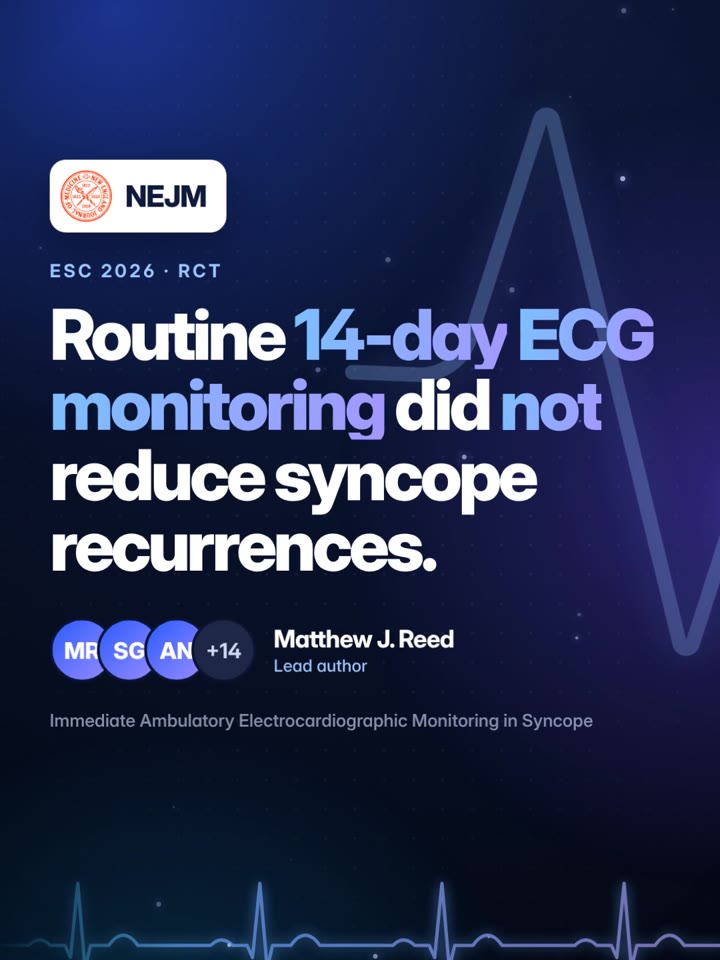
NEJM · ESC 2026 · RCT. Routine 14-day ECG monitoring did not reduce syncope recurrences. ASPIRED: Immediate Ambulatory Electrocardiographic Monitoring in Syncope 2,234 adults: Unexplained syncope after ED evaluation, 45 UK hospitals. Monitoring started at the ED visit: 14-day ambulatory ECG vs Standard care. 0.89 Incidence rate ratio. No significant drop in syncope episodes at 1 year. Clinically relevant arrhythmias detected: 14-day ECG 22% vs Standard 9%. Bottom line: More arrhythmias found, but no fewer syncope episodes at one year.
Journal, society, and media accounts. Useful signal, not independent expert judgment.
Reed et al. (2026) conducted an RCT in Unexplained syncope (n=2,234). 14-day ambulatory electrocardiographic (ECG) monitoring vs. Standard care was evaluated on Mean number of patient-reported episodes of syncope at 1 year (IRR 0.89, 95% CI 0.68 to 1.18, p=0.43). 14-day ambulatory ECG monitoring did not significantly reduce the mean number of self-reported syncope episodes at 1 year compared to standard care in patients with unexplained syncope (IRR 0.89).
Synapse has enriched 5 closely related papers on similar clinical questions. Consider them for comparative context:
