This research is Trending!
October 13, 2026Circulation
Multidisciplinary Approach to Antiplatelet Management in Coronary Syndromes: A Scientific Statement From the American Heart Association
Why the study?
Optimal antiplatelet therapy requires balancing thrombotic risk reduction with bleeding complications amid growing complexity and variability in patient care.
Key Points
- Individualized antiplatelet therapy balances thrombotic risk reduction with bleeding complications in acute coronary syndrome and chronic coronary disease.
- Scientific statement consensus evaluates major clinical advances in stent technology, pharmacotherapy, and risk stratification tools developed since the mid-2000s.
- Multidisciplinary cardiovascular care teams promote antithrombotic stewardship, mitigating inappropriate prescribing and adverse outcomes during care transitions.
Structured PICO
P
Population
Patients with acute coronary syndrome and chronic coronary disease
E
Exposure
Multidisciplinary approach to antiplatelet management and antithrombotic stewardship
Highlights the critical role of a multidisciplinary cardiovascular team in tailoring antiplatelet strategies to balance thrombotic risk reduction and bleeding complications.
Implication
Reinforces individualized antiplatelet strategies and multidisciplinary teams in coronary syndromes; extends consensus with post-2000s advances in stents and risk tools.
Abstract
Antiplatelet therapy is a cornerstone of care for patients with acute coronary syndrome and chronic coronary disease, yet its optimal use requires careful balancing of thrombotic risk reduction with bleeding complications. Since the mid-2000s, advances in stent technology, antiplatelet pharmacotherapy, procedural technique, and risk stratification tools have led to increasingly individualized approaches to antiplatelet management. Current guidelines and evidence emphasize tailoring agent selection, intensity, and duration of therapy according to patient-, procedure-, and disease-specific factors rather than a uniform strategy. However, the growing complexity of evidence, frequent care transitions, social determinants of health, and variability in patient characteristics have increased the risk of inappropriate prescribing, nonadherence, and adverse outcomes. This scientific statement reviews contemporary evidence informing antiplatelet strategies and highlights the critical role of the multidisciplinary cardiovascular team (interventional cardiology, general cardiology, pharmacists, advanced practice nurses) and the importance of their collective expertise in ensuring antithrombotic stewardship in patients with acute coronary syndrome and chronic coronary disease.
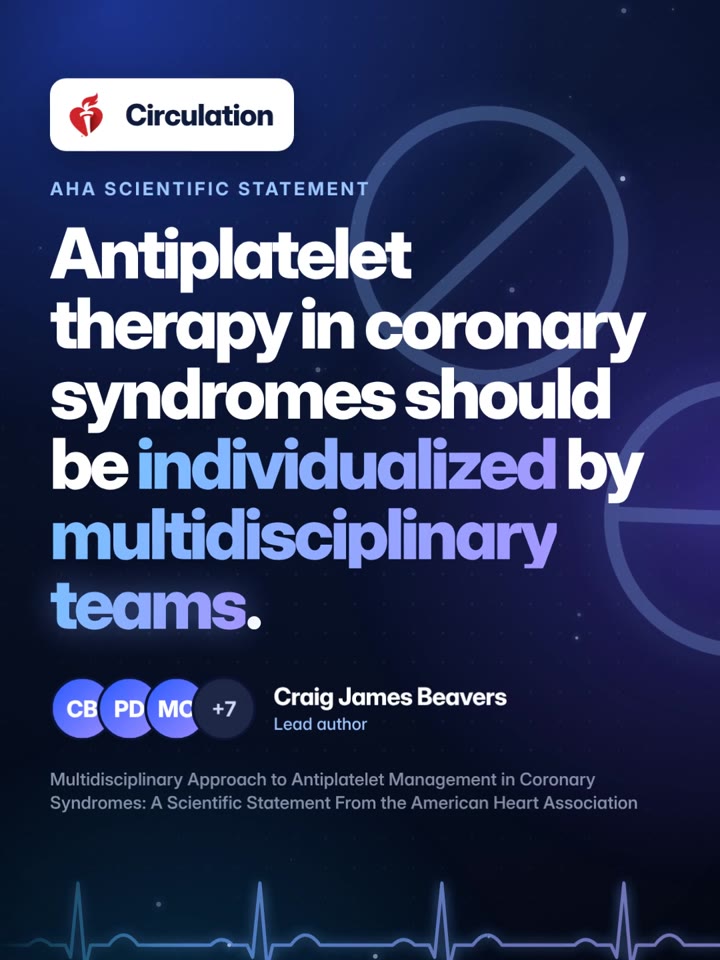
Circulation · AHA scientific statement. Antiplatelet therapy in coronary syndromes should be individualized by multidisciplinary teams. Multidisciplinary Approach to Antiplatelet Management in Coronary Syndromes: A Scientific Statement From the American Heart Association Covers acute and chronic coronary disease: Acute coronary syndrome, Chronic coronary disease. Multidisciplinary antithrombotic stewardship: Weigh thrombotic risk → Weigh bleeding risk → Cardiovascular team decides → Individualized antiplatelet strategy. Reviews advances in stents, drugs and risk tools: Modern stents, Antiplatelet drugs, Risk tools. Bottom line: Antiplatelet therapy should be individualized, guided by a multidisciplinary team.
Discussion
No takes yet. Share an insight, caveat, or question.
Cite This Study
Beavers et al. (2026) conducted a review in Acute coronary syndrome and chronic coronary disease. Multidisciplinary approach to antiplatelet management was evaluated. Current guidelines and evidence emphasize individualized antiplatelet strategies and highlight the critical role of a multidisciplinary cardiovascular team for patients with coronary syndromes.