SA
Sunil A. Sheth
Acute Ischemic Stroke Management
The University of Texas Health Science Center at Houston
About
Research focus
Acute Ischemic Stroke Management
Impact
448 pubs · 9,209 cites · h-index 45
Affiliations
Publications
Cohort Study
NOV 2GriessenauerNeurosurgery
The Contour Neurovascular System Versus Woven Endobridge for Endovascular Embolization of Cerebral Aneurysms: A Propensity Score-matched Cohort Study
BACKGROUND AND OBJECTIVES: The Woven Endobridge (WEB) and the Contour Neurovascular System (Contour) are both intrasaccular devices used to treat cerebral aneurysms. We compared outcomes of these 2 devices using data from 2 large registries. METHODS: Data were sourced from the WorldWideWEB Consortium, which included 1363 cases treated with WEB from 2017, and a registry of 277 Contour cases from 10 European centers starting the same year. Patient demographics, aneurysm characteristics, procedural specifics, and outcomes were analyzed. Propensity score matching was applied for comparison. RESULTS: Before matching, the Contour group had more men (37.9% vs 30.8%), more asymptomatic cases (83.4% vs 70.3%), and fewer acute subarachnoid hemorrhage cases (10.8% vs 26.2%). After matching, no significant differences were found in demographics or aneurysm characteristics between groups. The median age was 60 years, and median aneurysm dimensions were comparable. Logistic regression showed no significant differences between WEB and Contour in achieving complete occlusion (odds ratio [OR] = 1.01, 95% CI, 0.67-1.52, P = .971), adequate occlusion (OR = 0.85, 95% CI, 0.41-1.76, P = .665), or achieving modified Rankin Scale 0 to 2 at last follow-up (OR = 0.48, 95% CI, 0.21-1.02, P = .064). Retreatment (OR = 2.23, P = .086), thromboembolic complications (OR = 0.75, P = .452), and adjunctive treatment use (OR = 1.93, P = .141) were also similar. CONCLUSION: The WEB and Contour demonstrated comparable clinical and angiographic outcomes in this large multicenter study comprised majority small, asymptomatic cerebral aneurysms.
Cohort Study
OCT 1SchwarzStroke
Beyond the Threshold: Continuous Creatinine Change and Outcomes After Endovascular Thrombectomy for Acute Ischemic Stroke
BACKGROUND: Contrast-associated acute kidney injury (CA-AKI) after endovascular thrombectomy (EVT) worsens outcomes in acute ischemic stroke, but threshold-based definitions do not capture prognostic information from subthreshold changes. We tested whether early creatinine change within 48 hours of EVT conveys graded prognostic information beyond dichotomous CA-AKI. METHODS: We performed a secondary analysis of the CAN-REST (Contrast-Associated Nephropathy After Endovascular Stroke Treatment; REGISTRATION: URL: https://www.clinicaltrials.gov; Unique identifier: NCT06596603) registry, a retrospective multicenter observational cohort study of 6638 EVT-treated adults with acute ischemic stroke enrolled at 73 centers in 16 countries between January 1 and December 31, 2023. Early creatinine change was quantified as the natural logarithm ratio of 48-hour creatinine to baseline creatinine (ln[48-hour/baseline creatinine]), with CA-AKI defined per Kidney Disease: Improving Global Outcomes criteria (≥0.3 mg/dL or ≥1.5× baseline rise within 48 hours). Multivariable logistic regression adjusted for prespecified baseline and periprocedural covariates examined associations with 90-day modified Rankin Scale shift and in-hospital mortality; linear versus restricted cubic spline specification was selected by likelihood ratio testing, and contrasts were estimated at ±10%, ±25%, and ±50%. RESULTS: Greater creatinine worsening within 48 hours of EVT was independently associated with an unfavorable 90-day modified Rankin Scale shift (adjusted common odds ratio per 1-unit log-ratio increase, 1.48 [95% CI, 1.07-2.04]; linear) and in-hospital mortality (nonlinear dose-response, of larger magnitude). A 10% increase in creatinine at 48 hours-well below Kidney Disease: Improving Global Outcomes threshold-was associated with worse functional outcome (adjusted common odds ratio, 1.04 [95% CI, 1.01-1.07]) and death (adjusted odds ratio, 1.22 [95% CI, 1.13-1.32]); a 10% decrease in creatinine at 48 hours was associated with lower odds of both outcomes (adjusted common odds ratio, 0.96 [95% CI, 0.93-0.99] and 0.74 [95% CI, 0.65-0.86]). The functional-outcome association concentrated at upper modified Rankin Scale cut-points (severe disability, death); effect modification by baseline renal function was not significant. CONCLUSIONS: Early creatinine change after EVT conveys graded, outcome-specific prognostic information extending below formal CA-AKI thresholds, with a dose-response detectable at changes as modest as ±10%, complementing binary CA-AKI as a framework for post-EVT renal risk assessment. REGISTRATION: URL: https://www.clinicaltrials.gov; Unique identifier: NCT06596603.
RCT
SEP 24MatsoukasStroke Vascular and Interventional Neurology
Outcomes Following First-Pass Direct Aspiration Versus Stent Retriever for Endovascular Thrombectomy in Primary Medium or Distal Vessel Occlusion: An Analysis of the SVIN Registry
Registry analysis finds direct aspiration speeds recanalization but stent retrievers yield higher first-pass success in medium vessel occlusions, indicating distinct procedural advantages.
Original Research
SEP 10SamahaStroke and Vascular Neurology
Racial disparities in off-guideline endovascular treatments for acute ischaemic stroke
Registry analysis finds racial disparities in off-guideline endovascular treatment for acute stroke, indicating inequitable adoption of expanded therapies.
Original Research
AUG 27NogueiraJournal of NeuroInterventional Surgery
Millipede Aspiration for Revascularization in Stroke (MARRS): prospective trial of a novel 0.088 inch corrugated catheter
Prospective single-arm trial demonstrates high revascularization rates with a corrugated aspiration catheter in acute ischemic stroke, highlighting effective large vessel occlusion treatment.
Human Clinical Trial · n=1361 mentionsTrending on X
AUG 7KhalidStroke Vascular and Interventional Neurology
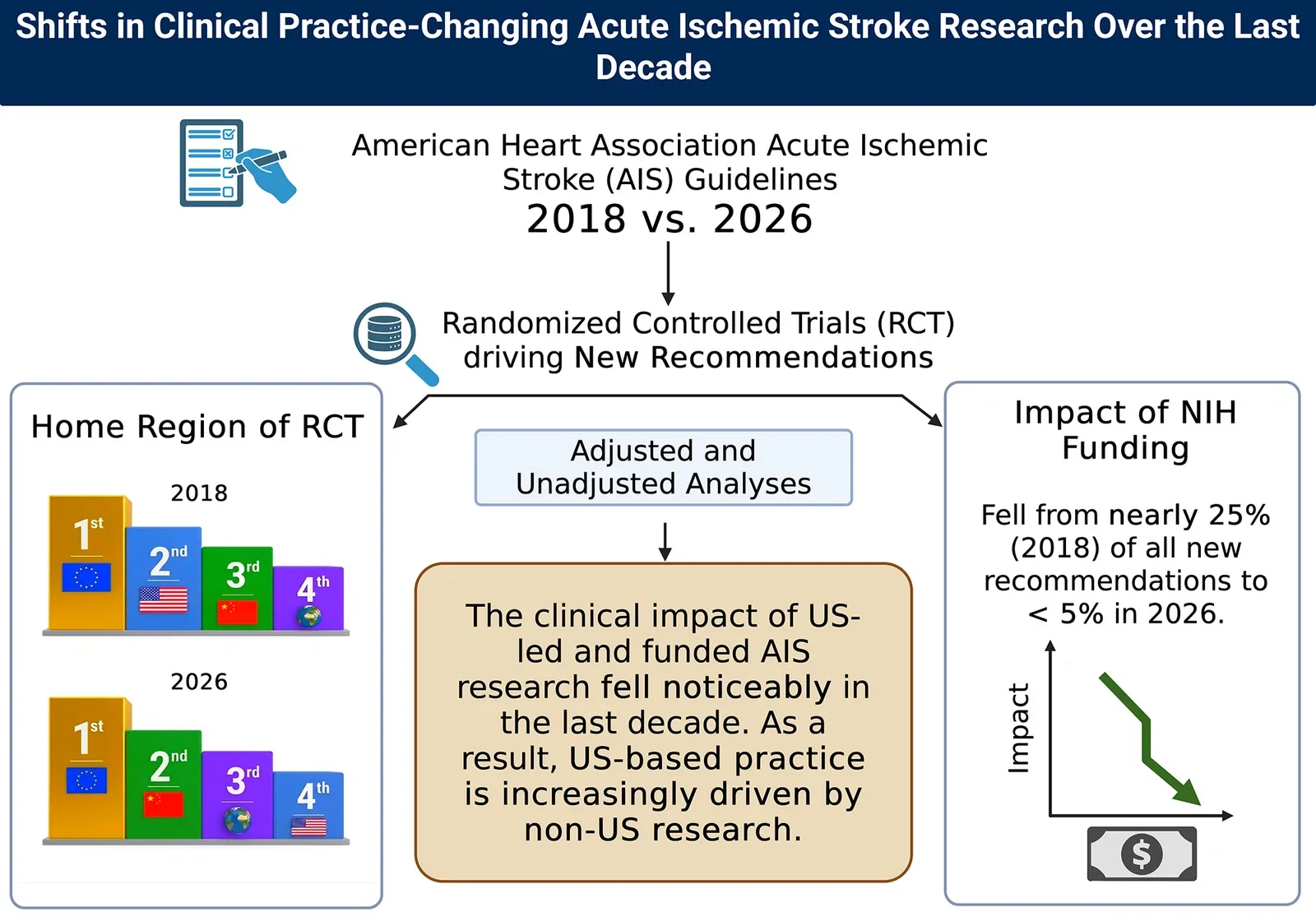
US-based RCTs in stroke guidelines drop ~54%, while China-based trials triple.
Clinicians should monitor the shifting geographic sources of stroke evidence; this analysis extends global RCT trends while leaving applicability questions open.
Randomized Controlled Trial
JUL 9Diel
Role of Perfusion Parameters on Outcomes and Safety of Endovascular Therapy in Posterior Cerebral Artery Stroke.
Observational analysis evaluates the relationship of perfusion parameters with outcomes in isolated posterior cerebral artery occlusion, suggesting cautions in endovascular therapy.
Randomized Controlled Trial
JUL 9DielStroke
Role of Perfusion Parameters on Outcomes and Safety of Endovascular Therapy in Posterior Cerebral Artery Stroke
Randomized trial investigates perfusion imaging's role in outcomes of endovascular therapy for PCA occlusion, suggesting risks may vary.
Cohort Study
JUL 8ChenStroke
MAD-MT Score: A Tool to Optimize Patient Selection for Mechanical Thrombectomy in Distal Vessel Occlusions
Randomized Controlled Trial
JUN 19FukudaJournal of NeuroInterventional Surgery
Faster reperfusion with combined delivery catheter systems in aspiration-first stroke thrombectomy: a multicenter analysis
Retrospective analysis shows improved efficiency with aspiration-first catheter systems in strokes, suggesting benefits for treatment protocols.
Registry Study
MAY 18DugarNeuroradiology
Woven Endobridge device for ruptured vs. unruptured aneurysms: insights from the WorldWideWEB study
PURPOSE: Although the Woven EndoBridge (WEB) device is increasingly used for the treatment of wide-neck intracranial aneurysms, including in the acute rupture setting, comparative evidence assessing the impact of rupture status remains limited. This study compared angiographic, safety, and clinical outcomes between ruptured and unruptured intracranial aneurysms treated with WEB. METHODS: We conducted a retrospective analysis of prospectively collected data from the multicenter cohort registry WorldWideWEB, including consecutive adult patients with intracranial aneurysms treated with the WEB. Patients were stratified into groups of ruptured and unruptured aneurysms. Propensity score matching was used to balance baseline characteristics between both groups. Retreatment rate was the primary outcome. Secondary outcomes included mRS, safety events (thromboembolic complications) and angiographic outcomes (periprocedurally and last follow-up). RESULTS: Among 1,220 patients, 342 (28.0%) presented with ruptured aneurysms. Propensity-score-matched analyses revealed no significant difference in thromboembolic complications (11.8% vs. 5.9%, p = 0.056), similar periprocedural adequate occlusion (53.3% vs. 53.8%, p > 0.9), and similar retreatment rates (11.8% (95% CI 7.8-17.6%) vs. 7.1% (95% CI 4.1-12.0%), p = 0.14); however, adequate occlusion at follow-up was lower (82.2% vs. 93.3%, p = 0.002) and functional outcomes were worse (mRS ≥ 2 in 34.1% vs. 21.9%, p = 0.012) among patients with ruptured aneurysms. CONCLUSION: Ruptured aneurysms demonstrated expected inferior follow-up functional and angiographic outcomes when compared with unruptured aneurysms, but no difference in retreatment rate and procedural safety. These findings support WEB as a safe and effective treatment option for appropriately selected ruptured intracranial aneurysms in routine clinical practice.
Cohort Study
NOV 2025WaworuntuStroke Vascular and Interventional Neurology
Predictors of 90-Day Functional Outcome in Large Infarct Core Endovascular Therapy
Cohort study finds endovascular therapy outcomes linked to age and NIHSS in patients with large core strokes, suggesting factors for better recovery.
Retrospective Study
NOV 2025SayedStroke Vascular and Interventional Neurology
Scoring System for Pre-Thrombectomy Diagnosis of ICAD in Posterior Circulation Strokes
Retrospective analysis shows a scoring system for ICAD improves predictive accuracy in posterior circulation strokes, highlighting its potential clinical utility.
cohort · n=2,073
NOV 2025TomppoStroke
Unwitnessed stroke onset shows no difference in 90-day functional outcomes vs witnessed onset after thrombectomy.
In the extended time window, patients with unwitnessed large-vessel occlusion stroke undergoing endovascular thrombectomy have similar likelihoods of favorable outcomes compared to those with witnessed onset.
Original Research
NOV 2025Gomez‐FariasMassachusetts General Hospital
Sex Differences in the Protective Effect of Brain Volume: Age Attenuates Protection in Females
Background Sex differences in outcomes after acute ischemic stroke (AIS) are well recognized, but mechanisms remain unclear. This study evaluates whether parenchymal brain volume (PBV), age, and final infarct volume (DWI-FIV) explain sex-specific differences in post-stroke disability. Methods We analyzed a prospectively collected multicenter registry of AIS patients treated between 2015 and 2024. Automated pipelines quantified PBV from non-contrast CT and DWI-FIV from 24–48-hour MRI. With the primary outcome being 90-day functional independence (mRS 0–2), sex-stratified logistic regression models evaluated its association with PBV. Logistic and linear models examined sex-specific relationships among covariables. Results Among 1,103 patients, 48% were female, median age was 66 [IQR 56–77], median NIHSS was 9 [IQR 4-17], and median DWI-FIV was 7.8 [IQR 0.2-36.3]. Functional independence at 90 days was achieved in 51.7% of males versus 44.9% of females ( p = 0.025). In univariable analyses, greater PBV was associated with higher odds of functional independence in both males (OR 1.30; 95% CI: 1.11–1.53) and females (OR 1.35; 95% CI: 1.13–1.61). After ruling out multicollinearity (mean VIF = 1.32), multivariable analyses showed persistent association in males (aOR 1.30 per 100 cm 3 ; 95% CI: 1.10–1.60) but not in females (aOR 1.10; 95% CI: 0.90–1.33). Each decade of age reduced the odds of functional independence by 30% in females (aOR 0.70; 95% CI: 0.62– 0.79) versus 15% in males (aOR 0.85; 95% CI: 0.72–0.97; p i nteraction = 0.019). Age was also associated with larger infarcts in females (+4.22 cm 3 /decade; p = 0.033) but not in males. Conclusion PBV was protective in males but less so in females, where stronger age-related effects on infarct size and severity abrogated its benefit. These suggest aging weakens brain reserve in women, emphasizing the importance of sex and brain volume measurements in outcome models.
cohort · n=51
OCT 2025FingerJournal of Thrombosis and Thrombolysis
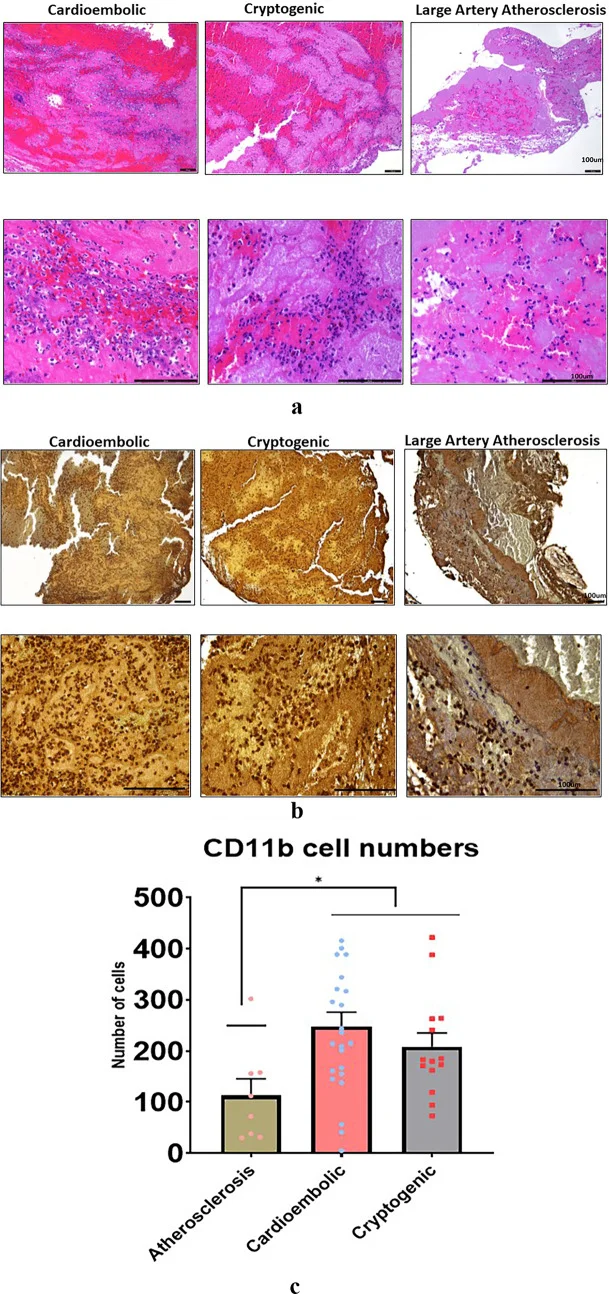
Cardioembolic thrombi contained significantly higher number of CD11b positive cells (248.2 ± 137.4) compared to strokes from large artery atherosclerosis (138.3 ± 92.1, p = 0.01).
Thrombus CD11b levels may aid AF detection post-thrombectomy; leaves open whether inflammation distinguishes cardioembolic etiology.
Clinical Trial
OCT 2025ChenJAMA Neurology
Sedation vs General Anesthesia for Endovascular Therapy in Acute Ischemic Stroke
Randomized trial shows GA improved 90-day outcomes in acute ischemic stroke patients, suggesting better therapeutic strategies.
Original Research
SEP 2025LakhaniInternational Journal of Stroke
Factors associated with Early Neurological Deterioration in Minor Distal Medium Vessel Acute Ischemic Stroke: A Multinational Multicenter Study
Multinational analysis identifies key factors affecting early neurological deterioration in minor strokes, suggesting careful treatment planning.
Review
AUG 2025MehtaStroke
Should We Stop Endovascular Treatment of M2 Occlusions?: A Critical Look at Recent Evidence
This review critically examines endovascular treatment outcomes for M2 occlusions in acute ischemic stroke, suggesting refined treatment guidelines.
Original Research
AUG 2025MallavarapuFrontiers in Neurology
A novel automated CT biomarker to predict outcomes in acute ischemic stroke: net water uptake
Observational analysis compares net water uptake and ASPECTS for predicting outcomes in acute ischemic stroke patients, indicating promising performance.