

Lisa Monk
Cross-Cutting Cardiology
Duke University
About
Lisa Monk works in Cross-Cutting Cardiology affiliated with Duke University.
Lisa Monk, MSN, RN, CPHQ, is a Clinical Research Associate at the Duke Clinical Research Institute and Implementation Director for the RACE-CARS trial. She is a core member of the Duke Implementation Science Collaborative and works on statewide systems of care for acute heart attack, cardiac arrest, and stroke. She has been involved with Duke’s RACE quality-improvement work since 2006 and previously spent about 10 years as a bedside nurse in an open-heart intensive care unit.
Research focus
Out-of-hospital cardiac arrest systems of careSTEMI regionalization and reperfusion systemsBystander CPR and first-responder defibrillationImplementation science in emergency cardiovascular careAcute stroke systems of care
Impact
65 pubs · 1,629 cites · h-index 16
Affiliations
Work Experience
Clinical Research Associate and Implementation Director, RACE-CARS Trial
Duke Clinical Research Institute · 2006 - Present
Operational Improvement Advisor
Forsyth Cardiac and Vascular Center · 2009 - 2009
Publications
Original Research
JUL 2024KrychtiukAmerican Heart Journal

RAndomized Cluster Evaluation of Cardiac ARrest Systems (RACE-CARS) trial: Study rationale and design
Out-of-hospital cardiac arrest (OHCA) occurs in nearly 350,000 people each year in the United States (US). Despite advances in pre- and in-hospital care, OHCA survival remains low and is highly variable across systems and regions. The critical barrier to improving cardiac arrest outcomes is not a lack of knowledge about effective interventions, but rather the widespread lack of systems of care to deliver interventions known to be successful. The RAndomized Cluster Evaluation of Cardiac ARrest Systems (RACE-CARS) trial is a 7-year pragmatic, cluster-randomized trial of 60 counties (57 clusters) in North Carolina using an established registry and is testing whether implementation of a customized set of strategically targeted community-based interventions improves survival to hospital discharge with good neurologic function in OHCA relative to control/standard care. The multi-faceted intervention comprises rapid cardiac arrest recognition and systematic bystander CPR instructions by 9–1-1 telecommunicators, comprehensive community CPR training and enhanced early automated external defibrillator (AED) use prior to emergency medical systems (EMS) arrival. Approximately 20,000 patients are expected to be enrolled in the RACE CARS Trial over 4 years of the assessment period. The primary endpoint is survival to hospital discharge with good neurologic outcome defined as a cerebral performance category (CPC) of 1 or 2. Secondary outcomes include the rate of bystander CPR, defibrillation prior to arrival of EMS, and quality of life. We aim to identify successful community- and systems-based strategies to improve outcomes of OHCA using a cluster randomized-controlled trial design that aims to provide a high level of evidence for future application.
Cohort Study
NOV 2025PollockBlood
Seasonal variation in chronic and acute pain in patients with sickle cell disease
This analysis reveals seasonal changes in pain scores among patients with sickle cell disease, indicating significant differences in pain intensity and impact between seasons.
cohort · n=21,647
NOV 2025EhrlichEquity Neuroscience
Disparities in baseline median door-to-needle times between racial groups decreased, with Black patients achieving similar treatment times as others by the end of the program (Black 39 minutes, White 40, Other 40; p=0.478).
Regional collaboratives may reduce racial disparities in stroke door-to-needle times; leaves open causal effects and generalizability to outcomes.
Original Research
AUG 2025AltmanJournal of Midwifery & Women s Health
Community‐Led Priorities for Re‐Envisioning Midwifery Education to Better Support Black and Indigenous Students
Community-led priorities reveal the need for inclusive midwifery education for Black and Indigenous students, suggesting crucial structural changes.
Original Research
MAR 2024DymmDuke University Hospital

IMPROVE Time to Anti-Coagulation Reversal for Hemorrhagic Strokes
Abstract Background Oral anticoagulation (OAC) is a risk factor for intracerebral hemorrhage (ICH) which is an important source of disability and mortality. OAC-associated ICH (OAC-ICH) patients have worse outcomes as compared to ICH patients not on OAC, likely because of the associated larger stroke volumes, higher propensity to intraventricular hemorrhage, and a higher risk of rebleeding. Although current guidelines recommend that OAC should be reversed quickly, many health care systems have not developed a process for optimizing that aspect of care. Methods Through the IMPROVE Stroke Care Consortium, a group of nine Hub hospitals and their 57 regional community hospitals, a systems of care improvement project was implemented. Performance reviews identified best practices which were disseminated throughout all centers. We compared the median door-to-reversal (DTR) time before and after an institutional campaign to speed the process with a target time of 60 minutes. Results Over two years of the study, there were 6,699 ischemic strokes, 152 subarachnoid hemorrhages, and 889 intracerebral hemorrhages. During that time, 36 hemorrhagic stroke patients received reversal agents emergently. The overall baseline median DTR time was 123 minutes (IQR 99, 361 minutes). By the end of the program, the median DTR time had trended down to 84 minutes (IQR 58.5, 151 minutes) which is a 31.7% reduction of DTR from baseline, though times remained somewhat variable (p = 0.08). Conclusions Utilizing an integrated stroke systems of care approach, we were able to reduce DTR times for patients presenting with acute ICH and concurrent use of anticoagulants despite lack of definitive guidelines around targets for reversal times or operational guidance on protocols and agents.
Original Research
JAN 2024EzemResuscitation Plus
Factors influencing support for the implementation of community-based out-of-hospital cardiac arrest interventions in high- and low-performing counties
Aim of the study: Survival to hospital discharge from out-of-hospital cardiac arrest (OHCA) after receiving treatment from emergency medical services (EMS) is less than 10% in the United States. Community-focused interventions improve survival rates, but there is limited information on how to gain support for new interventions or program activities within these populations. Using data from the RAndomized Cluster Evaluation of Cardiac ARrest Systems (RACE-CARS) trial, we aimed to identify the factors influencing emergency response agencies' support in implementing an OHCA intervention. Methods: North Carolina counties were stratified into high-performing or low-performing counties based on the county's cardiac arrest volume, percent of bystander-cardiopulmonary resuscitation (CPR) performed, patient survival to hospital discharge, cerebral performance in patients after cardiac arrest, and perceived engagement in the RACE-CARS project. We randomly selected 4 high-performing and 3 low-performing counties and conducted semi-structured qualitative interviews with emergency response stakeholders in each county. We identified three themes salient to community support for OHCA intervention: (1) initiating support at emergency response agencies; (2) obtaining support from emergency response agency staff (senior leadership and emergency response teams); and (3) and maintaining support. For each theme, we described similarities and differences by high- and low-performing county. Conclusions: We identified techniques for supporting effective engagement of emergency response agencies in community-based interventions for OHCA improving survival rates. This work may inform future programs and initiatives around implementation of community-based interventions for OHCA.
Cohort Study
DEC 2023KollsAmerican Heart Journal
IMPROVE quality program linked to ~16-point increase in timely lytic therapy delivery.
BACKGROUND: Despite guidelines and strong evidence supporting intravenous thrombolysis and endovascular thrombectomy for acute stroke, access to these interventions remains a challenge. The objective of the IMPROVE stroke care program was to accelerate acute stroke care delivery by implementing best practices and improving the regional systems of care within comprehensive stroke networks. METHODS: The IMPROVE Stroke Care program was a prospective quality improvement program based on established models used in acute coronary care. Nine hub hospitals (comprehensive stroke centers), 52 regional/community referral hospitals (spokes), and over 100 emergency medical service agencies participated. Through 6 regional meetings, 49 best practices were chosen for improvement by the participating sites. Over 2 years, progress was tracked and discussed weekly and performance reviews were disseminated quarterly. RESULTS: Data were collected on 21,647 stroke code activations of which 8,502 (39.3%) activations had a final diagnosis of stroke. There were 7,226 (85.0%) ischemic strokes, and thrombolytic therapy was administered 2,814 times (38.9%). There was significant overall improvement in the proportion that received lytic therapy within 45 minutes (baseline of 44.6%-60.4%). The hubs were more frequently achieving this at baseline, but both site types improved. A total of 1,455 (17.1%) thrombectomies were included in the data of which 401 (27.6%) were transferred from a spoke. There was no clinically significant change in door-to-groin times for hub-presenting thrombectomy patients, however, significant improvement occurred for transferred cases, 46 minutes (interquartile range [IQR] 36, 115.5) at baseline to 27 minutes (IQR 10, 59). CONCLUSIONS: The IMPROVE program approach was successful at improving the delivery of thrombolytic intervention across the consortium at both spoke and hub sites through collaborative efforts to operationalize guideline-based care through iterative sharing of performance and best practices for implementation. Our approach allowed identification of both opportunities for improvement and operational best practices providing guidance on how best to create a regional stroke care network and operationalize the published acute stroke care guidelines.
Registry Study
AUG 2021MoellerJournal of the American Heart Association
Race Differences in Interventions and Survival After Out‐of‐Hospital Cardiac Arrest in North Carolina, 2010 to 2014
Background Following the implementation of the HeartRescue project, with interventions in the community, emergency medical services, and hospitals to improve care and outcomes for out‐of‐hospital cardiac arrests (OHCA) in North Carolina, improved bystander and first responder treatments as well as survival were observed. This study aimed to determine whether these improvements were consistent across Black versus White individuals. Methods and Results Using the Cardiac Arrest Registry to Enhance Survival (CARES), we identified OHCA from 16 counties in North Carolina (population 3 million) from 2010 to 2014. Temporal changes in interventions and outcomes were assessed using multilevel multivariable logistic regression, adjusted for patient and socioeconomic neighborhood‐level factors. Of 7091 patients with OHCA, 36.5% were Black and 63.5% were White. Black patients were younger, more females, had more unwitnessed arrests and non‐shockable rhythm (Black: 81.0%; White: 75.4%). From 2010 to 2014, the adjusted probabilities of bystander cardiopulmonary resuscitation (CPR) went from 38.5% to 51.2% in White, P <0.001; and 36.9% to 45.6% in Black, P =0.002, and first‐responder defibrillation went from 13.2% to 17.2% in White, P =0.002; and 14.7% to 17.3% in Black, P =0.16. From 2010 to 2014, survival to discharge only increased in White (8.0% to 11.4%, P =0.004; Black 8.9% to 9.5%, P =0.60), though, in shockable patients the probability of survival to discharge went from 24.8% to 34.6% in White, P =0.02; and 21.7% to 29.0% in Black, P =0. 10. Conclusions After the HeartRescue program, bystander CPR and first‐responder defibrillation increased in both patient groups; however, survival only increased significantly for White patients.
cohort · n=2,063
JUN 2020ZeitouniCirculation Cardiovascular Quality and Outcomes

Timely cath lab activation was associated with shorter door-in door-out times (40 versus 68 minutes) and reperfusion times (98 versus 135 minutes), with 80.1% treated within the national goal of ≤120 minutes versus 39.0% in the delayed group.
Faster cath lab activation may shorten reperfusion in transferred STEMI; hypothesis-generating and requires prospective validation before practice change.
Original Research
NOV 2018HansenJournal of the American Heart Association
First responder defibrillation near fire stations is linked to ~2-fold higher survival to hospital discharge.
May guide first responder placement near fire stations; leaves open prospective validation of distance-based defibrillation protocols.
Registry Study
SEP 2018HansenJournal of the American Heart Association
Association of Bystander and First‐Responder Efforts and Outcomes According to Sex: Results From the North Carolina HeartRescue Statewide Quality Improvement Initiative
Background The Institute of Medicine has called for actions to understand and target sex‐related differences in care and outcomes for out‐of‐hospital cardiac arrest patients. We assessed changes in bystander and first‐responder interventions and outcomes for males versus females after statewide efforts to improve cardiac arrest care. Methods and Results We identified out‐of‐hospital cardiac arrests from North Carolina (2010–2014) through the CARES (Cardiac Arrest Registry to Enhance Survival) registry. Outcomes for men versus women were examined through multivariable logistic regression analyses adjusted for (1) nonmodifiable factors (age, witnessed status, and initial heart rhythm) and (2) nonmodifiable plus modifiable factors (bystander cardiopulmonary resuscitation and defibrillation before emergency medical services), including interactions between sex and time (ie, year and year 2 ). Of 8100 patients, 38.1% were women. From 2010 to 2014, there was an increase in bystander cardiopulmonary resuscitation (men, 40.5%–50.6%; women, 35.3%–51.8%; P for each <0.0001) and in the combination of bystander cardiopulmonary resuscitation and first‐responder defibrillation (men, 15.8%–23.0%, P =0.007; women, 8.5%–23.7%, P =0.004). From 2010 to 2014, the unadjusted predicted probability of favorable neurologic outcome was higher and increased more for men (men, from 6.5% [95% confidence interval (CI), 5.1–8.0] to 9.7% [95% CI, 8.1–11.3]; women, from 6.3% [95% CI, 4.4–8.3] to 7.4% [95% CI, 5.5–9.3%]); while adjusted for nonmodifiable factors, it was slightly higher but with a nonsignificant increase for women (from 9.2% [95% CI, 6.8–11.8] to 10.2% [95% CI, 8.0–12.5]; men, from 5.8% [95% CI, 4.6–7.0] to 8.4% [95% CI, 7.1–9.7]). Adding bystander cardiopulmonary resuscitation and defibrillation before EMS (modifiable factors) did not substantially change the results. Conclusions Bystander and first‐responder interventions increased for men and women, but outcomes improved significantly only for men. Additional strategies may be necessary to improve survival among female cardiac arrest patients.
cohort · n=10,730Circulation Highlight
NOV 2017JollisCirculation
Regional EMS-hospital coordination linked to ~7 percentage point increase in STEMI FMC-to-device times ≤90 minutes.
Regional organization of STEMI care between EMS and hospitals significantly improves reperfusion times and reduces in-hospital mortality.
cohort · n=23,809
OCT 2017HinoharaJournal of the American Heart Association
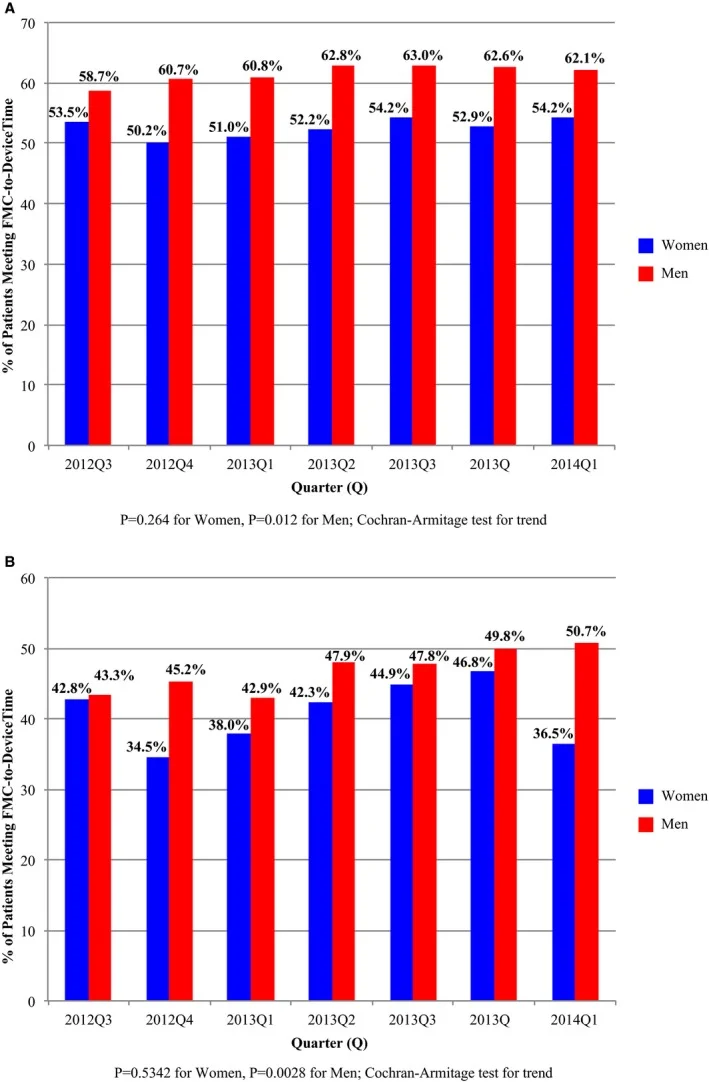
Regional STEMI networks improve timely reperfusion in men and white patients, but fail in women and Black patients.
Regional STEMI systems did not reduce sex or racial reperfusion disparities; leaves open whether equity-focused modifications are needed.
Registry Study
OCT 2017FordyceJAMA Cardiology
Association of Public Health Initiatives With Outcomes for Out-of-Hospital Cardiac Arrest at Home and in Public Locations
Observational study reveals improved survival after cardiac arrest across home and public settings following community training initiatives, highlighting the life-saving impact of bystander CPR.
Registry Study
JUN 2017KragholmCirculation Cardiovascular Quality and Outcomes
Direct transport to a PCI center linked to ~2.5-fold higher survival after out-of-hospital cardiac arrest.
Shows higher discharge survival after out-of-hospital cardiac arrest when transporting directly to cardiac intervention centers, suggesting bypassing closer non-PCI hospitals improves survival.
Original Research
JUL 2015HansenJAMA
Association of Bystander and First-Responder Intervention With Survival After Out-of-Hospital Cardiac Arrest in North Carolina, 2010-2013
Following a statewide educational intervention on rescusitation training, the proportion of patients receiving bystander-initiated CPR and defibrillation by first responders increased and was associated with greater likelihood of survival. Bystander-initiated CPR was associated with greater likelihood of survival with favorable neurological outcome.
Registry Study
SEP 2013BagaiCirculation
Overnight and winter OHCA are linked to ~19% lower odds of survival to discharge.
BACKGROUND: Understanding temporal differences in the incidence and outcomes of out-of-hospital cardiac arrest (OHCA) has important implications for developing preventative strategies and optimizing systems for OHCA care. METHODS AND RESULTS: We studied 18 588 OHCAs of presumed cardiac origin in patients aged ≥18 years who received resuscitative efforts by emergency medical services (EMS) and were enrolled in the Cardiac Arrest Registry to Enhance Survival (CARES) from October 1, 2005, to December 31, 2010. We evaluated temporal variability in OHCA incidence and survival to hospital discharge. There was significant variability in the frequency of OHCA by hour of the day (P<0.001), day of the week (P<0.001), and month of the year (P<0.001), with the highest incidence occurring during the daytime, from Friday to Monday, in December. Survival to hospital discharge was lowest for OHCA that occurred overnight (from 11:01 pm to 7 am; 7.1%) versus daytime (7:01 am to 3 pm; 10.8%) or evening (3:01 pm to 11 pm; 11.3%; P<0.001) and during the winter (8.8%) versus spring (11.1%), summer (11.0%), or fall (10.0%; P<0.001). There was no difference in survival to hospital discharge between OHCAs that occurred on weekends and weekdays (9.5% versus 10.4%, P=0.06). After multivariable adjustment for age, sex, race, witness status, layperson resuscitation, first monitored cardiac rhythm, and emergency medical services response time, compared with daytime and spring, survival to hospital discharge remained lowest for OHCA that occurred overnight (odds ratio, 0.81; 95% confidence interval, 0.70-0.95; P=0.008) and during the winter (odds ratio, 0.81; 95% confidence interval, 0.70-0.94; P=0.006), respectively. CONCLUSIONS: There is significant temporal variability in the incidence of and survival after OHCA. The relative contribution of patient pathophysiology, likelihood of the OHCA being observed, and prehospital and hospital-based resuscitative factors deserves further exploration.
cohort · n=1,687
JUL 2013BagaiCirculation Cardiovascular Interventions
Bypassing the emergency department for direct catheterization laboratory transport in prehospital STEMI patients improved device activation within 90 minutes (74.1% vs 50.1%; P<0.001).
Supports direct cath lab transport in prehospital STEMI for timely activation; leaves open impact on clinical outcomes pending randomized data.
cohort · n=1,288
DEC 2012FosbølCirculation

Direct transport of STEMI patients to a PCI center (64% of cohort) versus transfer from a non-PCI center (36%) was associated with significantly shorter times to reperfusion.
Direct transport to PCI centers was associated with shorter STEMI reperfusion times; hypothesis-generating for statewide protocols, needing prospective validation.
cohort · n=6,841
JUN 2012JollisCirculation
Expansion of a regional STEMI system to an entire state reduced the rate of patients not receiving reperfusion from 5.4% to 4.0% (P=0.04) and significantly improved door-to-device treatment times.
Supports statewide STEMI networks to improve reperfusion; extends regional data but leaves randomized outcome confirmation open.