This research is Trending!
View all ESC 2026 trials
Atorvastatin, Cardiovascular Events, and Disability-free Survival in Older Adults
Key result
Atorvastatin cuts major CV events ~30% vs placebo in older adults without improving disability-free survival.
- HR 0.70
- 95% CI 0.61 to 0.82
- P<0.001
- n=9,971
Why the trial?
Statins are proven for primary prevention in middle age, but healthy adults over 70 were never the subject of a dedicated randomised trial, leaving both the benefit and the effect on disability-free survival uncertain in older people.
Does atorvastatin 40 mg once daily reduce cardiovascular events and improve disability-free survival in community-dwelling adults ≥70 years without prior cardiovascular disease, diabetes, or dementia?
Key Points
- To assess the efficacy and safety of daily atorvastatin for the primary prevention of cardiovascular events and extension of disability-free survival in community-dwelling older adults.
- Double-blind, randomized, placebo-controlled trial across general practices in Australia (STAREE; NCT02099123) enrolling 9,971 community-dwelling adults aged ≥70 years (mean age 74.7±4.5 years, 51.9% women) without cardiovascular disease, diabetes, or dementia.
- Participants were randomly assigned in a 1:1 ratio to receive atorvastatin 40 mg daily (N=4,984) or matching placebo (N=4,987) with a median follow-up of 5.9 years.
- Dual primary endpoints were major adverse cardiovascular events (cardiovascular death, nonfatal myocardial infarction/stroke, or coronary revascularization) and disability-free survival (death from any cause, dementia, or persistent physical disability).
- Major cardiovascular events occurred in 297 participants (10.9 per 1000 person-years) in the atorvastatin group versus 412 participants (15.5 per 1000 person-years) in the placebo group (HR 0.70; 95% CI, 0.61 to 0.82; P<0.001).
- Disability-free survival events occurred in 637 participants (21.6 per 1000 person-years) receiving atorvastatin versus 676 participants (23.0 per 1000 person-years) receiving placebo (HR 0.94; 95% CI, 0.84 to 1.05; P=0.25).
- Serious adverse events occurred in 131 participants (2.7%) in the atorvastatin group and 129 (2.7%) in the placebo group, with higher rates of musculoskeletal, hepatobiliary, and diabetes-related adverse events in the atorvastatin arm.
Evidence details
What drove the result?
| Outcome | Atorvastatin | Placebo |
|---|---|---|
| Major CV events (CV death, MI/stroke, revascularization) | 297 (10.9/1000 py) | 412 (15.5/1000 py) |
| Co-primary - HR 0.70 (95% CI 0.61-0.82); P<0.001 | ||
| Death, dementia, or persistent physical disability | 637 (21.6/1000 py) | 676 (23.0/1000 py) |
| Co-primary - HR 0.94 (95% CI 0.84-1.05); P=0.25 - not significant | ||
Limitations & tradeoffs
Safety
Serious adverse events 131 (2.7%) vs 129 (2.7%); musculoskeletal, hepatobiliary, and diabetes-related adverse events were more common with atorvastatin (per-arm counts not reported).
Representation
enrolled only healthy community-dwelling Australians without diabetes or dementia, limiting generalizability to frailer elders.
Statistical certainty
the disability-free survival co-primary was not met, so the benefit is confined to cardiovascular events.
Structured PICO
Does atorvastatin 40 mg once daily reduce cardiovascular events and improve disability-free survival in community-dwelling adults ≥70 years without prior cardiovascular disease, diabetes, or dementia?
P
Population
9,971 community-dwelling adults aged ≥70 years without cardiovascular disease, diabetes, or dementia, followed for a median of 5.9 years.
I
Intervention
Atorvastatin 40 mg oral once daily
C
Comparator
Identical placebo
O
Outcome
Two primary end points: 1) composite of death from cardiovascular causes, nonfatal myocardial infarction or stroke, or coronary revascularization; 2) composite of death from any cause, dementia, or persistent physical disability, assessed at a median of 5.9 yearscomposite
Main Result
Hazard Ratio: 0.7 (95% CI 0.61–0.82)
Absolute Event Rate: 10.9% vs 15.5%
p-value: p=<0.001
In older adults without prior cardiovascular disease, atorvastatin 40 mg daily significantly reduced major cardiovascular events but did not extend disability-free survival.
Discussion
Key questions
No takes yet. Share an insight, caveat, or question.
Where experts stand
Experts read STAREE as a clear win for statins in healthy adults over 70, shifting the debate to who should be treated rather than whether the drugs work.
Early expert reaction reads STAREE as the randomized answer the field has been waiting for on statins in healthy adults 70 and older. Most clinicians lead with the same two facts: major cardiovascular events fell about 30 percent on atorvastatin 40 mg over a median of 5.9 years, and the second primary endpoint, disability-free survival, did not improve. The live question is what a clear cardiovascular benefit without a longevity gain should change in practice.
Agreement
Among clinicians discussing the trial, the shared ground is that a real evidence gap just closed. Statins had never been properly tested in people over 70, and STAREE now shows a meaningful reduction in major cardiovascular events in that group (HR 0.70, 95% CI 0.61 to 0.82).
11 clinicians say this directly
Main debate
What the split result means at the bedside. The benefit was carried by fewer nonfatal coronary events, with cardiovascular death unchanged and no gain in disability-free survival.
Green light for healthy over-70s3
Their posts read the event reduction as reason to treat.vs
Benefit real, individualize the decision1
Weighs absolute benefit, frailty, polypharmacy, and patient preferences first.+11Not placed16 reporting, watching, or context only
What they’re arguing about
supportiveneutralcautiouscritical
Counts are expert takes we classified by axis. Tap a row to see the takes behind its count.
Still unclear
Whether guidelines for people over 70 will move, and who exactly should start therapy. Clinicians also flag the endpoints that stayed flat: dementia alone (HR 1.03) and the combined endpoint of death, dementia, or persistent disability (HR 0.94).
Key expert perspectives
“The key takeaway from STAREE is that statins prescribed to older patients living independently results in event reduction, but not preserved independence. That makes remaining life expectancy discussions very important for older adults.”

A cardiovascular win, but not automatic treatment by age alone
The benefit was carried by fewer nonfatal coronary events: myocardial infarction and coronary revascularization each fell sharply (HR 0.57) while cardiovascular death was unchanged (HR 1.00). The second primary endpoint, death, dementia, or persistent disability, was neutral (HR 0.94). He supports statins for healthy, community-dwelling older adults, with absolute benefit, frailty, polypharmacy, preferences, and adherence still shaping the decision.
Distilled from 4 of their postsView originals

Preventing heart attacks and strokes is worthwhile in its own right, even without longer life
He explains the null mortality result: 80 percent of deaths in STAREE were from non-cardiovascular causes, since these patients mostly die of cancer, infections, and dementia. His three-year view: about 1.4 percent absolute risk reduction, an NNT near 72, no gain in lifespan or disability, a safe profile with no rise in serious adverse events, roughly 30 dollars a year in drug cost, and shared decision making.
Distilled from 2 of their postsView originals
Implication
Supports statin initiation for CV prevention in adults ≥70 without CVD; confirms event reduction in primary prevention but leaves disability-free survival benefit open.
Abstract
BackgroundThe effectiveness and safety of statins for the primary prevention of cardiovascular events and the extension of disability-free survival among older adults remain uncertain. MethodsWe conducted a double-blind, randomized, placebo-controlled trial at general medical practices across Australia. Community-dwelling adults at least 70 years of age with no history of cardiovascular disease, diabetes, or dementia were randomly assigned in a 1:1 ratio to receive atorvastatin at a dose of 40 mg once daily or identical placebo. The two primary end points were a composite of death from cardiovascular causes, nonfatal myocardial infarction or stroke, or coronary revascularization (to assess effects on major cardiovascular events) and a composite of death from any cause, dementia, or persistent physical disability (to assess effects on disability-free survival). Analyses were performed according to a hierarchical testing plan. ResultsA total of 9971 participants were enrolled: 4984 were assigned to receive atorvastatin and 4987 to receive placebo. The mean (±SD) age of the participants was 74.7±4.5 years, and 51.9% were women. After a median of 5.9 years, a primary cardiovascular event had occurred in 297 participants (10.9 events per 1000 person-years) in the atorvastatin group and in 412 participants (15.5 events per 1000 person-years) in the placebo group (hazard ratio, 0.70; 95% confidence interval [CI], 0.61 to 0.82; P<0.001). Death from any cause, dementia, or persistent physical disability occurred in 637 participants (21.6 events per 1000 person-years) in the atorvastatin group and in 676 participants (23.0 events per 1000 person-years) in the placebo group (hazard ratio, 0.94; 95% CI, 0.84 to 1.05; P=0.25). Serious adverse events occurred in 131 participants (2.7%) in the atorvastatin group and in 129 (2.7%) in the placebo group, with musculoskeletal, hepatobiliary, and diabetes-related adverse events occurring more commonly in the atorvastatin group. ConclusionsTreatment with atorvastatin led to a lower risk of major cardiovascular events than placebo at a median of 5.9 years but did not result in longer disability-free survival among community-dwelling older adults without clinical cardiovascular disease. (Funded by the National Health and Medical Research Council and others; STAREE ClinicalTrials.gov number, NCT02099123.)Atorvastatin and Cardiovascular Events in Older Adults
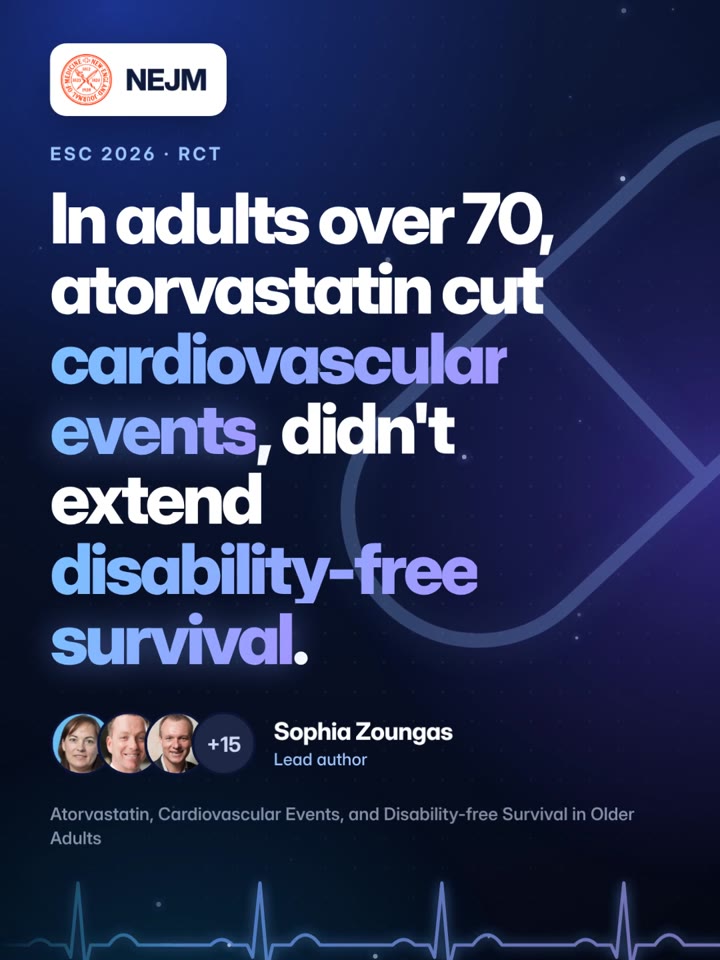
NEJM · ESC 2026 · RCT. In adults over 70, atorvastatin cut cardiovascular events, didn't extend disability-free survival. STAREE: Atorvastatin, Cardiovascular Events, and Disability-free Survival in Older Adults 9,971 adults aged ≥70: Older adults without CVD, diabetes or dementia. Followed for a median 5.9 years: Atorvastatin 40 mg daily vs Identical placebo. Major CV events per 1000 person-years: Atorvastatin 10.9 /1000 PY vs Placebo 15.5 /1000 PY. HR 0.70 (95% CI 0.61–0.82), P<0.001. Atorvastatin cut major cardiovascular events. No gain in disability-free survival: Death, Dementia, Physical disability. Bottom line: Supports statin initiation after 70; disability-free survival benefit still open. Read the evidence and every expert take. synapsesocial.com/papers/6a8fbb6217152b56e6b64813
Coverage & sources
Journal, society, and media accounts. Useful signal, not independent expert judgment.
Cite This Study
Zoungas et al. (2026) conducted an RCT in Primary prevention of cardiovascular events (n=9,971). Atorvastatin vs. Placebo was evaluated on composite of death from cardiovascular causes, nonfatal myocardial infarction or stroke, or coronary revascularization (HR 0.70, 95% CI 0.61 to 0.82, p=<0.001). Atorvastatin reduced the risk of major cardiovascular events compared to placebo (HR 0.70; 95% CI 0.61-0.82; P<0.001) but did not result in longer disability-free survival in older adults.