
Anything that is 'routine' usually does not work
X post ↗What happened
Early outpatient CT coronary angiography fails to reduce MI or CV death versus standard care.
Multiple clinicians agree that the result is definitively negative and that routine CTCA after MI has been ruled out is not warranted in this population.
Experts read TARGET-CTCA as a clear null result: routine CT coronary angiography after a heart attack has been ruled out does not improve outcomes, and the reaction is uniformly that the scan is not warranted in this population.
Cardiologists broadly accept that adding a CT scan of the coronary arteries after myocardial infarction has been excluded does not reduce future heart attacks or cardiac death. The trial's lead investigator says patients can simply be reassured and sent home. No expert voice in the early reaction challenges the finding or calls for routine imaging in this group.
Whether specific subgroups, such as patients with higher intermediate troponin levels, might still derive benefit from CTCA remains unaddressed in the expert commentary so far.
It is also unclear how this result will influence existing guidelines that recommend non-invasive imaging for risk stratification after MI is excluded.
Anything that is 'routine' usually does not work
X post ↗
Implementing CTCA to guide management in these patients is not warranted
X post ↗
CTCA's diagnostic gains again fail to translate into better patient outcomes
X post ↗
The trial asks whether scanning intermediate-risk troponin patients changes their trajectory
X post ↗Nick Mills
Results readoutBHF Professor of Cardiology, University of EdinburghPatients cleared of a heart attack can be reassured and sent home without a scan
Original post ↗
Identifying coronary disease by CTCA after MI rule-out did not improve clinical outcomes
X post ↗
Summarized TARGET-CTCA among the key ESC 2026 results as showing no benefit from CTCA after MI rule-out.
X post ↗
“These findings demonstrate why high-quality clinical trials are required to answer important questions about patient care. Robust and representative evidence ensures that the right people receive the right tests at the right time, supporting the best possible outcomes for heart patients while making effective use of health care resources.”
News Coverage ↗“In patients with suspected ACS without MI, routine CT coronary angiography did NOT RESULT in a lower incidence of MI or from a cardiac cause than standard care. Full TARGET-CTCA trial results: nej.md/4wH7Yk7”
X ↗Upvote a question you would like answered, or open it to join the discussion.
Why the trial, key points, tables, limitations, PICO, abstract, media & sources
Why the trial?
Patients whose acute chest pain proves not to be myocardial infarction still carry meaningful longer-term coronary risk. TARGET-CTCA asked whether early outpatient CT coronary angiography after MI has been ruled out prevents subsequent infarction or cardiovascular death.
Does outpatient CT coronary angiography-guided care reduce the composite of myocardial infarction or death from a cardiac cause in patients with suspected acute coronary syndrome in whom myocardial infarction has been ruled out and who have intermediate risk?
| Outcome | CTCA-guided | Standard care |
|---|---|---|
| MI or death from a cardiac cause | 112/1,587 (7.1%) | 116/1,583 (7.3%) |
| Adjusted HR 0.95 (95% CI 0.73-1.23; P=0.71) · no benefit; treatment separation was good (CTCA in 92.1% vs 2.2%) | ||
Patient burden
CTCA-related adverse events 7/1,587 (0.4%) in the CTCA group.
Representation
applies only to intermediate-risk patients (peak hs-cTn >5 ng/L) after MI has been ruled out, and was conducted entirely in the UK (14 hospitals).
Design limitations
follow-up was event-driven, ending once standard-care primary-outcome events exceeded the prespecified minimum of 97.
Does outpatient CT coronary angiography-guided care reduce the composite of myocardial infarction or death from a cardiac cause in patients with suspected acute coronary syndrome in whom myocardial infarction has been ruled out and who have intermediate risk?
No takes yet. Share an insight, caveat, or question.
Expert reaction
NEJM · ESC Congress 2026
2 experts have reacted so far. We show the split once 3 have.
Expert labels are toward TARGET-CTCA's result, from named public quotes (n=2). As of Aug 30, 2026.
Experts read TARGET-CTCA as a clear null result: routine CT coronary angiography after a heart attack has been ruled out does not improve outcomes, and the reaction is uniformly that the scan is not warranted in this population.
Cardiologists broadly accept that adding a CT scan of the coronary arteries after myocardial infarction has been excluded does not reduce future heart attacks or cardiac death. The trial's lead investigator says patients can simply be reassured and sent home. No expert voice in the early reaction challenges the finding or calls for routine imaging in this group.
Multiple clinicians agree that the result is definitively negative and that routine CTCA after MI has been ruled out is not warranted in this population.
What they’re arguing about
supportiveneutralcautiouscritical
Counts are expert takes we classified by axis. Tap a row to see the takes behind its count.
Whether specific subgroups, such as patients with higher intermediate troponin levels, might still derive benefit from CTCA remains unaddressed in the expert commentary so far. It is also unclear how this result will influence existing guidelines that recommend non-invasive imaging for risk stratification after MI is excluded.
““Once a heart attack has been ruled out, routine heart scans may not be required. Implementation of these trial findings could reduce healthcare costs and simplify care for patients without compromising future outcomes.””
Damluji frames the null result as predictable, arguing that blanket application of a test to an entire population rarely delivers benefit. He highlights the trial's multicenter, event-driven, randomized design.
Ghanavati summarizes the negative primary endpoint and concludes explicitly that routine CT coronary angiography should not be implemented for patients with suspected acute coronary syndrome without MI.
Routine outpatient CT coronary angiography-guided management did not reduce the incidence of subsequent myocardial infarction or cardiac death compared to standard care in patients with suspected ACS and intermediate risk after MI rule-out.
BackgroundMany patients with suspected acute coronary syndrome in whom myocardial infarction has been ruled out in the emergency department remain at risk for cardiovascular events. Whether further investigation reduces this risk is unknown. MethodsIn a multicenter, randomized, controlled trial, patients who presented to an emergency department in 14 hospitals across the United Kingdom were enrolled if myocardial infarction had been ruled out and high-sensitivity cardiac troponin testing indicated an intermediate risk of a cardiovascular event (maximum high-sensitivity cardiac troponin I or T concentration, >5 ng per liter). Participants were randomly assigned in a 1:1 ratio to receive either outpatient computed tomographic (CT) coronary angiography–guided care or standard care. The primary outcome was a composite of myocardial infarction or death from a cardiac cause. ResultsFrom September 18, 2019, to May 11, 2023, a total of 3170 participants (median age, 61 years; female sex, 30.2%) were assigned to undergo CT coronary angiography (1587 participants) or receive standard care (1583 participants). At 90 days after randomization, CT coronary angiography had been performed in 1462 participants (92.1%) in the CT coronary angiography group and in 35 participants (2.2%) in the standard-care group. Overall, 7 participants (0.4%) had a CT coronary angiography–related adverse event. After a median of 3.0 years, at which point the number of primary-outcome events in the standard-care group exceeded the prespecified minimum of 97, a primary-outcome event had occurred in 112 participants (7.1%) in the CT coronary angiography group and in 116 (7.3%) in the standard-care group (adjusted hazard ratio, 0.95; 95% confidence interval, 0.73 to 1.23; P=0.71). ConclusionsIn patients with suspected acute coronary syndrome in whom myocardial infarction had been ruled out, routine CT coronary angiography–guided management did not result in a lower incidence of subsequent myocardial infarction or death from a cardiac cause than standard care. (Funded by the British Heart Foundation; TARGET-CTCA ClinicalTrials.gov number, NCT03952351.)
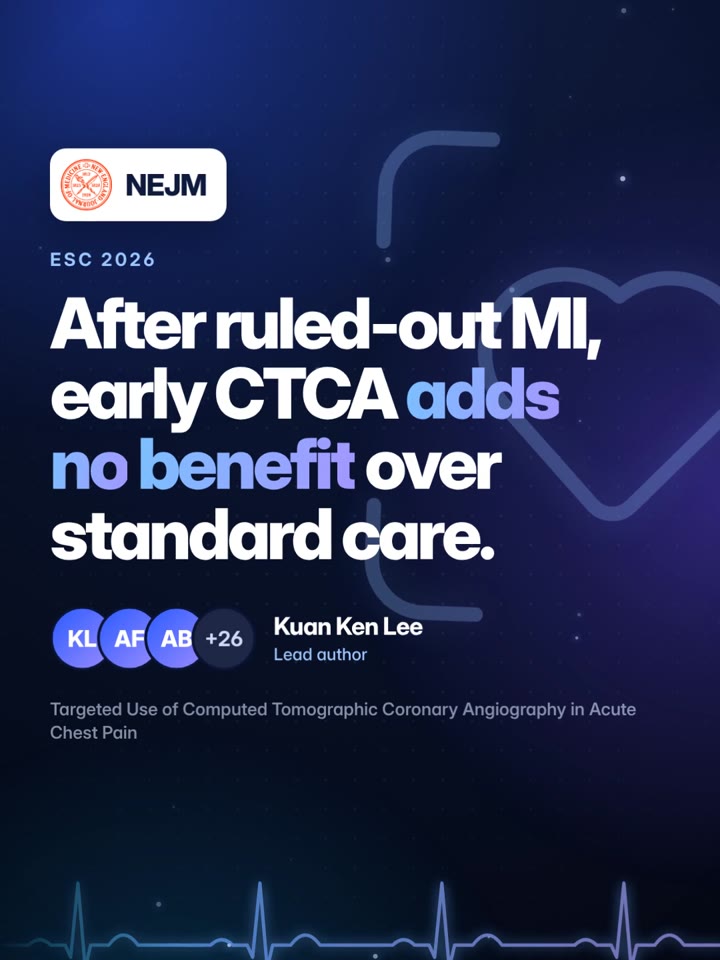
NEJM · ESC 2026. After ruled-out MI, early CTCA adds no benefit over standard care. TARGET-CTCA: Targeted Use of Computed Tomographic Coronary Angiography in Acute Chest Pain 3,170 patients: Ruled-out MI, intermediate troponin risk, 14 UK hospitals. Followed for a median 3.0 years: Outpatient CTCA-guided care vs Standard care. MI or cardiac death by arm: CTCA-guided 7.1% vs Standard care 7.3%. HR 0.95 (95% CI 0.73–1.23), P=0.71. No significant reduction in MI or cardiac death. 92.1% had CTCA: Clear separation: only 2.2% with standard care. Bottom line: After MI rule-out, standard care alone suffices for event reduction.
Journal, society, and media accounts. Useful signal, not independent expert judgment.
Lee et al. (2026) conducted an RCT in Suspected acute coronary syndrome (n=3,170). CT coronary angiography-guided care vs. Standard care was evaluated on Composite of myocardial infarction or death from a cardiac cause (HR 0.95, 95% CI 0.73 to 1.23, p=0.71). Routine CT coronary angiography-guided management did not reduce the incidence of myocardial infarction or cardiac death compared to standard care (HR 0.95; 95% CI 0.73-1.23; P=0.71).
Synapse has enriched 5 closely related papers on similar clinical questions. Consider them for comparative context: