
Ginebra ferreiraSep 30
Interesting
Key result
Catheter-directed thrombolysis reduces mortality, PE recurrence, or decompensation ~90% vs standard anticoagulation.
Why the trial?
In intermediate-high-risk pulmonary embolism, anticoagulation alone leaves some patients to deteriorate while systemic thrombolysis causes major bleeding, and catheter-directed thrombolysis had not been proven in a randomised outcomes trial. Prague 26 addressed that gap.
Does catheter-directed thrombolysis with alteplase plus anticoagulation reduce the composite of all-cause mortality, recurrent pulmonary embolism, or cardiorespiratory decompensation or collapse in patients with intermediate-high-risk pulmonary embolism compared to anticoagulation alone?
| Outcome | CDT | Anticoag |
|---|---|---|
| Death, PE recurrence, or cardiorespiratory decompensation/collapse at 7 days | 0.7% | 6.8% |
| Primary composite · RR 0.10 (95% CI 0.02-0.44; p<0.001); driven mainly by less decompensation or collapse | ||
Safety
Bleeding at 7 days was 4.6% vs 5.0% (p=0.846), with 2 intracranial bleeds in the CDT arm vs 0.
Statistical certainty
Very few primary events (0.7% with CDT) make the effect estimate imprecise (CI 0.02–0.44).
Subgroup caution
The benefit was driven mainly by decompensation or collapse, a softer component than death or recurrence.
Design limitations
Only 7 days of follow-up are reported in the record.
Does catheter-directed thrombolysis with alteplase plus anticoagulation reduce the composite of all-cause mortality, recurrent pulmonary embolism, or cardiorespiratory decompensation or collapse in patients with intermediate-high-risk pulmonary embolism compared to anticoagulation alone?
Relative Risk: 0.1 (95% CI 0.02–0.44)
Absolute Event Rate: 0.7% vs 6.8%
Absolute Risk Reduction: 6.1%
p-value: p=<0.001
In patients with intermediate-high-risk pulmonary embolism, conventional catheter-directed thrombolysis significantly reduced the 7-day risk of death, recurrent PE, or cardiorespiratory decompensation compared to anticoagulation alone, driven primarily by prevention of decompensation.
Interesting
Experts see PRAGUE-26 as a strong signal favoring catheter-directed thrombolysis in intermediate-high-risk PE, but most stop short of calling it a mandate for routine adoption, citing bleeding concerns and the need for more evidence.
Cardiologists and critical care voices are broadly encouraged by the large reduction in early decompensation with catheter-directed thrombolysis, viewing it as the strongest interventional evidence yet in this patient population. However, the reaction is tempered: clinicians flag intracranial bleeding events and emphasize that the results support consideration of the approach in selected patients rather than wholesale practice change. The live question is whether these findings will move guidelines toward earlier catheter-directed therapy and which patients should be prioritized.
Whether guidelines will endorse catheter-directed thrombolysis as a preferred strategy over anticoagulation alone in intermediate-high-risk PE, or reserve it for selected subgroups. The intracranial bleeding signal, though numerically small, leaves open the question of which patients' risk-benefit profile truly favors intervention.
“As a clinician, preventing hemodynamic deterioration in the intermediate-high-risk group is meaningful. If these findings are replicated and reflected in future guideline updates, there may be a shift from reactive management towards a more proactive reperfusion strategy in carefully selected intermediate-risk pulmonary embolism patients.”
Highlights the reduction in the primary endpoint from 6.8% to 0.7%, translating to an NNT of 17 driven mainly by preventing cardiorespiratory deterioration. Calls the results promising but explicitly stops short of endorsing routine catheter-directed thrombolysis.
 C. Michael GibsonInterventional / Structural Cardiology · Beth Israel Deaconess Medical CenterResults readoutAug 31
Summarizes the trial's key finding that catheter-directed thrombolysis lowered the composite of all-cause mortality, PE recurrence, and cardiorespiratory decompensation or collapse compared with anticoagulation alone.
Supports catheter-directed thrombolysis for intermediate-high-risk pulmonary embolism to prevent early decompensation; extends randomized evidence beyond anticoagulation alone and may inform guideline updates.
PRAGUE-26 randomised 558 patients with acute intermediate-high-risk pulmonary embolism at 11 Czech centres to conventional catheter-directed thrombolysis or standard anticoagulation alone. Median age was 64 years and 41% were women. The primary endpoint was a composite of all-cause mortality, pulmonary-embolism recurrence, or cardiorespiratory decompensation or collapse within seven days. CDT reduced the primary endpoint (0.7% vs 6.8%; RR 0.10, 95% CI 0.02 to 0.44; p<0.001), driven mainly by less decompensation or collapse. Seven-day bleeding was 4.6% versus 5.0% (p=0.846), with two intracranial bleeds in the CDT group and none in standard care. Simultaneous publication in NEJM. Source: ESC Congress 2026 press, 31 August 2026.
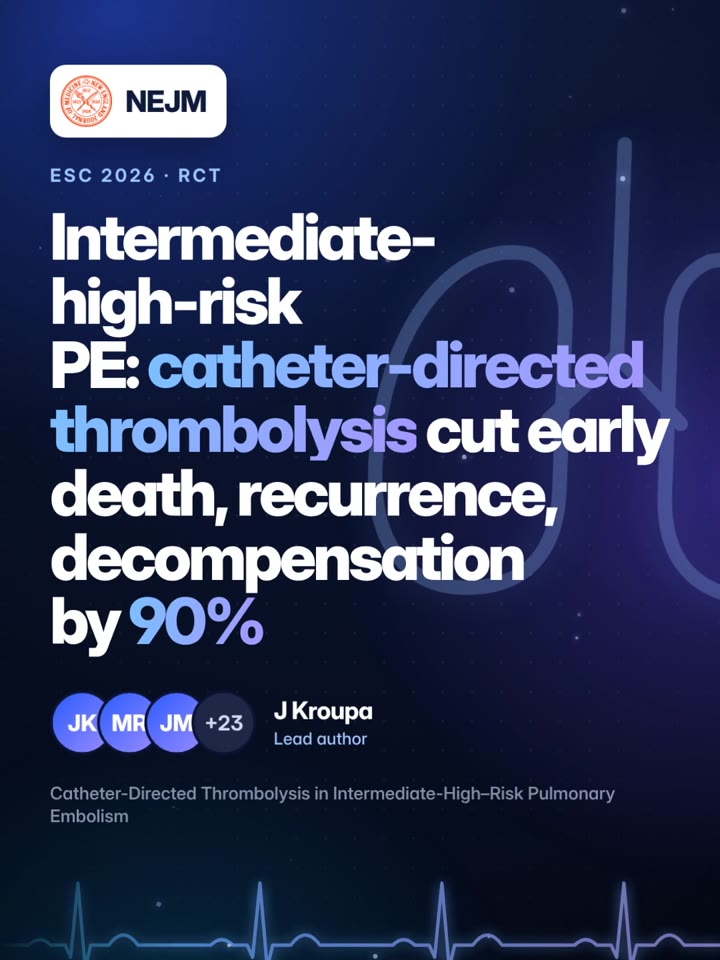
NEJM · ESC 2026 · RCT. Intermediate-high-risk PE: catheter-directed thrombolysis cut early death, recurrence, decompensation by 90% Prague 26: Catheter-Directed Thrombolysis in Intermediate-High–Risk Pulmonary Embolism 558 patients: Stable PE, right ventricular dysfunction, raised biomarkers. Randomised in the Czech Republic: CDT alteplase + anticoagulation vs Anticoagulation alone. 7-day death, recurrence or decompensation: CDT 0.7% vs Anticoag 6.8%. RR 0.10 (95% CI 0.02–0.44), P<0.001. Driven mainly by less decompensation or collapse. Bleeding similar through day 7; ICH only CDT: CDT 4.6%, Anticoag 5.0%, 2 intracranial (CDT). Bottom line: Supports catheter-directed thrombolysis to prevent early decompensation in intermediate-high-risk PE.
Journal, society, and media accounts. Useful signal, not independent expert judgment.
Kroupa et al. (2026) conducted an RCT in Acute intermediate-high-risk pulmonary embolism (n=558). Catheter-directed thrombolysis with alteplase plus anticoagulation vs. Standard anticoagulation alone was evaluated on Composite of all-cause mortality, recurrent pulmonary embolism, or cardiorespiratory decompensation or collapse within 7 days (RR 0.10, 95% CI 0.02 to 0.44, p=<0.001). Catheter-directed thrombolysis reduced the 7-day composite of mortality, recurrent pulmonary embolism, or cardiorespiratory decompensation by 90% (RR 0.10, p<0.001) compared to anticoagulation alone.
Synapse has enriched 5 closely related papers on similar clinical questions. Consider them for comparative context:
