Pattern of use of conventional medical treatments of heart failure with reduced ejection fraction in end-stage hypertrophic cardiomyopathy
Giacomo TiniIsabella PerlatiSofia PalmaSara GiovaniCaterina SantolamazzaEmanuele MondaFabio VagnarelliMarco MariniEdoardo BerteroLaura De MichieliGuido GiacaloneGiulia MarchionniCristina ChimentiDomitilla RussoChiara LanzilloFederica ReMarco CanepaChiara CaloreMarco MerloGianfranco SinagraEnrico AmmiratiGiuseppe LimongelliIacopo OlivottoCamillo AutoreB Musumeci
Key result
Only 26% of end-stage HCM patients receive all four HFrEF pillars.
- n=274
Why the study?
The prescription of conventional medical treatments for HFrEF had never been investigated in patients with end-stage hypertrophic cardiomyopathy.
What is the pattern of use of conventional HFrEF medical treatments in patients with end-stage hypertrophic cardiomyopathy?
Key Points
- To evaluate the prescription rates and clinical patterns of the four standard medical therapy pillars for heart failure with reduced ejection fraction in end-stage hypertrophic cardiomyopathy.
- Retrospective multicenter study evaluating N=274 patients with end-stage hypertrophic cardiomyopathy across 11 Italian referral centers.
- Restricted inclusion to patients with a last clinical evaluation after 2019 to evaluate modern use of beta-blockers, renin-angiotensin system inhibitors (RASi), mineralocorticoid receptor antagonists (MRA), and sodium-glucose cotransporter-2 inhibitors (SGLT2i).
- All four guideline-directed medical therapy pillars were prescribed in only 26% of patients; individual prescription rates were 90% for beta-blockers, 75% for RASi, 66% for MRA, and 46% for SGLT2i.
- Patients prescribed MRAs and SGLT2i more frequently presented with atrial fibrillation and unfavorable echocardiographic parameters, with SGLT2i use significantly elevated in patients with left ventricular ejection fraction under 40%.
Study Design
Type
Observational (n=274)
Multicenter
Yes
Structured PICO
What is the pattern of use of conventional HFrEF medical treatments in patients with end-stage hypertrophic cardiomyopathy?
P
Population
274 patients with end-stage hypertrophic cardiomyopathy (mean age 60, 41% female) evaluated after 2019 to assess the prescription rates of the four pillars of HFrEF medical therapy.
E
Exposure
Prescription of conventional medical treatments for HFrEF (beta blockers, renin-angiotensin system inhibitors, mineralocorticoid receptor antagonists, and sodium-glucose cotransporter-2 inhibitors)
O
Outcome
Prescription rates of the 4 HFrEF pillars at last clinical evaluation
Only 26% of patients with end-stage hypertrophic cardiomyopathy receive all four pillars of guideline-directed medical therapy for HFrEF, with MRA and SGLT2i being underutilized.
Implication
GDMT underuse appears common in end-stage HCM; leaves open whether optimization improves outcomes.
Abstract
BACKGROUND: In approximately 5-10% of cases, hypertrophic cardiomyopathy (HCM) presents left ventricular remodeling with hypokinesia and dilatation, defined "end-stage" phase (ES) of the disease, typically associated with development of advanced heart failure (HF). Prescription of conventional medical treatments for HF with a reduced ejection fraction (HFrEF) have never been investigated in ES-HCM. METHODS: ES-HCM patients from 11 Italian referral centres were retrospectively evaluated. We included only patients with a last clinical evaluation after 2019, to ensure all patients were potentially evaluated in the era of the "4 HFrEF pillars" (beta blockers [BB], renin-angiotensin system inhibitors [RASi], mineralocorticoid receptor antagonists [MRA], and sodium-glucose cotransporter-2 inhibitors [SGLT2i]). For all patients we collected clinical information, with a focus on medical therapy at last clinical evaluation. RESULTS: The study population included 274 ES-HCM patients (59% males, mean age 60 ± 15 years). All 4 HFrEF pillars were prescribed in 26%. Specifically, 90% were treated with BB, 75% with RASi, 66% with MRA, 46% with SGLT2i. Few differences emerged when comparing patients taking versus not taking BB or RASi. Patients taking versus not taking MRA and SGLT2i more commonly had atrial fibrillation and showed worse echocardiographic features. SGLT2i use was significantly higher among ES-HCM patients with LVEF <40%. CONCLUSIONS: While BB and RASi are commonly used in ES-HCM, MRA and SGLT2i are prescribed less frequently and in patients with a worse clinical profile. Combination of all classes is not common, suggesting both clinical inertia and limitations inherent to the disease pathophysiology.
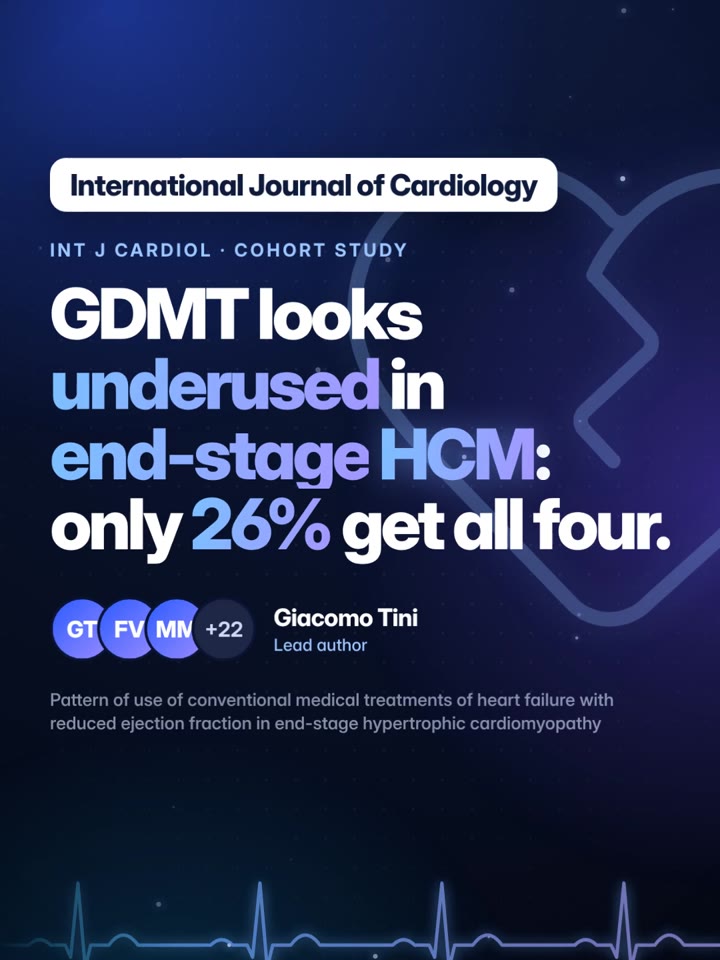
Int J Cardiol · cohort study. GDMT looks underused in end-stage HCM: only 26% get all four. Pattern of use of conventional medical treatments of heart failure with reduced ejection fraction in end-stage hypertrophic cardiomyopathy 274 patients: End-stage HCM across 11 Italian referral centres. HFrEF pillar use at last evaluation: BB 90%, RASi 75%, MRA 66%, SGLT2i 46%. 46% on SGLT2i: SGLT2 inhibitors: the least used pillar. Would optimizing GDMT improve outcomes in end-stage HCM? Bottom line: GDMT underuse appears common in end-stage HCM; outcome benefit remains untested.
Discussion
No takes yet. Share an insight, caveat, or question.
Cite This Study
Tini et al. (2026) conducted an observational in End-stage hypertrophic cardiomyopathy (n=274). Conventional medical treatments for HFrEF (BB, RASi, MRA, SGLT2i) was evaluated on Prescription of all 4 HFrEF pillars. Among patients with end-stage hypertrophic cardiomyopathy, all 4 HFrEF pillars were prescribed in only 26%, with beta-blockers used in 90% and SGLT2 inhibitors in 46%.