This research is Trending!
October 1, 2026JACC Heart Failure
Sex Differences in the Prevalence, Medical Therapy, and Outcomes in Heart Failure With Improved Ejection Fraction
Key result
Female patients with incident HFrEF were more likely to develop improved ejection fraction than males (36.5% vs 34.5%, P<0.0001), but subsequently experienced higher rates of worsening heart failure.
Why the study?
There is little understanding of how sex relates to the epidemiology, guideline-directed medical therapy use, and clinical outcomes in heart failure with improved ejection fraction (HFimpEF).
Do clinical outcomes and guideline-directed medical therapy use differ between females and males with heart failure with improved ejection fraction (HFimpEF)?
Key Points
- To evaluate sex-based differences in epidemiology, guideline-directed medical therapy utilization, and clinical outcomes among patients with heart failure with improved ejection fraction.
- Identified 28,292 adults with incident heart failure with reduced ejection fraction (ejection fraction ≤40%) between 2013 and 2022, defining improvement as ejection fraction >40% within 12 months.
- Evaluated guideline-directed medical therapy use and examined 1-year adjusted rates of worsening heart failure and all-cause death stratified by self-reported sex.
- Among 28,292 patients, 35.2% developed improved ejection fraction, with females demonstrating higher improvement rates than males (36.5% vs 34.5%, P < 0.0001).
- Guideline-directed medical therapy usage rates were similar between sexes but declined following ejection fraction improvement in both groups.
- While ejection fraction improvement correlated with reduced mortality and worsening events compared with persistent reduction, females with improved ejection fraction had significantly higher adjusted rates of worsening heart failure than males.
Study Design
Type
Cohort (n=28,292)
Structured PICO
Do clinical outcomes and guideline-directed medical therapy use differ between females and males with heart failure with improved ejection fraction (HFimpEF)?
P
Population
28,292 adults with incident heart failure with reduced ejection fraction (≤40%), evaluated for transition to improved ejection fraction and subsequent 1-year clinical outcomes.
E
Exposure
Female sex
C
Comparator
Male sex
O
Outcome
Incidence of worsening heart failure (WHF) events and all-cause death 1 year postincident HFrEFhard clinical
Main Result
Absolute Event Rate: 36.5% vs 34.5%
p-value: p=<0.0001
Key expert perspectives
Captured external expert commentary on this paper, strongest first. Original sources are linked where available.
CSCarolyn S.P. Lam
“For one, LVEF alone may not adequately measure or reflect risk of adverse outcomes among females. Females at a given LVEF may have more systolic dysfunction than males at a similar LVEF.”
Implication
While heart failure with improved ejection fraction (HFimpEF) is associated with improved outcomes overall, females with HFimpEF have significantly higher rates of worsening heart failure than males.
Abstract
Background Heart failure with improved ejection fraction (HFimpEF) is a rapidly growing clinical entity. There is little understanding of how sex relates to the epidemiology, predictors, and trajectory of HFimpEF. Objectives The authors aimed to describe sex-based differences in the epidemiology, guideline-directed medical therapy (GDMT) use, and clinical outcomes among patients with HFimpEF within a large, diverse health care system. Methods The authors identified adults with incident heart failure with reduced ejection fraction (HFrEF) (ejection fraction ≤40%) between 2013 and 2022. HFimpEF was defined as a subsequent ejection fraction measurement >40% within the following 12 months. Sex was based on self-report. Among patients with HFimpEF, the authors examined GDMT use at the time of incident HFrEF, HFimpEF, and 1 year following HFimpEF, stratified by sex. They examined the incidence of worsening heart failure (WHF) events and all-cause death 1 year postincident HFrEF. We compared event rates between patients with HFimpEF and persistent HFrEF, adjusted for demographic and clinical characteristics. Results Among 28,292 patients with incident HFrEF (females: 34.8%), 35.2% experienced HFimpEF. Females were more likely to experience HFimpEF in the 12 months following HFrEF than males (36.5% vs 34.5%, P < 0.0001). Among patients with HFimpEF, GDMT use was similar among females and males and declined after incident HFimpEF in both sexes. Compared with patients with persistent HFrEF, patients with HFimpEF had better WHF outcomes and all-cause death outcomes, which was consistent by sex. However, females with HFimpEF had higher rates of WHF compared with males with HFimpEF, even when adjusted for clinical covariates. Conclusions HFimpEF is associated with improved outcomes for both females and males. However, females with HFimpEF have higher rates of WHF events compared with males.
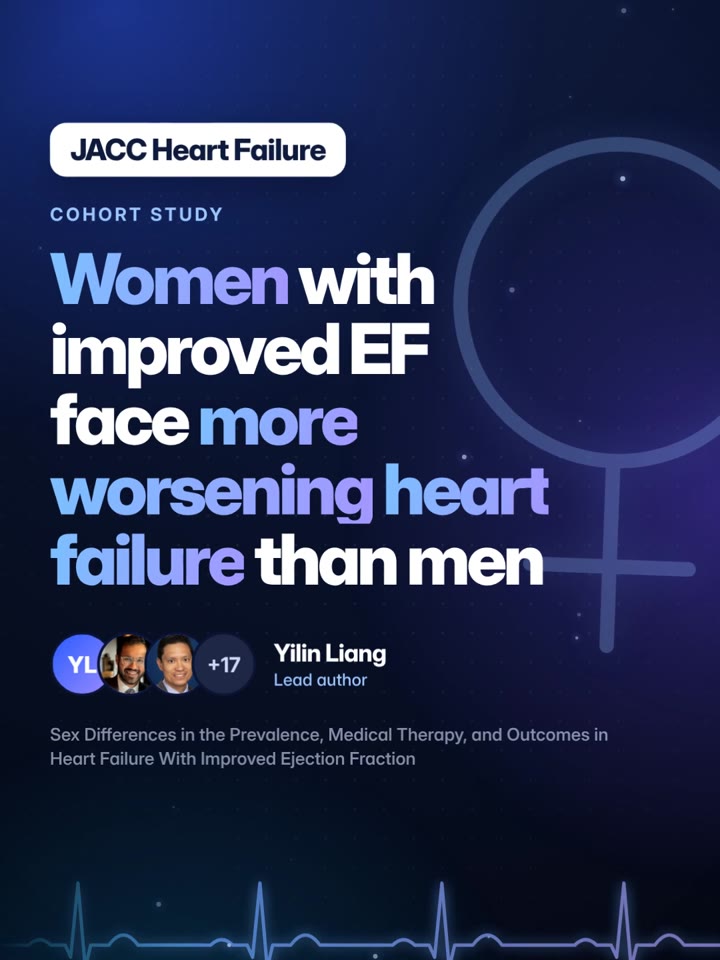
JACC Heart Failure · cohort study. Women with improved EF face more worsening heart failure than men Sex Differences in the Prevalence, Medical Therapy, and Outcomes in Heart Failure With Improved Ejection Fraction 28,292 adults: Adults with incident HFrEF, 2013 to 2022. Who reaches improved EF?: Female patients vs Male patients. 35.2%: of all patients developed improved EF. 36.5% of females reached improved EF. vs 34.5% of males within 12 months. After EF improved: therapy and outcomes: Similar GDMT use, GDMT then declined, Women: more WHF. Bottom line: Women improve EF more often, yet face more worsening HF afterwards.
Discussion
No takes yet. Share an insight, caveat, or question.
Cite This Study
Liang et al. (2026) conducted a cohort in Heart failure with improved ejection fraction (n=28,292). Female sex vs. Male sex was evaluated on Heart failure with improved ejection fraction (>40%) within 12 months (p=<0.0001). Female patients with incident HFrEF were more likely to develop improved ejection fraction than males (36.5% vs 34.5%, P<0.0001), but subsequently experienced higher rates of worsening heart failure.