DC
Donald C. Harrison
Electrophysiology
University of Cincinnati Medical Center
About
Donald C. Harrison works in Electrophysiology affiliated with University of Cincinnati Medical Center.
Donald C. Harrison is a professor of medicine emeritus at the University of Cincinnati, where he served as senior vice president and provost for health affairs from 1986 to 2002. He previously served as chief of the division of cardiology at Stanford University School of Medicine for 20 years. He also served as president of the American Heart Association from 1981 to 1982.
Research focus
Cardiac arrhythmias and treatmentsCardiac pacing and defibrillationCardiac electrophysiologyCardiac imaging and diagnosticsCardiac valve diseases and treatments
Impact
434 pubs · 19,285 cites · h-index 75
Affiliations
Work Experience
Senior Vice President and Provost for Health Affairs Emeritus
University of Cincinnati · 2002 - Present
Senior Vice President and Provost for Health Affairs
University of Cincinnati · 1986 - 2002
Chief of the Division of Cardiology
Stanford University School of Medicine · 1966 - 1986
President
American Heart Association · 1981 - 1982
Publications
cohort · n=47
OCT 2008MasonCardiology
Autonomic cardiac denervation in transplant recipients was associated with an increased incidence of ventricular arrhythmias and altered electrophysiologic responses compared to normal subjects.
May heighten arrhythmia vigilance in transplant recipients; leaves open causal mechanisms and need for prospective confirmation.
review · n=86,000
MAY 2005BlotCirculation

Outlet strut fractures occurred in 0.7% of 86,000 implanted Björk-Shiley convexoconcave valves over 25 years, with current rates in 60-degree valves at <0.1% per year.
Twenty-five years post-implantation, Björk-Shiley convexoconcave valves continue to carry a small but persistent risk of outlet strut fracture, necessitating individualized risk assessment for prophylactic reoperation.
cross-sectional · n=1,961
APR 1994DeMariaJournal of the American College of Cardiology

A survey of cardiovascular specialists revealed that 76% participated in at least one HMO or PPO arrangement, despite concerns over quality of care and general philosophical opposition.
Widespread managed care participation persists despite concerns; leaves open effects on care quality and warrants prospective outcomes research.
review
DEC 1987SmithJournal of Electrophysiology
Oral propafenone exhibits complex pharmacokinetics with saturable first-pass hepatic elimination, marked interpatient variability, and may exacerbate ventricular arrhythmias in 20-15% of patients.
Requires individualized dosing and proarrhythmia monitoring with oral propafenone; leaves open optimal strategies pending prospective trials.
Original Research
DEC 1986RubensteinProceedings of the National Academy of Sciences
Synchrotron radiation transvenous coronary angiography successfully acquires diagnostic coronary angiograms in humans.
The risks and costs of the present method of visualizing the coronary arteries have limited the use of coronary angiography in long-term serial studies needed to establish the natural history of coronary atherosclerosis and its response to interventions. A less invasive method, in which the contrast agent is administered intravenously, has been developed using synchrotron radiation as the illuminating source. The present report describes the initial results in human subjects. The findings indicate that transvenous coronary angiograms can be acquired in this manner. Further refinements in the x-ray imaging system are expected to result in increased x-ray fluence and improved image quality.
cohort · n=202
MAY 1985KeefePacing and Clinical Electrophysiology
Transient complete heart block occurred in 17.6% of aortic and 13% of mitral valve replacements, but no predictive factors were identified and it did not predict late recurrence of AV block.
Transient complete AV block during isolated valve replacement is common but does not predict late recurrence, suggesting prophylactic pacemaker implantation is unnecessary.
Original Research
AUG 1984ConnollyClinical Pharmacology & Therapeutics

Propafenone administration in patients with ventricular arrhythmias showed a terminal t1/2 of 5.0 +/- 3.6 hr, which increased to 6.2 +/- 3.3 hr after 5 days of oral dosing.
Suggests clearance may decline with chronic oral use; leaves open dosing optimization in ventricular arrhythmia patients.
RCT · n=13
SEP 1983ConnollyCirculation
There was a greater than 90% reduction of ventricular premature beats in 10 subjects during dose ranging and in seven during double-blind crossover.
Propafenone suppresses frequent VPBs in most patients; extends RCT evidence for class Ic agents while underscoring need for individualized dosing due to variability.
In Vitro Study
JUL 1982BristowNew England Journal of Medicine

Decreased Catecholamine Sensitivity and β-Adrenergic-Receptor Density in Failing Human Hearts
Identifies decreased beta-adrenergic-receptor density in failing hearts, suggesting implications for heart failure treatment.
Original Research
APR 1982KatesClinical Pharmacology & Therapeutics
Metabolite cumulation during long-term oral encainide administration
Cumulation of encainide and its major metabolites, O-demethylencainide (ODE), 3-methoxy-ODE (MODE), and N-demethylencainide (NDE) was examined in patients with frequent complex ventricular ectopy. After 6 mo on encainide patients were admitted to Stanford University Hospital and the drug was discontinued for 24 hr. During this time blood samples were drawn to characterize the cumulation and disposition of the drug and metabolites. The mean steady-state concentrations of encainide, ODE, and MODE were 56.3, 214.6, and 184.6 ng/ml after doses ranging from 100 to 250 mg/day. The concentration ratios of ODE/encainide and MODE/encainide were 5.02 +/- 2.61 and 5.15 +/- 4.13. NDE was detected in the plasma of only one patient. Elimination half lifes of encainide and ODE were 1.16 +/- 0.5 and 11.41 +/- 9.58 hr. MODE disappeared slowly and at 24 hr the plasma concentration was still 59.8 +/- 39.9% of its mean steady-state concentration. Our data indicate that the metabolites of encainide cumulate in the plasma of patients on long-term oral therapy and must be considered when evaluating its clinical efficacy.
Original Research
NOV 1981AldermanProceedings of SPIE, the International Society for Optical Engineering/Proceedings of SPIE
Quantitation Of Coronary Artery Dimensions Using Digital Image Processing
Sequential observations of coronary artery disease depend upon reproducibility of measurements of coronary dimensions. Because the coronary artery segment to be digitized for quantitation occupies only a small portion of the 35 mm cine frame, a cine projector was mounted on a movable X, Y stage so that the area of interest could be focused through a lens turret system onto a video camera. The lens turret provides lx, 3.5x, and 7x magnification. A digital image processing device operating under computer control permits direct application of smoothing and edge finding algorithms to the magnified coronary image. Using separately recorded grids, an external reference marker, and isocentering of the heart within a U-arm radiographic system, it is possible to adjust for distortion and magnification. A split screen technique provides capability for single plane or sequential biplane analyses. A digital lightpen is used to input fiducial points for segment identification and define an initial coronary margin which is superceded by computer defined edges. Final measurements include maximum, minimum and mean diameter of 1.0 cm long coronary segments and the absolute area of the segment profile, along with provision for hard copy image recording. Reproducibility of the minimum and maximum diameter measurements provided by the digitization system and edge finding algorithm are + .06 mm for vessels with an average diameter of 2.3 mm (+ S.D.). When duplicate coronary injections during the same catheterization procedure are made, the coefficient of variation of the minimum diameter is 9.5%, of the maximum diameter 5.0% and of the segment area 3.9%. The capability for area of interest selectivity, variable optical magnification and digital image analysis provides a unique and reproducible system for coronary segment quantitation.
RCT · n=9
AUG 1981WinkleCirculation
Eight of nine patients had more than 90% suppression of premature ventricular complexes for 3-36 hours.
Encainide achieves high PVC suppression rates; supports evaluation for chronic oral dosing in ventricular arrhythmias.
Original Research · n=12
JUL 1981KatesClinical Pharmacology & Therapeutics
Verapamil administration in patients with chronic atrial fibrillation showed 35% oral bioavailability, with long-term oral therapy yielding plasma concentrations twice the predicted single-dose value.
May warrant plasma monitoring for verapamil accumulation in chronic AF; leaves open prospective dosing studies.
editorial
JUN 1981HarrisonHospital Practice
Coronary Bypass: The First 10 Years
Coronary bypass surgery has become a widely performed procedure in the United States, recognized for prolonging life and enhancing quality of life in patients with inadequate response to medical management.
preclinical
JAN 1981LurieTransplantation
The combination of cyclosporin A and dipyridamole prevented the development of graft arteriosclerosis in transplanted rat hearts at 20 and 50 days postoperatively.
May warrant adjunctive therapy beyond cyclosporin A post-transplant; leaves open clinical translation of dipyridamole combination from rat models.
Original Research · n=21
DEC 1980SamiCirculation
To establish antiarrhythmic efficacy with 95% confidence, the minimal percent reduction of PVCs between baseline and placebo visits was 68% for treadmill exercise testing and 65% for ambulatory electrocardiography.
Spontaneous PVC variability demands stringent suppression thresholds to infer efficacy; leaves open prospective validation across agents and subgroups.
Original Research
MAR 1980JacksonCirculation
Once-daily atenolol reduces anginal attacks and suppresses 24-hour resting and exercise heart rates.
The physiology, pharmacokinetics and efficacy of atenolol, a cardioselective beta-adrenergic blocking agent, were evaluated in 10 patients with stable angina pectoris in a single-blind, dose-ranging study. After a 1-month control placebo period, atenolol was administered once daily at dosages of 25, 50, 100 and 200 mg for 2-week periods. All patients had fewer anginal attacks and consumed fewer nitroglycerin tablets than mg for 2-week periods. All patients had fewer anginal attacks and consumed fewer nitroglycerin tablets than during the placebo period. Twenty-four-hour ambulatory ECG recordings showed a decrease in mean hourly heart rate throughout the dosing period, with preservation of diurnal variation. Maximal, symptom-limited, treadmill exercise tests performed 3 hours after drug ingestion showed significantly increased exercise time and decreased double products for all doses, but especially with 100-mg and 200-mg doses. Exercise time 24 hours after drug ingestion continued to show a decrease in maximum heart rate and double product, with 100-mg and 200-mg doses again being most effective. Atenolol serum levels correlated with percent reduction in exercise heart rate and increased exercise time. Serum levels rose linearly, with an average elimination half-life of about 10 hours after chronic oral dosing. Thus, atenolol was an effective antianginal agent and suppressed resting and exercise-stressed heart rate for 24 hours after ingestion when given in a 100-mg or 200-mg dose once daily.
Original Research
DEC 1979HarrisonCirculation
Noninvasive cardiac instrumentation enables quantification of cardiac function and disease severity.
In the past three decades, techniques that permit noninvasive quantitation of the function of the heart have been developed. Exercise electrocardiography has been widely used to determine the presence or absence of ischemic heart disease. Echocardiography permits detection of valvular, congenital and arteriosclerotic disease and quantitation of its severity. Selective use of isotopes allows nuclear angiogarphy, myocardial perfusion studies and detection of damage to cellular myocardium. New techniques such as computerized axial tomography, magnetometry, focused pulsed Doppler, and wider application of computer-enhanced image processing are important future directions for noninvasive monitoring.
Original Research
JUN 1979JaillonClinical Pharmacology & Therapeutics
Influence of congestive heart failure on prazosin kinetics
The kinetics of oral prazosin was studied in 10 healthy normal subjects (NS) and in 9 patients with congestive heart failure (CHF). NS received a single 5-mg dose, and blood concentrations of prazosin (CB) were measured, using a specific HPLC assay, during an 8-hr period. CHF patients received a 2-mg dose after which CB was measured for 10 hr. These patients then received 2 to 5 mg prazosin every 8 hr for 48 hr. After the last dose of prazosin, CB was measured for 24 hr. After the initial dose, time to peak CB did not differ significantly between that of the NS (123 +/- 19 SEM min) and of patients with CHF (132 +/- 31.3 min). AUC/mg prazosin was greater (p less than 0.001) in patients with CHF (3,385 +/- 380 Ng x min/ml) than in NS (1,603 +/- 208 ng x min/ml). Elimination of prazosin from blood was slower in CHF patients (t1/2 = 374 +/- 33.4 min) than in NS (t1/2 = 144.5 +/- 4.3 min) (p less than 0.001). These data suggest that in patients with CHF the elimination of prazosin is substantially slower than in NS and therefore higher steady-state prazosin concentrations can be expected in CHF patients than in NS.
editorial
OCT 1978HarrisonCirculation
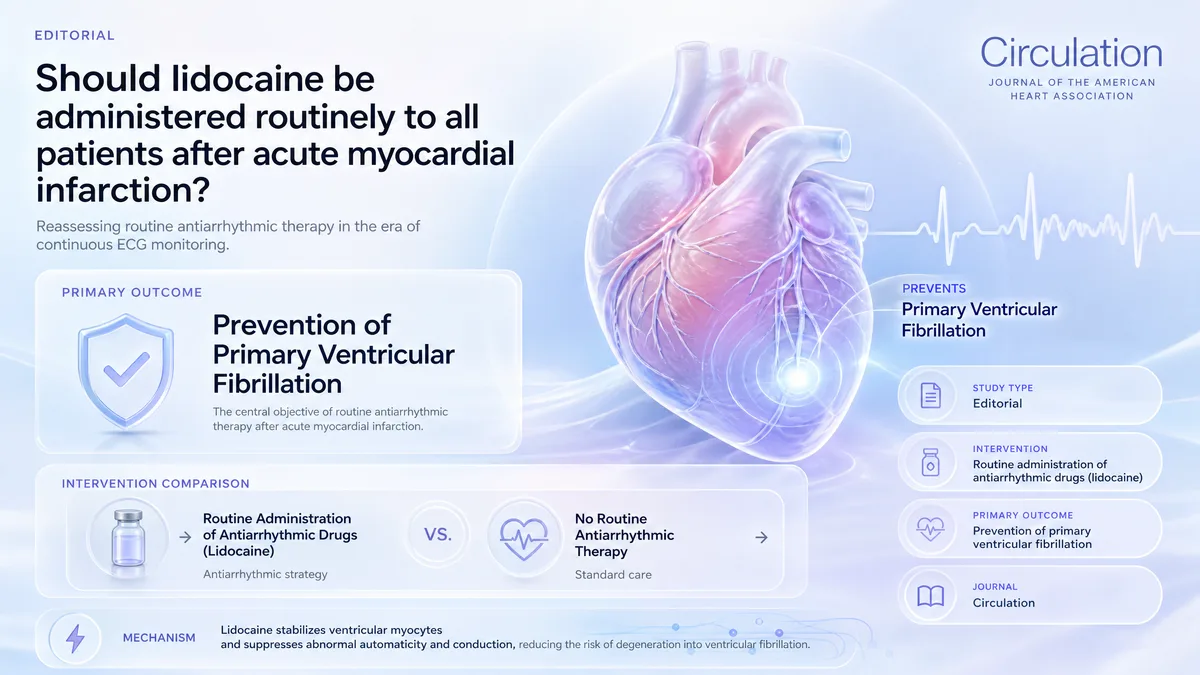
Should lidocaine be administered routinely to all patients after acute myocardial infarction?
This editorial reviews the concept of routine lidocaine administration to prevent primary ventricular fibrillation in patients with acute myocardial infarction.