This research is Trending!
Health Status Outcomes 7 Years After Transcatheter or Surgical Aortic Valve Replacement in Low-Surgical Risk Patients With Aortic Stenosis
Key result
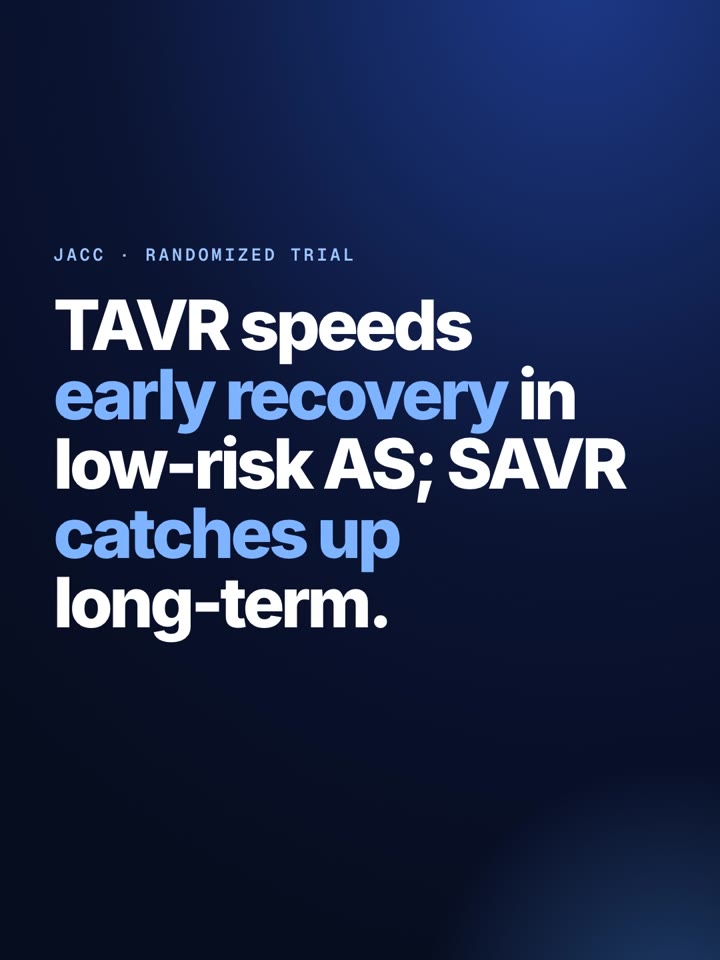
TAVR improves 1-month KCCQ-OS scores by ~16 points over SAVR but equalizes after two years.
- MD 16.2
- 95% CI 14.3-18.1
- n=943
Why the study?
TAVR improves early health status versus SAVR in low-surgical risk patients with severe aortic stenosis, but long-term comparative data are lacking.
Does TAVR improve long-term patient-reported health status compared to SAVR in low-surgical risk patients with severe aortic stenosis?
Key Points
- To compare long-term health status outcomes between TAVR and SAVR in low-risk patients with aortic stenosis.
- Randomized trial (NCT02675114) of 943 patients with severe aortic stenosis, 1:1 allocated to TAVR or SAVR.
- Health status assessed using KCCQ and Short Form-36 at baseline, 1 month, 6 months, and annually up to 7 years.
- Analyses used mixed effects models for repeated measures, adjusted for baseline.
- TAVR showed significantly higher KCCQ-OS scores at 1 month (mean difference: +16.2, 95% CI: 14.3-18.1) compared to SAVR.
- At 2 years, KCCQ-OS scores remained higher for TAVR (mean difference: +1.9, 95% CI: 0.2-3.7), but no significant differences were observed from years 3-7.
- Around 60% of patients in both groups achieved excellent health outcomes at 7 years.
Study Design
Type
RCT (n=943)
Randomization
1:1
Structured PICO
Does TAVR improve long-term patient-reported health status compared to SAVR in low-surgical risk patients with severe aortic stenosis?
P
Population
943 patients with severe aortic stenosis and low surgical risk randomized to TAVR or SAVR and followed for 7 years to assess health status outcomes.
I
Intervention
Transcatheter aortic valve replacement (TAVR) with a balloon-expandable valve
C
Comparator
Surgical aortic valve replacement (SAVR)
O
Outcome
Health status evaluated with the Kansas City Cardiomyopathy Questionnaire (KCCQ) and Short Form-36 Heath Survey at baseline and 1 month, 6 months, and annually from years 1 to 7patient reported
Main Result
Mean Difference: 16.2 (95% CI 14.3–18.1)
In low-risk patients with severe aortic stenosis, TAVR provides faster early recovery in health status compared to SAVR, but both therapies offer similar, sustained improvements from 3 to 7 years.
Key expert perspectives
Captured external expert commentary on this paper, strongest first. Original sources are linked where available.

“It's really reassuring to tell a patient that if we could have a crystal ball and look 7 years out in the future, you have nearly a 60% chance of feeling really good and being alive. For most patients with aortic stenosis who are in their early to mid 70s, that's a pretty good vote of confidence and a stamp of approval for either transcatheter or surgical valve replacement.”
DSDr. Sertaç ÇiçekCardiovascular Surgeon
“The 7-year outcomes of the Placement of Aortic Transcatheter Valves 3 (PARTNER 3) trial comparing transcatheter aortic valve implantation (TAVI) with surgical aortic valve replacement (SAVR) in low-risk patients indicate that the narrowing difference between the two strategies reflects study design convergence rather than true clinical equivalence. Although the composite endpoint of death, stroke, and rehospitalization appeared comparable, important asymmetries persisted. Emerging trends in late mortality and crossing hazard curves further suggest potential divergence in long-term survival.”

“TAVR with the Sapien 3 platform demonstrated comparable 7-year durability to surgery, supporting its use as a treatment option in lifetime management of low-risk patients with symptomatic severe AS.”
Implication
TAVR accelerates early recovery in low-risk aortic stenosis; extends RCT evidence of equivalent health status through 7 years.
Abstract
BACKGROUND: Transcatheter aortic valve replacement (TAVR) results in early improvements in health status outcomes relative to surgical aortic valve replacement (SAVR) in low-surgical risk patients with symptomatic severe aortic stenosis. However, long-term data comparing the detailed health status outcomes of these 2 treatments are lacking. OBJECTIVE: The purpose of this study was to compare long-term health status outcomes between TAVR and SAVR in low-risk patients and explore heterogeneity of treatment effect. METHODS: The PARTNER 3 (Placement of Aortic Transcatheter Valves) trial randomized patients with severe aortic stenosis and low surgical risk 1:1 to TAVR with a balloon-expandable valve vs SAVR. Health status was evaluated with the Kansas City Cardiomyopathy Questionnaire (KCCQ) and Short Form-36 Heath Survey at baseline and 1 month, 6 months, and annually from years 1 to 7. Between treatment group differences in health status scores over time were examined with mixed effects models for repeated measures adjusted for baseline. RESULTS: The analytic cohort included 943 patients enrolled in the PARTNER 3 trial who had baseline KCCQ assessments and underwent their assigned procedure (494 TAVR, 449 SAVR; mean age: 73.5 ± 5.9 years; 69.2% men; mean Society of Thoracic Surgeons-Predicted Risk of Mortality: 1.9% ± 0.6%; mean KCCQ-overall summary [KCCQ-OS] score: 70.9 ± 20.5). TAVR and SAVR both resulted in significant improvements in KCCQ and Short Form-36 Heath Survey summary scores relative to baseline through 7-year follow-up. KCCQ-OS scores were substantially higher at 1 month after TAVR vs SAVR (mean treatment difference: +16.2 points; 95% CI: 14.3-18.1) and remained modestly higher through 2 years of follow-up (mean difference at 2 years: +1.9 points; 95% CI: 0.2-3.7), but there were no significant between-group differences in years 3-7. At 7 years, ∼60% of patients in both treatment groups had an excellent outcome (alive, KCCQ-OS ≥75; no KCCQ-OS decline ≥10 from baseline). CONCLUSIONS: Patients with severe aortic stenosis at low surgical risk had substantial improvement in patient-reported health status with either TAVR or SAVR that was sustained through 7 years. Patients had earlier recovery with TAVR, but health status outcomes after 2 years were similar between treatment groups. (PARTNER 3 Trial: Safety and Effectiveness of the SAPIEN 3 Transcatheter Heart Valve in Low Risk Patients With Aortic Stenosis; NCT02675114).
Coverage & sources
Journal, society, and media accounts. Useful signal, not independent expert judgment.
Discussion
No takes yet. Share an insight, caveat, or question.
Cite This Study
Brener et al. (2026) conducted an RCT in severe aortic stenosis (n=943). Transcatheter aortic valve replacement (TAVR) vs. Surgical aortic valve replacement (SAVR) was evaluated on Kansas City Cardiomyopathy Questionnaire overall summary (KCCQ-OS) score at 1 month (MD 16.2, 95% CI 14.3-18.1). TAVR provided earlier recovery in health status compared to SAVR, with a mean KCCQ-OS difference of +16.2 points (95% CI 14.3-18.1) at 1 month, but outcomes were similar between groups after 2 years.