KR
Kausik RaySep 5
Why didn’t achieving an LDL-C of 16mg/dl 6 weeks after MI and an LDL-C difference between groups of 40mg/dl at week 6 with the aforementioned rationale translate into significant clinical benefits at 1 year?
Key result
First-line evolocumab before PCI for acute MI significantly improved LDL-C target achievement at 1 year (82% vs 40%; OR 5.54) but did not reduce all-cause death or cardiovascular hospitalization.
Why the trial?
Statin therapy takes weeks to lower LDL cholesterol, leaving early post-infarction risk unaddressed. AMUNDSEN asked whether giving the PCSK9 inhibitor evolocumab immediately before primary PCI for acute myocardial infarction confers additional early benefit over standard lipid-lowering alone.
Does evolocumab started before PCI improve LDL-C control and clinical outcomes at 1 year in patients with high-risk acute MI?
| Outcome | Evolocumab | Standard care |
|---|---|---|
| LDL-C <55 mg/dL + >=50% reduction at 12 months | 792/970 (82%) | 370/934 (40%) |
| Adjusted OR 5.54 (95% CI 4.50-6.82); P<.001 | ||
| Median LDL-C at 6 weeks | 16 mg/dL | 56 mg/dL |
| Rapid separation after in-lab initiation | ||
| All-cause death or unplanned CV hospitalization | 159/1087 (14.6%) | 165/1074 (15.4%) |
| Main clinical endpoint - adjusted OR 0.94 (0.73-1.19); P=.59 - no benefit at 1 year | ||
Design limitations
the primary endpoint is a lipid target, a surrogate rather than a clinical outcome, and LDL-C was assessable in only 970/1087 and 934/1074 patients.
Background therapy
control patients could receive PCSK9 inhibitors per guideline indication, diluting the contrast.
Does evolocumab started before PCI improve LDL-C control and clinical outcomes at 1 year in patients with high-risk acute MI?
Odds Ratio: 5.54 (95% CI 4.5–6.82)
Absolute Event Rate: 82% vs 40%
p-value: p=<.001
Experts agree AMUNDSEN doubled LDL-C goal attainment with early evolocumab after acute MI but see the absence of clinical benefit at one year as a sign that longer follow-up is needed before this changes practice.
The reaction is largely unified: starting evolocumab in the cath lab dramatically improved lipid target attainment, but experts are not reading this as practice-changing because clinical events were no different at one year. Several clinicians frame the result as confirmation that LDL lowering takes time to translate into fewer events. The live question is whether longer follow-up or better use of existing oral therapies could close the gap more efficiently.
Multiple clinicians converge on the same reading: AMUNDSEN showed striking LDL-C target attainment with early evolocumab but no detectable reduction in clinical events at one year, and they caution against interpreting this as evidence that PCSK9 inhibitors do not work after MI.
What they’re arguing about
supportiveneutralcautiouscritical
Counts are expert takes we classified by axis. Tap a row to see the takes behind its count.
Whether longer follow-up will eventually show a clinical event reduction remains the central open question. Several experts also wonder whether maximizing oral combination therapy (high-intensity statin plus ezetimibe) from day one could achieve comparable LDL-C control at lower cost, potentially reducing the need for early PCSK9 inhibitor use. The trial's low ezetimibe use in the standard-care arm leaves it unclear how much of the gap was driven by undertreatment rather than the inherent advantage of evolocumab.
“[T]he trial shows that for patients with MI, the benefits from LDL-C lowering are a marathon, not a sprint, and that a rapid LDL-C reduction at 7 days with a PCSK9 monoclonal antibody will take years to translate into meaningful clinical benefits.”
Fogacci cautions against over-reading the null clinical result: the trial shows cath-lab evolocumab produced profound LDL-C lowering but no detectable 1-year reduction in death or unplanned CV hospitalization. She emphasizes that AMUNDSEN is also an implementation trial, noting that only 40% of standard-care patients reached target and only 3.8% received a PCSK9 inhibitor, calling this a pathway problem. She highlights an accompanying editorial arguing the point is to separate rapid LDL-C lowering from the time needed to see clinical benefit.
Ragy points out that less than 30% of patients in AMUNDSEN received ezetimibe and that in Egypt, where generic statin-ezetimibe combos are cheap and widely used, most non-FH patients reach LDL-C of 55 on oral combination therapy alone. He questions whether the trial showed clinical benefit over what full statin-ezetimibe from day one could achieve.
First-line evolocumab administered before PCI in acute MI significantly improved LDL-C target achievement at 1 year but did not reduce all-cause death or unplanned cardiovascular hospitalization, arguing against acute pleiotropic clinical benefits.
Importance: Proprotein convertase subtilisin-kexin type 9 (PCSK9) inhibition is recommended as second- or third-line lipid-lowering therapy after myocardial infarction (MI), resulting in prolonged periods of inadequate low-density lipoprotein cholesterol (LDL-C) control. Whether in-catheterization laboratory decision of PCSK9 inhibition, started before mechanical reperfusion, could improve LDL-C control and clinical outcomes at 1 year is unknown. Objective: To evaluate evolocumab as first-line therapy vs standard care in patients with high-risk acute MI undergoing percutaneous coronary intervention (PCI). Design, Setting, and Participants: This international, phase 4, prospective randomized, open, blinded end-point adjudication study was conducted at 48 sites in 6 countries. Adults with high-risk ST-elevation MI (STEMI; aged >55 years) or non-ST-elevation MI (NSTEMI) with 1 or more additional high-risk characteristics were enrolled beginning September 29, 2021, through May 22, 2025, with final follow-up on May 22, 2026. Interventions: Patients were randomized 1:1 to receive evolocumab 140 mg subcutaneously every 2 weeks for 1 year (first injection before PCI) in addition to standard care (n = 1087) or standard care alone (n = 1074). Standard care included high-intensity oral lipid-lowering therapy with the optional PCSK9 inhibitor use per guideline indication in the control group. Main Outcomes and Measures: The primary outcome was LDL-C less than 55 mg/dL and at least 50% reduction in LDL-C from baseline at 12 months. The main clinical end point was all-cause death or unplanned cardiovascular hospitalization at 12 months. Results: Among 2161 randomized patients (mean age, 67 years; 1703 males [79%]; 1261 [58%] with STEMI; 900 [42%] with NSTEMI), the primary outcome was achieved in 792 of 970 patients (82%) with evolocumab vs 370 of 934 (40%) with standard care (adjusted odds ratio, 5.54 [95% CI, 4.50-6.82]; P < .001). At 6 weeks, median LDL-C was 16 mg/dL with evolocumab vs 56 mg/dL with standard care. The main clinical end point occurred in 159 of 1087 patients (14.6%) with evolocumab vs 165 of 1074 (15.4%) with standard care (adjusted odds ratio, 0.94 [95% CI, 0.73-1.19]; P = .59). Conclusions and Relevance: In patients with acute MI undergoing PCI, first-line evolocumab combined with high-intensity lipid-lowering therapy produced rapid and sustained LDL-C reduction, with more than 80% of patients reaching the guideline-recommended target at 1 year. However, no clinical benefit was detected during the first year of follow-up, arguing against clinically meaningful acute pleiotropic effects of PCSK9 inhibitors in addition to standard care. Trial Registration: ClinicalTrials.gov Identifier: NCT04951856.
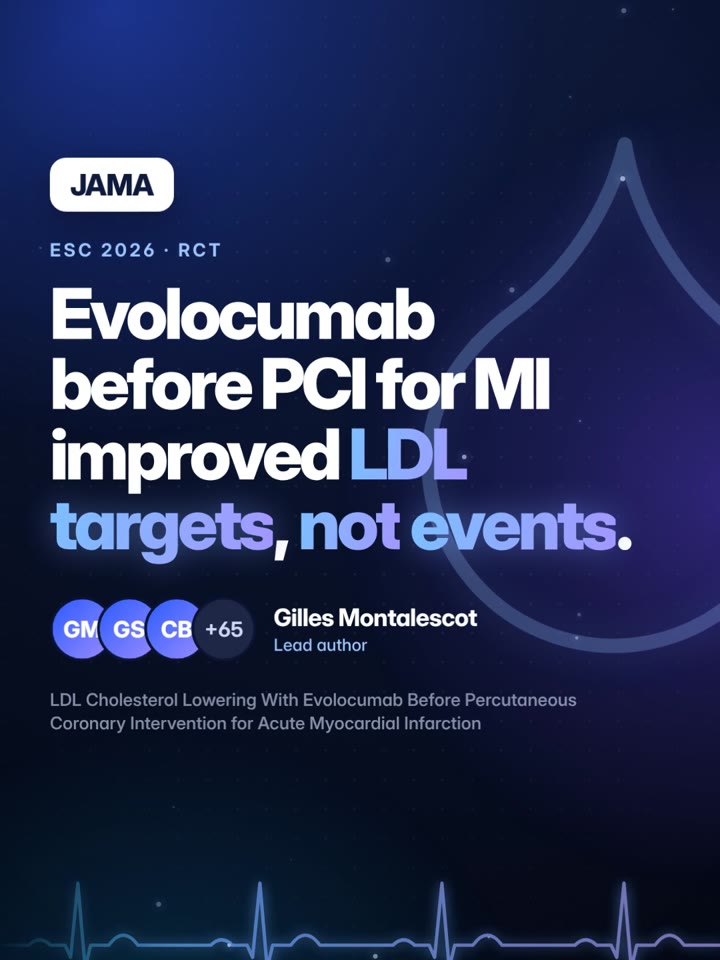
JAMA · ESC 2026 · RCT. Evolocumab before PCI for MI improved LDL targets, not events. AMUNDSEN: LDL Cholesterol Lowering With Evolocumab Before Percutaneous Coronary Intervention for Acute Myocardial Infarction 2161 adults: High-risk acute MI undergoing PCI. Evolocumab given before PCI: Evolocumab plus standard care vs Standard care alone. LDL-C target reached at 12 months: Evolocumab 82% vs Standard care 40%. 82% reached LDL-C target. OR 5.54 (95% CI 4.50–6.82). Odds of target higher with evolocumab. Death or CV hospitalization: no difference: 14.6% evolocumab, 15.4% standard, P = .59. Bottom line: Better LDL-C targets, but no fewer events at 1 year.
Journal, society, and media accounts. Useful signal, not independent expert judgment.
Montalescot et al. (2026) conducted an RCT in Acute myocardial infarction (n=2,161). Evolocumab vs. Standard care was evaluated on LDL-C less than 55 mg/dL and at least 50% reduction in LDL-C from baseline at 12 months (OR 5.54, 95% CI 4.50-6.82, p=<.001). First-line evolocumab before PCI for acute MI significantly improved LDL-C target achievement at 1 year (82% vs 40%; OR 5.54) but did not reduce all-cause death or cardiovascular hospitalization.
Synapse has enriched 5 closely related papers on similar clinical questions. Consider them for comparative context:

