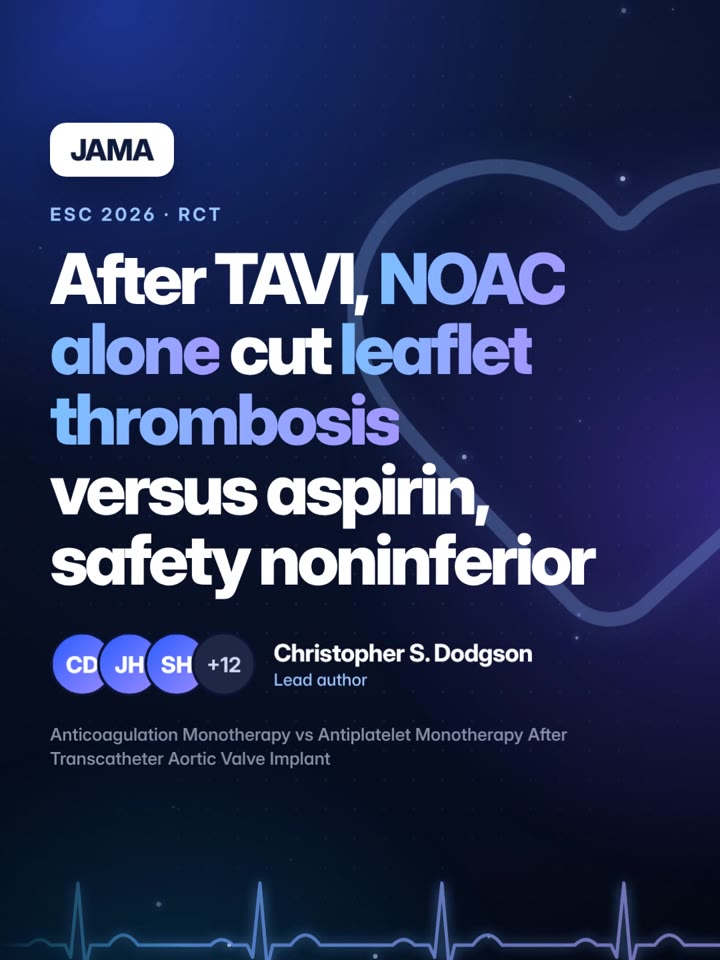
NOAC monotherapy after TAVI reduced HALT versus aspirin (16.2% vs 28.6% (27/167 vs 48/168)) with noninferior safety.
RR 0.55
95% CI 0.37 to 0.82
P=.004
n=360
Why the trial?
The optimal antithrombotic regimen after TAVI is unsettled: aspirin is standard, yet leaflet thrombosis is frequent and its prevention unproven. ACASA-TAVI asked whether NOAC monotherapy protects the valve better without excess bleeding.
Does NOAC monotherapy reduce valve leaflet thrombosis and maintain safety compared to ASA monotherapy in patients aged 65-80 years undergoing TAVI for severe aortic valve stenosis?
Key Points
To evaluate the safety and efficacy of factor Xa inhibitor non-vitamin K antagonist oral anticoagulant (NOAC) monotherapy compared with acetylsalicylic acid (ASA) monotherapy after transcatheter aortic valve implant (TAVI).
Prospective, randomized, open-label, blinded-endpoint trial (NCT05035277) conducted across 3 centers in Norway enrolling 360 patients (aged 65–80 years) undergoing TAVI for severe aortic stenosis.
Participants were randomly assigned (1:1) to receive 12 months of monotherapy with either a factor Xa inhibitor NOAC or ASA.
Co-primary endpoints were valve leaflet thrombosis (hypoattenuated leaflet thickening on 4D CT) and a composite safety outcome of VARC-3 bleeding, thromboembolism, or all-cause death at 12 months.
The primary efficacy endpoint occurred in 16.2% (27/168) of the NOAC group versus 28.6% (48/168) of the ASA group (risk ratio, 0.55; 95% CI, 0.37 to 0.82; P = .004).
The composite safety endpoint occurred in 7.5% (13/168) of the NOAC group versus 10.6% (19/168) of the ASA group (risk difference, -3.3%; 95% CI, -9.5% to 2.8%; P < .001 for noninferiority).
Evidence details
What drove the result?
Outcome
NOAC
ASA
HALT (valve leaflet thrombosis) on 4D CT at 12 months
Co-primary efficacy · in-world sources disagree (abstract 16.2% vs 28.6%; structured record 17.2% vs 32.6%); values withheld pending review
Limitations & tradeoffs
Safety
VARC-3 bleeding, thromboembolic events, or death (co-primary safety) occurred in 13 (7.5%) vs 19 (10.6%); RD −3.3% (95% CI −9.5% to 2.8%); noninferior (p<0.001).
Design limitations
In-world sources disagree on the primary HALT rates, so the efficacy result needs manual reconciliation.
Subgroup caution
HALT is a subclinical imaging endpoint; its link to clinical events is not established by this trial.
Representation
Findings apply to patients aged 65–80 without another indication for anticoagulation.
Structured PICO
Does NOAC monotherapy reduce valve leaflet thrombosis and maintain safety compared to ASA monotherapy in patients aged 65-80 years undergoing TAVI for severe aortic valve stenosis?
P
Population
360 patients aged 65 to 80 years undergoing TAVI for severe aortic valve stenosis, followed for 12 months.
I
Intervention
Factor Xa inhibitor non-vitamin K antagonist oral anticoagulant (NOAC) monotherapy for 12 months
C
Comparator
Acetylsalicylic acid (ASA) monotherapy for 12 months
O
Outcome
Co-primary endpoints at 12 months: 1) TAVI valve leaflet thrombosis defined as hypoattenuated leaflet thickening (HALT) on blinded core laboratory 4D cardiac CT scan; 2) Composite of adjudicated VARC-3 bleeding events, thromboembolic events, and all-cause deathcomposite
Main Result
Relative Risk: 0.55 (95% CI 0.37–0.82)
Absolute Event Rate: 16.2% vs 28.6%
p-value: p=.004
In patients aged 65-80 undergoing TAVI, NOAC monotherapy for 12 months significantly reduced subclinical valve leaflet thrombosis and was noninferior for clinical safety events compared to standard aspirin monotherapy.
Looking forward to discussing ACASA-TAVI with this community.
Wouldn’t it be better to diagnose subclinical valve thrombosis first with CT followed bij randomisation of only positive patients to continuing ASA vs DOAC (POPULAR ATLANTIS)
Where experts stand
Experts see ACASA-TAVI as intriguing but not practice-changing, noting that reduced leaflet thrombosis is a surrogate endpoint and the trial was too small to settle whether NOACs improve hard clinical outcomes after TAVI.
The reaction is cautious: most commentators acknowledge that NOAC monotherapy cut leaflet thrombosis compared with aspirin, but they stress the trial relied on imaging surrogates rather than strokes or mortality. The live question is whether a larger, outcomes-powered trial can justify switching younger, lower-risk TAVI patients away from single antiplatelet therapy.
Agreement
Multiple clinicians agree the trial does not warrant a change in practice because it was not powered for hard clinical outcomes and leaflet thrombosis on CT remains a surrogate endpoint.
2 clinicians say this directly
Still unclear
Whether reducing leaflet thrombosis on CT translates into fewer strokes, better valve durability, or improved survival remains unknown. Experts note a dedicated clinical-outcomes trial comparing monotherapy strategies is still needed, and whether younger, lower-bleeding-risk patients represent a subgroup that could benefit from NOACs is unresolved.
“We were able to show substantial reductions in signs of subclinical leaflet thrombosis with NOAC monotherapy, without compromising safety. Results from the ACASA-TAVI trial may establish a new antithrombotic treatment paradigm after TAVI and could be used to inform future guidelines.”
Oslo University Hospital Rikshospitalet
Stefano GarzonHospital Israelita Albert EinsteinPractice takeAug 30
SAPT remains the standard of care after TAVI
Reads the combined signal from ACASA-TAVI and NOTION-4 as less leaflet thrombosis but more bleeding with anticoagulation, concluding that single antiplatelet therapy should remain the default post-TAVI strategy.
ALAlejandro Lara-GarcíaInterventional cardiologist, Hospital La PazPractice takeSep 14
Younger, lower-bleeding-risk TAVI patients may gain durability from NOAC without added major bleeding
Argues that as TAVI implants become more personalized, antithrombotic therapy should follow. In younger patients under 80 with low bleeding risk, an oral anticoagulant could reduce leaflet thrombosis and potentially improve durability without increasing serious bleeding.
NOAC monotherapy reduces TAVI leaflet thrombosis with noninferior safety; extends antithrombotic options beyond aspirin in moderate-risk patients.
Abstract
Importance: Transcatheter aortic valve implant (TAVI) is increasingly being performed in younger and healthier patients with severe aortic valve stenosis. Antithrombotic therapy after TAVI is a key element of optimizing valve durability and clinical outcomes. Objective: To evaluate the safety and efficacy of a factor Xa inhibitor non-vitamin K antagonist oral anticoagulant (NOAC) monotherapy strategy vs an acetylsalicylic acid (ASA) monotherapy strategy after TAVI. Design, Setting, and Participants: Between December 2021 and June 2025, 360 participants between the ages of 65 and 80 years undergoing TAVI for severe aortic valve stenosis were enrolled in this prospective, randomized, open-label, blinded end point trial conducted at 3 Norwegian centers managing the majority of TAVI procedures nationally. The last patient completed follow-up on May 19, 2026. Intervention: A total of 360 participants were randomly assigned (1:1) to receive 12 months of monotherapy with either NOAC (intervention) or ASA (control). Main Outcomes and Measures: A predefined co-primary end point strategy was chosen to address both efficacy and safety. The primary efficacy end point was TAVI valve leaflet thrombosis defined as the presence of hypoattenuated leaflet thickening (HALT) on blinded core laboratory 4-dimensional cardiac computed tomographic (CT) scan at 12 months. The primary safety end point was a composite of adjudicated Valve Academic Research Consortium 3 (VARC-3) bleeding events, thromboembolic events, and all-cause death at 12 months. Results: Of the 360 participants randomized (mean age, 74.5 years [SD, 3.7]; 134 females [37%]), 336 completed the trial (168 in each group). The primary efficacy end point occurred in 27 participants (16.2%) allocated to the NOAC group and in 48 participants (28.6%) allocated to the ASA group (risk ratio, 0.55; 95% CI, 0.37 to 0.82, P = .004). The primary safety end point occurred in 13 participants (7.5%) in the NOAC group and in 19 participants (10.6%) in the ASA group (risk difference, -3.3%; 95% CI, -9.5% to 2.8%; P for noninferiority <.001). Conclusions and Relevance: A strategy of NOAC monotherapy after TAVI reduced the incidence of HALT and was noninferior for bleeding, thromboembolic events, or death compared with acetylsalicylic acid monotherapy. These findings suggest that anticoagulation therapy can be beneficial after TAVI in selected patients. Trial Registration: ClinicalTrials.gov Identifier: NCT05035277.
JAMA · ESC 2026 · RCT. After TAVI, NOAC alone cut leaflet thrombosis versus aspirin, safety noninferior
ACASA-TAVI: Anticoagulation Monotherapy vs Antiplatelet Monotherapy After Transcatheter Aortic Valve Implant
360 TAVI patients: Aged 65-80, severe aortic stenosis, 3 Norwegian centers.
12 months of single therapy: NOAC monotherapy vs Aspirin monotherapy.
Leaflet thrombosis (HALT) on CT at 12 months: NOAC 16.2 vs ASA 28.6.
RR 0.55 (95% CI 0.37–0.82), P=.004. Less leaflet thrombosis with NOAC.
Safety composite noninferior: 7.5% vs 10.6%: Bleeding, Thromboembolism, Death.
Bottom line: NOAC monotherapy reduces leaflet thrombosis after TAVI with noninferior safety.
0:00 / 0:33
Coverage & sources
Journal, society, and media accounts. Useful signal, not independent expert judgment.
Cite This Study
Dodgson et al. (2026) conducted an RCT in Severe aortic valve stenosis (n=360). NOAC monotherapy vs. Acetylsalicylic acid (ASA) monotherapy was evaluated on TAVI valve leaflet thrombosis defined as the presence of hypoattenuated leaflet thickening (HALT) on blinded core laboratory 4-dimensional cardiac computed tomographic (CT) scan at 12 months (RR 0.55, 95% CI 0.37 to 0.82, p=.004). NOAC monotherapy reduced TAVI valve leaflet thrombosis at 12 months compared to ASA monotherapy (16.2% vs 28.6% (27/167 vs 48/168); risk ratio 0.55, 95% CI 0.37-0.82; P=0.004) and was noninferior for safety (7.5% vs 10.6%; risk difference -3.3%, 95% CI -9.5% to 2.8%; P for noninferiority <0.001).