Cardiotoxicity in breast cancer patients treated with chemoradiotherapy
View Full Paper
Ask AI
Bookmark
Share
Key result
Breast cancer treatments carry a ~15% risk of long-term cardiac dysfunction, necessitating early surveillance.
Figures
Key Points
- To review the mechanisms of treatment-induced cardiotoxicity in breast cancer patients and evaluate emerging surveillance strategies for early detection.
- Synthesized pathophysiological mechanisms and clinical risks associated with anthracyclines, taxanes, cyclophosphamide, HER2 inhibitors, and radiation therapy.
- Assessed cardiac surveillance modalities, comparing conventional left ventricular ejection fraction monitoring to advanced biomarker and myocardial strain analyses.
- Over 15% of women receiving chemotherapy or targeted therapy develop cardiotoxicity, with cardiac dysfunction serving as the leading cause of mortality at 10-year follow-up, exceeding cancer recurrence.
- Anthracyclines cause myocardial damage by inhibiting topoisomerase II, halting DNA repair, and generating reactive oxygen species, leading to left ventricular systolic dysfunction or heart failure.
- Transthoracic echocardiographic ejection fraction identifies cardiotoxicity late when damage may be irreversible, whereas left ventricular global longitudinal strain sensitively detects subclinical systolic dysfunction.
Structured PICO
P
Population
Breast cancer patients treated with chemoradiotherapy (including anthracyclines, taxanes, cyclophosphamide, HER2 inhibitors, immunotherapies, hormone therapies, and radiotherapy)
E
Exposure
Cardiac surveillance using biomarkers (troponins, natriuretic peptides) and advanced imaging techniques (left ventricular global longitudinal strain)
This review outlines the mechanisms and clinical manifestations of cardiotoxicity from breast cancer therapies and emphasizes the utility of left ventricular global longitudinal strain for early detection of subclinical myocardial injury.
Limitations
- Lack of standardized guidelines on surveillance and management of this vulnerable patient cohort.
- LVEF is a late marker of cardiotoxicity with damage potentially irreversible.
- Cardiac biomarkers lack standardization of measurement assays across centers.
Implication
May support GLS surveillance in targeted cancer therapy; leaves prospective outcome trials open.
Abstract
With national breast cancer screening programs leading to earlier diagnosis and improved treatments, more women are achieving long-term remission. However, this has resulted in rising rates of cardiotoxicity in breast cancer survivors consequent to their cancer therapies. Anthracyclines, a cornerstone treatment in breast cancer, carry a significant risk of short- and long-term cardiotoxicity through inhibition of topoisomerase II, preventing DNA repair and increasing oxidative stress. This most commonly manifests in the form of left ventricular (LV) systolic dysfunction or heart failure, and in severe cases, death. Many of the other treatments, including taxanes, cyclophosphamide, human epidermal growth factor receptor 2 inhibitors, immunotherapies, hormone therapies, and radiotherapy, also carry a risk of cardiac injury in the form of heart failure, arrhythmias, myocarditis, and pericardial disease. Surveillance has traditionally been performed by monitoring LV ejection fraction by transthoracic echocardiography. However, this has been found to be a late marker of cardiotoxicity, with damage potentially irreversible, and may reflect a missed opportunity for early intervention. Research has focused on identifying cardiac biomarkers and advanced imaging techniques, including strain analysis, to detect subclinical myocardial injury or dysfunction prior to irreversible damage, with LV global longitudinal strain a sensitive marker of subclinical LV systolic dysfunction and superior predictor of future cardiovascular events. Further research is needed to establish standardized guidelines on surveillance and management of this vulnerable patient cohort.
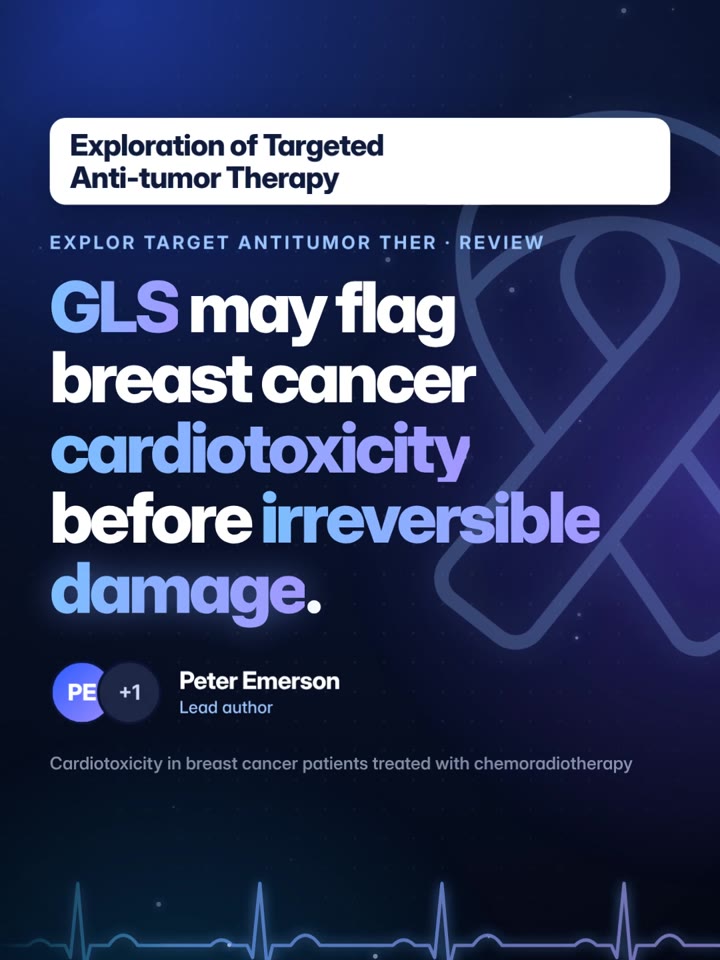
Explor Target Antitumor Ther · review. GLS may flag breast cancer cardiotoxicity before irreversible damage. Cardiotoxicity in breast cancer patients treated with chemoradiotherapy 15% of patients: Over 15% develop long-term cardiac dysfunction. Anthracyclines up to 29%, HER2 inhibitors 14%: Anthracyclines, HER2 inhibitors, Radiotherapy. 10 year follow-up: Cardiac dysfunction outranks recurrence as cause of death. GLS detects subclinical dysfunction earlier: Global longitudinal strain vs Ejection fraction. Bottom line: May support GLS surveillance; prospective outcome trials remain open.
Discussion
No takes yet. Share an insight, caveat, or question.
Cite This Study
Emerson et al. (2026) conducted a review in Breast cancer. Chemoradiotherapy was evaluated. Breast cancer treatments carry a significant risk of cardiotoxicity, with over 15% of patients showing signs of long-term cardiac dysfunction, necessitating early surveillance.
View Full Paper
Ask AI
Bookmark
Share