This research is Trending!
Early Discharge Strategy Including Subcutaneous Furosemide in Hospitalized Heart Failure
Ross T. CampbellJoanna OsmanskaKieran F. DochertyFozia AhmedAndrew L. ClarkLouise ClaytonJohn G.F. ClelandChristopher CritophMatthew DewhurstNick Hartshorne-EvansRoy S. GardnerKate GatenbyKaushik GuhaColette E. JacksonPaul KalraAndrea LeesKirsty MartinLiane McGlynnKirstie MowatPieter MuntendamJoanne O’DonnellAnna PlaczekColum OwensRobin RayHenry O. SavageRebekah SchiffIain SquireChih WongKen WongALEX MCCONNACHIEJohn J.V. McMurrayM C PetrieAndrew L. ClarkRoy S. GardnerPaul KalraColum OwensNick Hartshorne-EvansJoanna OsmanskaJohn JV. McMurrayRoss T. CampbellM C PetriePatrick B. MarkChristopher MillerRobin WeirStephen LeslieJim LewseyFozia AhmedRobin RayHenry O. SavageM C Petrie
Key result
Subcutaneous furosemide minipump adds ~4 days alive and out of hospital vs. usual care.
- Mean difference 4.0
- 95% CI 2.1-5.8
- P<0.001
- n=172
Why the study?
Patients hospitalized for heart failure often require prolonged intravenous diuretic therapy, contributing to costs and risks associated with inpatient care.
Does an early discharge strategy using a subcutaneous furosemide minipump increase days alive and out of hospital in patients hospitalized for heart failure requiring ongoing parenteral diuretics?
Key Points
- To evaluate whether an early discharge strategy using pH-neutral subcutaneous furosemide delivered through a wearable minipump increases days alive and out of hospital in patients hospitalized with heart failure.
- Multicenter, open-label, randomized, active-controlled trial (SUBCUT-HF II; NCT05419115) conducted across the United Kingdom.
- Enrolled 172 hospitalized heart failure patients requiring ongoing parenteral diuretics, randomly assigned to early discharge with patient-operated subcutaneous furosemide minipumps (n=92) or usual inpatient care (n=80).
- Early discharge resulted in 4.0 more days alive and out of hospital (DAOH) at 30 days (95% CI: 2.1-5.8 days; P < 0.001) and reduced index hospitalization length by a mean of 5.5 days (95% CI: 7.4-3.6 days; P < 0.001).
- The DAOH difference remained 4.2 days at 60 days (95% CI: 0.9-7.6 days), despite heart failure readmissions occurring in 14% (13/92) of early discharge vs 6% (5/80) of usual care patients (OR: 2.45; 95% CI: 0.81-7.43).
- Serious adverse events occurred in 25% of the early discharge group versus 23% in the usual care group, and device-related issues occurred in 3% of placements with none deemed serious.
Study Design
Type
RCT (n=172)
Blinding
Open-label
Randomization
randomized
Multicenter
Yes
Structured PICO
Does an early discharge strategy using a subcutaneous furosemide minipump increase days alive and out of hospital in patients hospitalized for heart failure requiring ongoing parenteral diuretics?
P
Population
172 patients hospitalized for heart failure requiring ongoing parenteral diuretics in the United Kingdom, followed for up to 60 days.
I
Intervention
Early discharge strategy using pH-neutral subcutaneous furosemide via a wearable, patient-operated minipump; postdischarge care included a review every 3 days while receiving subcutaneous furosemide and a 2-week clinic review
C
Comparator
Usual care (inpatient management for parenteral diuretics), with a 2-week clinic review
O
Outcome
Days alive and out of hospital (DAOH) at 30 days after randomizationcomposite
Main Result
Mean Difference: 4 (95% CI 2.1–5.8)
p-value: p=< 0.001
An early discharge strategy utilizing subcutaneous furosemide via a wearable minipump significantly increases days alive and out of the hospital at 30 days for hospitalized heart failure patients, despite a modest increase in early readmissions.
Key expert perspectives
Captured external expert commentary on this paper, strongest first. Original sources are linked where available.

“The heart failure rehospization rate so this is heavily skewed in favor of patients in the usual care arm you can't be readmitted to hospital if you're in a hospital bed. So if you're in a hospital bed for a week you have a 0% chance of being readmitted. So that is something I think is important to stress as well so it's that was actually a high bar for us to to have a you know a comparable result in terms of the rehospization rate and numbers although there was.”
“The motivation for this is primarily come from patients. Where we practice and around the world, patients with heart failure as we know, are likely to be admitted to hospital to require treatment for that and they often suffer very long admissions.”
DMDr. Mark Petrie
“We to some extent have been criticized for the end point because we sent people home so it's fairly obvious that the people going home are going to be home early. But as Ross said if we'd failed to keep people at home then that curve would have come together. So a few people clearly if you send lots of people home some are going to come back in as as failed discharges and we saw a little bit of that but not much.”
Implication
May support early HF discharge with subcutaneous furosemide; leaves open confirmation of safety and scalability in larger trials.
Abstract
BackgroundPatients hospitalized for heart failure often require prolonged intravenous diuretic therapy, contributing to costs and risks associated with inpatient care. ObjectivesWe evaluated whether an early discharge strategy using subcutaneous furosemide delivered via a wearable minipump could increase days alive and out of hospital (DAOH). MethodsIn this multicenter, open-label, randomized, active-controlled trial in the United Kingdom, 172 patients hospitalized for heart failure requiring ongoing parenteral diuretics were randomly assigned to an early discharge strategy or usual care. Patients in the early discharge group received pH-neutral subcutaneous furosemide via a wearable, patient-operated minipump; postdischarge care included a review every 3 days while receiving subcutaneous furosemide. Both groups had a 2-week clinic review. The primary outcome was DAOH at 30 days after randomization. ResultsA total of 92 patients were assigned to early discharge and 80 to usual care. The early discharge strategy resulted in 4.0 more DAOH at 30 days (95% CI: 2.1-5.8 days; P < 0.001). Index hospitalization was shorter by a mean of 5.5 days (95% CI: 7.4-3.6 days; P < 0.001). The benefit in DAOH was sustained at 60 days (difference 4.2 days; 95% CI: 0.9-7.6 days), despite more heart failure readmissions in the early discharge group (13 [14%] patients vs 5 [6%] patients; OR: 2.45; 95% CI: 0.81-7.43). Serious adverse events occurred in 25% and 23% of patients, respectively. Device-related problems occurred with 3% of minipump placements, but none were serious. ConclusionsAn early discharge strategy using a subcutaneous furosemide minipump increased DAOH compared with usual care. (Use of a Novel SUBCUTaneous Preparation of Furosemide to Facilitate Early Supported Discharge of Patients With Heart Failure [SUBCUT-HF II]; NCT05419115).
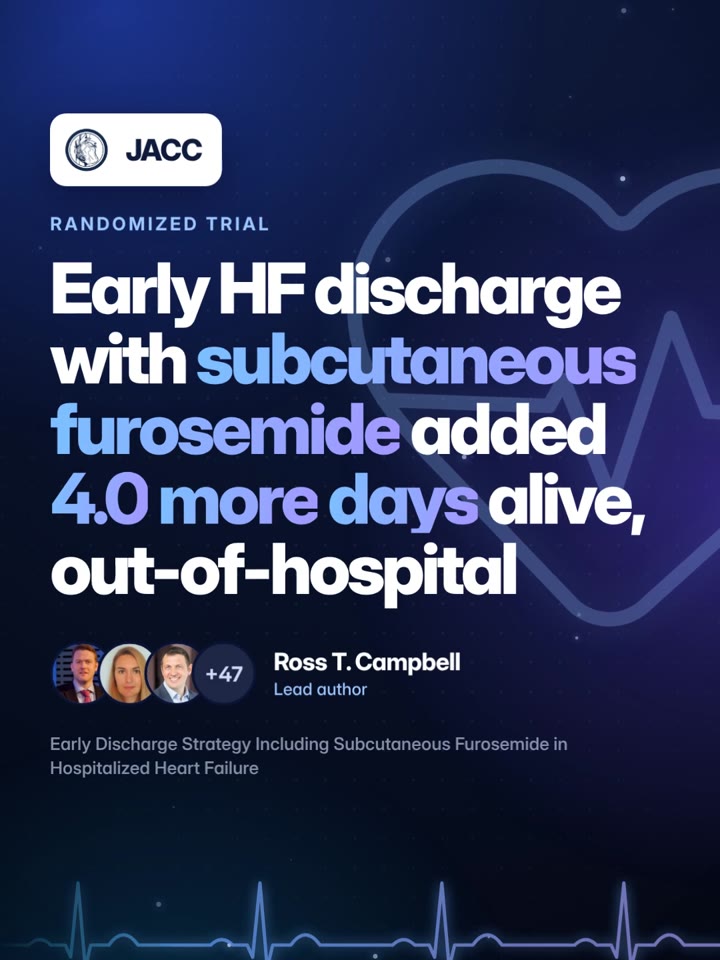
JACC · randomized trial. Early HF discharge with subcutaneous furosemide added 4.0 more days alive, out-of-hospital Early Discharge Strategy Including Subcutaneous Furosemide in Hospitalized Heart Failure 172 patients: Hospitalized for HF needing ongoing parenteral diuretics. Early discharge vs staying in: Subcutaneous furosemide minipump vs Usual inpatient care. 4.0 More days alive, out of hospital. MD 4.0 (95% CI 2.1–5.8), P< 0.001. Mean difference at 30 days. HF readmissions by arm: Early discharge 14%, Usual care 6%. Dr. Ross Campbell (Cardiologist · University of Glasgow): “this is heavily skewed in favor of patients in the usual care arm you can't be readmitted to hospital if you're in a hospital bed.” From their public comments on the paper Bottom line: Early discharge on subcutaneous furosemide may work; larger trials must confirm safety.
Discussion
No takes yet. Share an insight, caveat, or question.
Cite This Study
Campbell et al. (2026) conducted an RCT in heart failure (n=172). Early discharge strategy using subcutaneous furosemide via a wearable minipump vs. usual care was evaluated on days alive and out of hospital (DAOH) at 30 days after randomization (Mean difference 4.0, 95% CI 2.1-5.8, p=< 0.001). An early discharge strategy using a subcutaneous furosemide minipump increased days alive and out of hospital at 30 days by 4.0 days (95% CI 2.1-5.8; P<0.001) compared with usual care.